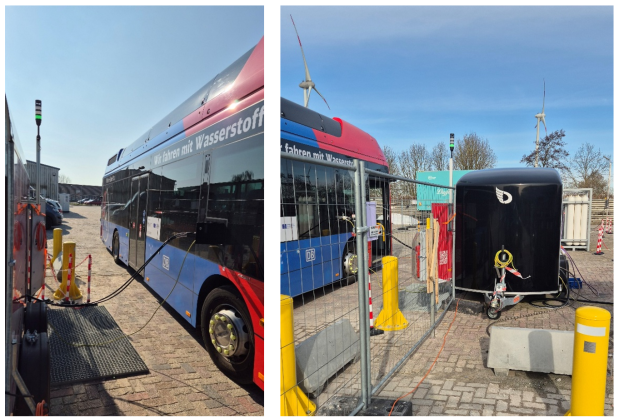


A mobile green hydrogen refuelling station has enabled the immediate rollout of a fuel cell bus service in northern Germany, effectively closing the gap between vehicle deployment and permanent infrastructure readiness.
In Jever, six hydrogen buses operated by Weser-Ems-Bus, a subsidiary of DB Regio AG, have been brought into daily service using a mobile refuelling unit owned by ttz Bremerhaven, operated by MoviaTec, and supplied with certified renewable hydrogen by Lhyfe.
Commissioned in December 2025, the solution has allowed operations to start without delay, despite the permanent refuelling station in Schortens (JadeWeserPark) not being scheduled to come online until 2026. In practical terms, it has decoupled vehicle rollout from infrastructure build-out — a recurring bottleneck in early hydrogen mobility projects across Europe.
The initiative, developed with the Friesland district, is increasingly viewed as a replicable operational model for municipalities seeking to avoid idle fleets during infrastructure transition phases.
Bridging the timing gap between buses, infrastructure and hydrogen supply
One of the persistent constraints in scaling hydrogen mobility is the lack of synchronisation between three parallel developments: vehicle procurement, hydrogen supply availability, and refuelling infrastructure commissioning. In most cases, delays in any one of these components can stall the entire deployment.
The Jever project demonstrates an alternative sequencing strategy. Rather than waiting for full infrastructure readiness, the mobile station enables immediate commissioning of the fleet, while permanent assets are still under construction.
The result is a shift from “infrastructure-first” deployment logic to an “operations-first” approach, where real-world service begins earlier and infrastructure evolves around actual demand.
A coordinated value chain: research, operations and hydrogen supply
The mobile station, provided by ttz Bremerhaven, is also being used as a live research platform. The institute is collecting operational data on daily hydrogen bus usage, enabling evidence-based optimisation of refuelling cycles, consumption profiles and system performance.
Operational responsibility lies with MoviaTec, which manages the refuelling site end-to-end, including safety compliance, explosion protection documentation, inspection regimes and technical operations. Its role has been critical in ensuring that a temporary installation can function at public transport reliability standards.
Hydrogen is supplied by Lhyfe, delivering RFNBO-certified renewable hydrogen aligned with EU sustainability criteria. With multiple production sites across Europe and a dedicated logistics fleet based on Type IV transport containers, the company is positioning itself as a key infrastructure enabler for early-stage hydrogen mobility deployment.
Operational reality outperforming initial modelling
The station operates at 350 bar, the standard pressure for hydrogen bus refuelling. Prior to commissioning, multiple operational scenarios were modelled to estimate fuelling duration, station throughput and daily demand balancing.
Actual operations have since demonstrated higher-than-expected performance, with buses refuelled more quickly than initial simulations indicated. In practice, the system has not only met design assumptions but in several cases exceeded them, improving turnaround efficiency for daily fleet operations.
This performance delta between modelling and field data is now feeding back into optimisation work, refining assumptions for future hydrogen mobility deployments.
A replicable template for early-stage hydrogen mobility
Beyond its immediate operational function, the Jever deployment is increasingly being assessed as a template for other regions facing similar infrastructure timing constraints.
By enabling early service commencement, mobile refuelling stations reduce stranded asset risk, accelerate learning curves, and generate operational data before permanent infrastructure is completed. This shifts hydrogen mobility from a sequential rollout model to a parallel deployment structure.
The next phase of the project will focus on refining operational efficiency and consolidating real-world data ahead of the commissioning of the permanent station in Schortens later in 2026.
Daniel Marx, Managing Director of Weser-Ems-Bus, said: “We are actively shaping the future of mobility and take our responsibility for climate protection seriously. With support from the Federal Ministry of Transport, a growing share of our fleet is already operating emission-free. The introduction of hydrogen buses in Friesland has allowed us to test real-world applications and build practical experience for future deployment.”
Günther Schumacher, Project Manager at ttz Bremerhaven, said: “Introducing hydrogen buses always involves coordination challenges between vehicles, infrastructure and operations. By modelling routes and demand patterns in advance, we were able to implement a functional refuelling solution that performs reliably under real operating conditions.”
Frank Rößler, Managing Director of MoviaTec, told The Voice of Renewables: “This project demonstrates that hydrogen mobility does not need to wait for full infrastructure completion. With the right operational framework, mobile refuelling solutions can deliver safe, reliable and immediate service readiness.”
Pascal Louvet, Sales Director Germany at Lhyfe, commented: “What we are seeing across Europe is a transition from demonstration projects to operational systems. The bottleneck is no longer technology, but execution speed. Mobile infrastructure is one of the tools that allows projects to move at the pace the transition requires.”
EVENT ALERT: