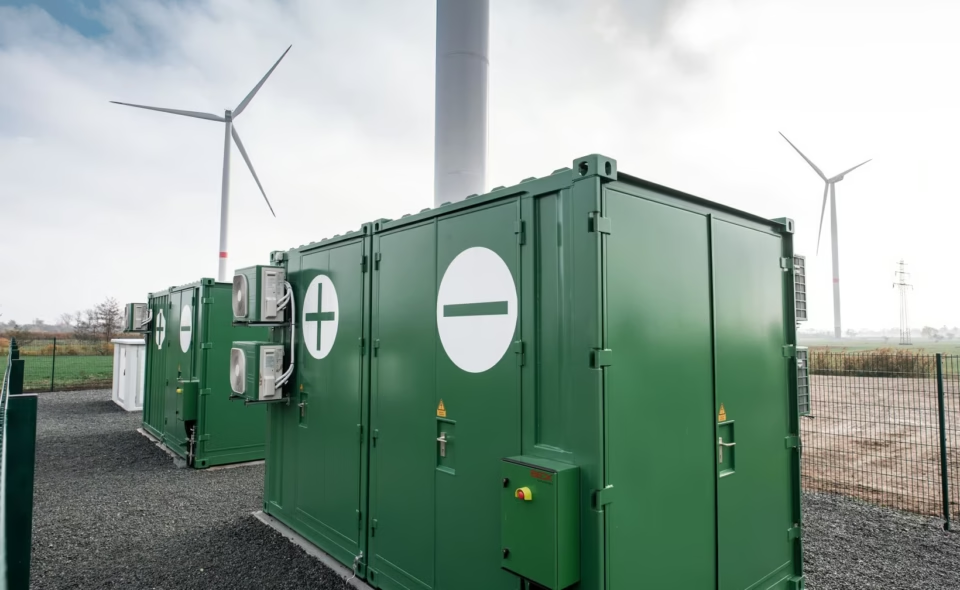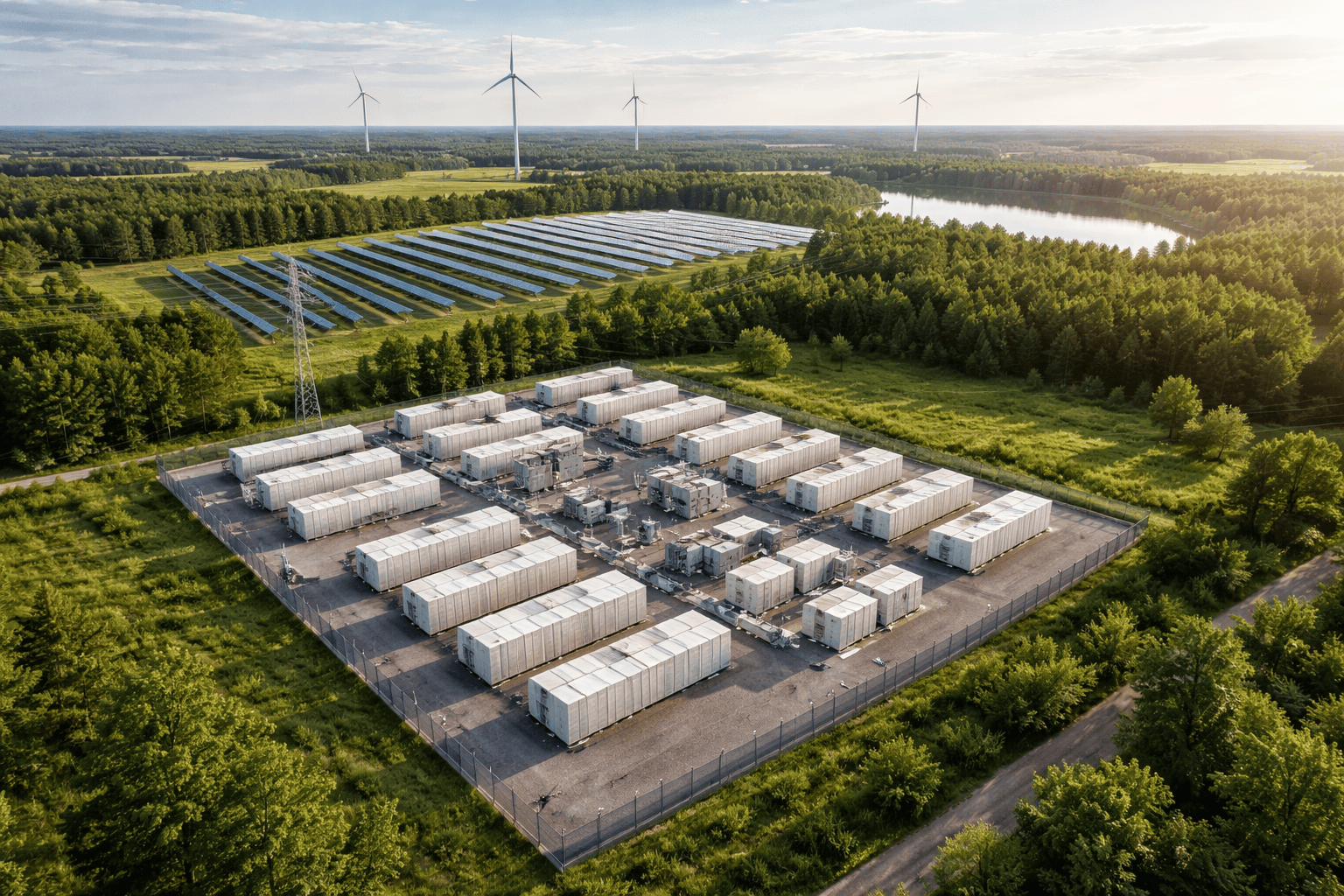
Lithuania continues to expand its battery energy storage fleet, with transmission system operator Litgrid connecting the country’s sixth commercial utility-scale battery energy storage system (BESS) to the national transmission network. The new project, developed by Solar PV UAB, part of ACME Group, marks another step in the country’s strategy to integrate higher shares of renewable generation while strengthening grid flexibility and security.
Located in the Pakruojis district, the project combines a 20 MW battery energy storage system with 49 MWh of storage capacity alongside an existing 52 MW solar power plant, creating one of Lithuania’s growing portfolio of hybrid renewable energy assets. By pairing solar generation with battery storage, the facility will be able to capture excess daytime generation, smooth output variability, and deliver electricity when demand is higher or renewable generation falls.
The project reflects a broader trend across Europe, where developers are increasingly co-locating battery storage with renewable generation to maximize asset utilization, improve project economics, and provide valuable flexibility services to transmission system operators.
Supporting Lithuania’s energy transition
According to Litgrid, the storage system has already begun charging and discharging electricity. The operator noted that battery systems are becoming an increasingly common feature of both solar and wind projects, helping to manage fluctuations inherent in renewable energy generation while improving the resilience of the national power system.
Ignas Mickevičius, Acting Head of Litgrid’s Renewable Energy Centre, told The Voice of Renewables” “Each successfully connected storage project strengthens Lithuania’s energy transition and expands the country’s domestic electricity generation capabilities.”
For ACME Group, the project represents more than an expansion of generation capacity. CEO Sergej Artemiuk described the installation as a significant step toward creating advanced hybrid energy projects that integrate renewable generation with flexible storage.
He noted that the 20 MW / 49 MWh battery complements the company’s 52 MW solar park, increasing renewable energy efficiency, reducing generation variability, and supporting a more stable electricity system. Artemiuk also highlighted that following Lithuania’s synchronization with the Continental European electricity grid earlier this year, flexible storage technologies have become an increasingly important component of national energy infrastructure.
The synchronization of the Baltic electricity systems with Continental Europe in February 2025 marked a historic milestone, ending decades of dependence on the Russian-controlled BRELL system. Since then, grid flexibility and balancing resources have become even more critical as Lithuania continues to increase renewable energy penetration.
Rapid growth of battery storage
The new facility brings the number of commercial battery storage systems connected to Lithuania’s transmission grid to six, with a combined permitted export capacity of 241 MW and 556 MWh of storage capacity.
These projects complement the strategically important Energy Cells battery system, a 200 MW / 200 MWhinstallation commissioned to provide reserve capacity for isolated grid operation and to support balancing services. Unlike commercial projects that participate in electricity markets, the Energy Cells system primarily serves system security functions.
When both transmission- and distribution-connected assets are considered, Lithuania’s battery storage sector has grown rapidly. The country now has:
- 742 MW of installed battery storage capacity;
- 581 MW of permitted export capacity; and
- 1,196 MWh of installed energy storage capacity.
The figures underscore how battery deployment is accelerating as Lithuania works toward its long-term objective of building a power system dominated by renewable energy.
Hybrid projects becoming the new standard
The Pakruojis project also illustrates the direction of travel for renewable energy development across the Baltic region. Rather than developing standalone solar or wind farms, developers are increasingly designing hybrid projects that combine generation, battery storage, and sophisticated energy management systems.
Such projects can reduce renewable curtailment, participate in ancillary service markets, provide peak-shaving capabilities, and improve revenue certainty through greater operational flexibility.
As Lithuania continues to expand its renewable generation fleet, battery storage is expected to play a central role in maintaining grid stability while enabling higher levels of intermittent solar and wind power. With more projects currently under development, the country’s energy storage market appears poised for continued growth, reinforcing its position as one of the Baltic region’s emerging leaders in grid-scale battery deployment.
EVENT ALERT: