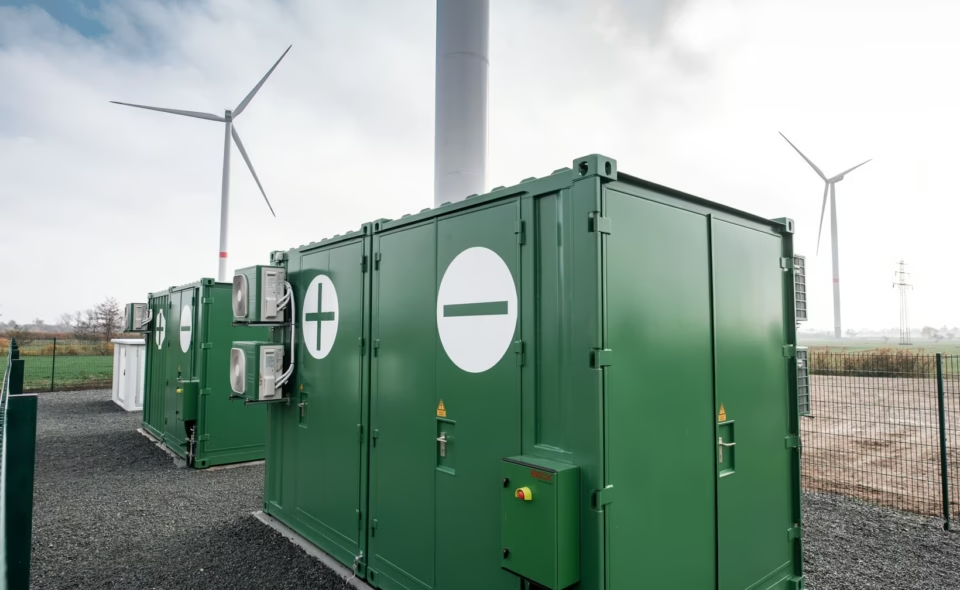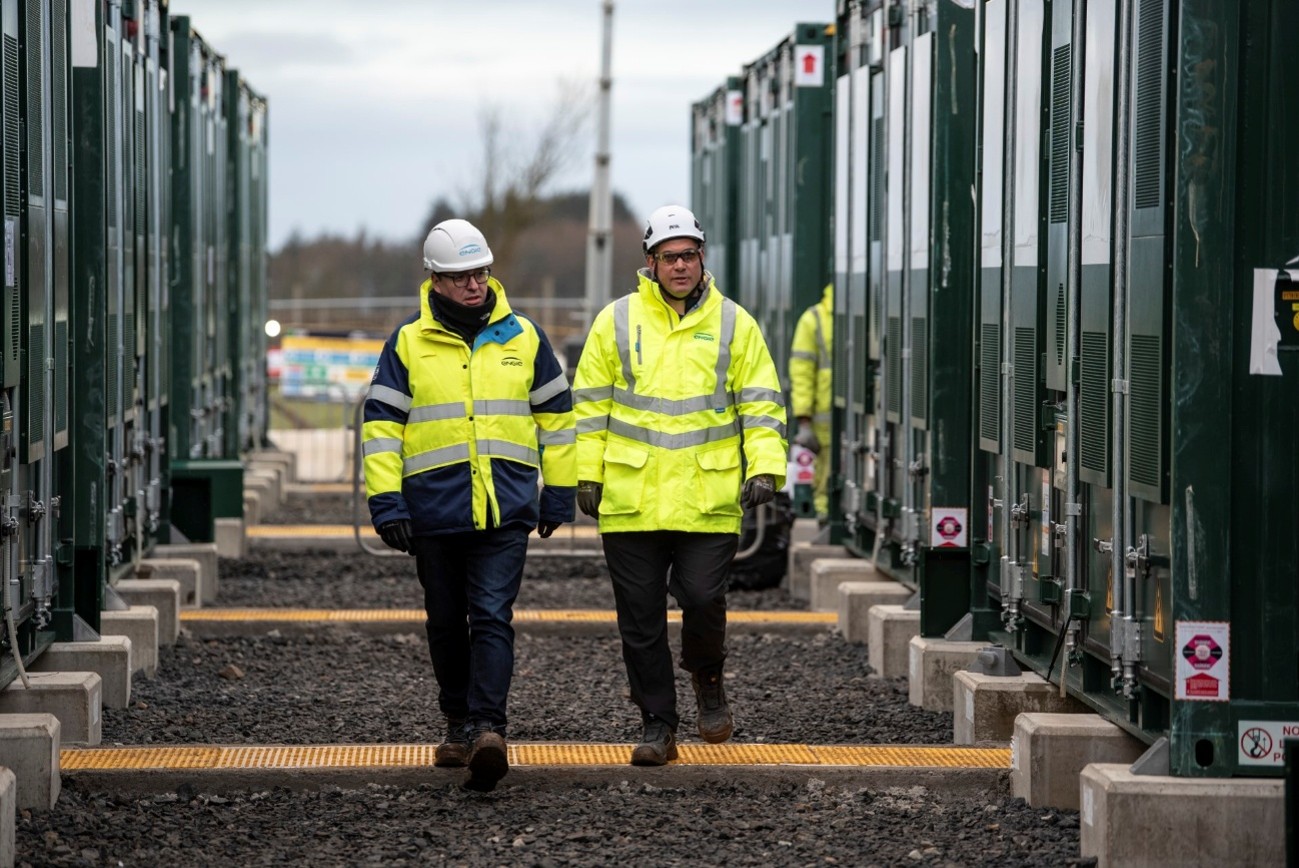
ENGIE has commissioned two utility-scale battery energy storage systems (BESS) in Scotland, adding 100 MW / 200 MWh of new flexibility capacity to Great Britain’s electricity network. The milestone strengthens the company’s growing European battery portfolio while highlighting the increasingly important role of energy storage in supporting a power system dominated by renewable generation.
The newly operational facilities are located at Cathkin, south of Glasgow, and Broxburn, west of Edinburgh. Each site delivers 50 MW of power and 100 MWh of storage, providing a combined capacity capable of rapidly responding to fluctuations in electricity supply and demand.
Connected to SP Energy Networks’ 33 kV distribution network, the batteries will store excess renewable electricity during periods of high generation before releasing it back to the grid when demand increases or renewable output declines. The assets will participate in wholesale electricity, balancing and ancillary services markets through ORUS, ENGIE’s AI-driven optimisation platform.
The commissioning comes at a critical time for Britain’s electricity system. Scotland has become one of Europe’s leading renewable energy regions, with onshore wind generation regularly producing more electricity than local demand requires. While this has accelerated the country’s decarbonisation efforts, it has also increased the need for flexible infrastructure capable of balancing intermittent renewable generation and reducing curtailment.
“Battery storage is becoming an indispensable part of the modern electricity system,” ENGIE said in announcing the projects. “These new assets will help integrate greater volumes of renewable energy while strengthening the resilience and flexibility of the UK’s electricity network.”
A growing role for battery storage
The Scottish projects reflect a broader transformation taking place across the UK energy sector. As wind and solar generation continue to expand, batteries are increasingly replacing conventional fossil fuel plants in providing fast-response grid services.
Unlike traditional generation, battery systems can respond within milliseconds to changes in network frequency, making them well suited to stabilising electricity systems with high levels of renewable generation. They also allow surplus renewable electricity to be stored and discharged during periods of peak demand, improving the utilisation of renewable assets and reducing reliance on gas-fired generation.
The UK battery market has grown rapidly over the past five years, driven by declining battery costs, increased renewable deployment and greater demand for grid flexibility. Industry analysts expect several gigawatts of additional storage capacity to enter operation before the end of the decade as Britain works towards a largely decarbonised electricity system by 2030.
Part of a wider European expansion
The commissioning of Cathkin and Broxburn is not an isolated investment but forms part of ENGIE’s wider strategy to expand battery storage across Europe.
Earlier this year, the company announced the acquisition of 278 MW / 1.1 GWh of standalone battery projects in Spain, significantly strengthening its presence in one of Europe’s fastest-growing flexibility markets. The four-hour duration systems, located in Andalusia, are expected to support Spain’s rapidly expanding solar sector by providing energy shifting and balancing services.
At the same time, ENGIE launched construction of its first large-scale battery project in France – a 110 MW / 220 MWh facility at Castelnau-d’Aude. Scheduled for commissioning in 2027, the installation will help provide flexibility to the French electricity system as renewable generation continues to increase alongside the country’s nuclear fleet.
These projects have pushed ENGIE’s European battery portfolio beyond 1 GW of capacity across eight countries, with more than 700 MW either operational or under construction. Globally, the company reports 5.6 GW of battery storage assets in operation or construction across twelve countries as part of its ambition to develop **95 GW of renewable generation and storage capacity by 2030.
Batteries becoming central to renewable integration
ENGIE’s investment strategy reflects a wider shift in how utilities are approaching the energy transition. Rather than viewing battery storage as a standalone technology, companies are increasingly integrating batteries with renewable generation, digital optimisation platforms and electricity trading capabilities to create more flexible energy systems.
The company’s proprietary ORUS optimisation platform exemplifies this trend. By using artificial intelligence and advanced forecasting to manage charging, discharging and market participation, the platform enables battery assets to respond dynamically to wholesale electricity prices, balancing requirements and ancillary service opportunities.
This approach is becoming increasingly important as renewable penetration rises across Europe. Periods of exceptionally high wind or solar output can depress wholesale electricity prices—or even push them into negative territory—while low renewable generation can create sharp price spikes. Intelligent battery optimisation allows operators to capture value from these market fluctuations while providing critical services that enhance overall grid stability.
Scotland’s strategic role
The location of the new battery systems also underlines Scotland’s growing importance in Britain’s energy transition. With some of Europe’s richest wind resources and ambitious renewable energy targets, Scotland has become a focal point for investment in flexibility infrastructure.
Large-scale battery systems are increasingly being deployed alongside renewable generation and at strategic points on the electricity network to relieve congestion, reduce renewable curtailment and improve the efficiency of power transmission to demand centres further south.
As renewable capacity continues to expand across the UK, investments such as Cathkin and Broxburn demonstrate how battery storage is evolving from a niche balancing technology into essential energy infrastructure.
For ENGIE, the projects strengthen its position in one of Europe’s most dynamic battery storage markets. For the UK, they represent another important step towards building a more flexible, resilient and decarbonised electricity system capable of supporting the next phase of renewable energy growth.