


On November 24, 2025, the Clean Hydrogen Partnership — the EU body that funds and judges Europe’s hydrogen infrastructure push — named BalticSeaH2 its European Hydrogen Valley of the Year. The project, anchored between southern Finland and Estonia, is routinely described in its own materials and in trade coverage as the largest cross-border hydrogen valley in Europe. Both of those claims are well documented and easy to verify.
What’s harder to verify is almost everything that comes after “how big.” Ask how much hydrogen the valley will actually produce, and the project’s own website says 60,000 tonnes a year by completion. Aalto University’s news office, a German industry outlet and a Polish hydrogen-valley site all say 100,000 tonnes at full capacity. The EU’s own Hydrogen Valleys Platform, which is supposed to be the authoritative public registry for exactly this kind of project, lists a different figure again — 45,000 tonnes a year from electrolysis plus 3,000 tonnes of finished product — attached to a construction timeline that has the project reaching commercial operation in early 2025, two years before BalticSeaH2’s Horizon Europe grant agreement even started the clock. Ask about total investment and the spread gets wider still: €1.5 billion in CAPEX according to the EU platform, €3 billion according to the project’s own site, “over €4 billion” according to German and Polish coverage of the same launch.
None of this means BalticSeaH2 is smaller than advertised, or that the award was undeserved. It means that one of the EU’s flagship demonstrations of what a hydrogen economy is supposed to look like doesn’t yet have a single number the public can point to and trust — which is worth knowing before repeating any one of those figures as settled fact, and worth watching as the project matures toward its 2028 end date.
What’s actually solid
Strip out the disputed projections and what’s left is a well-documented, consistently sourced core. BalticSeaH2 runs on a Horizon Europe grant (project number 101112047) worth roughly €32.4–33.2 million total, of which the EU is covering close to 75% — around €25 million — through the Clean Hydrogen Partnership. The grant agreement was signed on June 7, 2023, and the project runs through May 31, 2028. It’s coordinated by CLIC Innovation Oy, a Finnish open-innovation cluster, with the coordinator’s own share of the funding recorded at just over €1.6 million. The largest individual recipients, per the EU’s project database, are ABB Oy (€3.35 million), the VTT Technical Research Centre of Finland (€2.53 million), P2X Solutions Oy (€1.36 million) and Helen Oy (€1.34 million) — all Finnish, reflecting where most of the money and the physical valley actually sits.
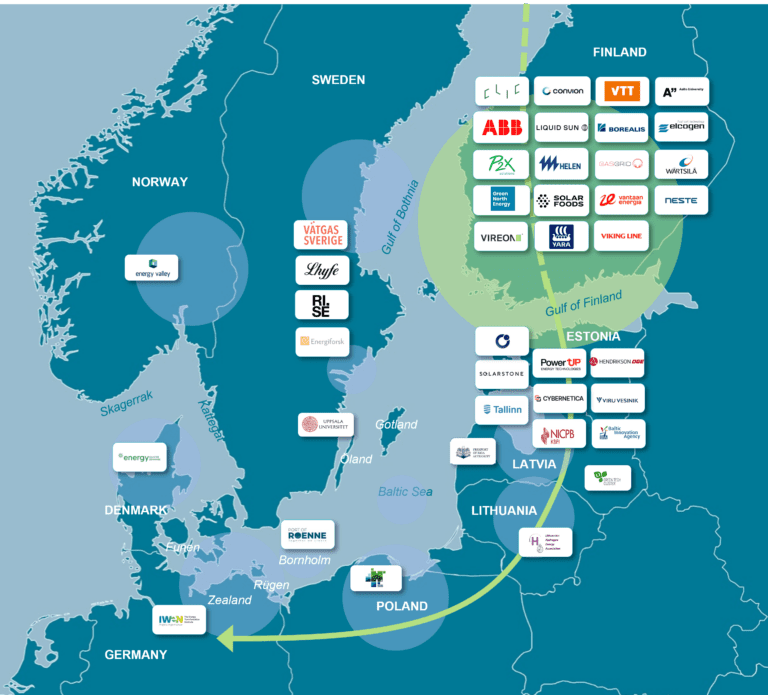
The headline partnership figure — 40 organisations across nine Baltic Sea countries: Finland, Estonia, Latvia, Lithuania, Poland, Germany, Denmark, Norway and Sweden — is repeated consistently enough across the project’s own site, the EU project dashboard and press coverage in every language checked for this piece that it’s safe to treat as accurate. Curiously, the EU’s own CORDIS database lists 43 participants across ten countries, adding France to the roster; that discrepancy wasn’t resolved from public sources, and most likely reflects a more granular administrative count — associated partners or subcontractors — rather than a different consortium entirely.
The full partner list, by country, gives a sense of who’s actually building this: Finland carries the bulk of it, with Aalto University, ABB, Convion, Elcogen, Helen, P2X Solutions, VTT, Wärtsilä Finland and Yara Finland among others. Sweden’s contingent is research-and-association-heavy — Energiforsk, RISE, Uppsala University and Vätgas Sverige — rather than industrial. Poland’s sole named partner is the Lower Silesian Hydrogen Valley, brought in specifically so that lessons from the Finland-Estonia “main valley” can be replicated in Poland’s own hydrogen region. Lithuania’s is the Lithuanian Hydrogen Energy Association. Latvia contributes the Green and Smart Technology Cluster and the Freeport of Riga Authority; Estonia contributes the City of Tallinn, the Estonian Hydrogen Cluster and four other organisations; Denmark and Norway each have two.
Why the numbers don’t line up
The likeliest explanation isn’t that anyone is lying — it’s that “BalticSeaH2” gets used loosely to describe several different things that happen to overlap. There’s the EU-funded coordination project itself: €33 million, nine countries, a research-and-demonstration mandate running to 2028. There’s the physical valley it’s meant to catalyse — the actual electrolysers, pipelines and industrial offtake in and around Helsinki and Tallinn, which is where a €1.5 billion CAPEX figure or a 45,000-tonne electrolysis number could plausibly come from if someone is counting only what’s financially committed today rather than what’s projected at full build-out. And there’s the wider regional ambition — the “over €4 billion” and 100,000-tonne figures — which look more like estimates of everything the valley is meant to unlock once its more than 20 demonstration and investment cases (some sources say 25) are all running, including projects and capital that sit outside the Horizon Europe grant entirely.
That distinction matters for a second reason: BalticSeaH2 isn’t the only EU-badged hydrogen project in this exact geography, and some of the confusion in press coverage comes from partners appearing in more than one initiative. The Baltic Sea Hydrogen Collector — a planned offshore pipeline linking Finland and Germany, with Gasgrid Finland, Copenhagen Infrastructure Partners, Gascade Gastransport and Sweden’s Nordion Energi involved — is a separate project entirely, designated a Project of Common Interest by the European Commission and awarded €15.3 million in EU planning funds through the Connecting Europe Facility. The Nordic Hydrogen Route is another. A third, unrelated feasibility study for a Baltic hydrogen pipeline, led by Sweden’s OX2 alongside Nordion, doesn’t involve BalticSeaH2’s consortium at all. Gasgrid Finland’s fingerprints are on several of these at once, which makes it easy — and, based on some of the coverage collected for this piece, apparently common — to blur “the hydrogen valley project” with “the hydrogen pipeline projects” into a single, bigger-sounding story.
The parts that don’t show up in a funding table
Some of the more interesting details in BalticSeaH2 sit well below the headline numbers. Solar Foods, a Finnish food-technology company, is using project funding — €350,000 of it — to scale up Solein, a protein made through gas fermentation using hydrogen and carbon dioxide, taking its “Factory 02” facility from 160 to 6,400 tonnes of annual capacity. It’s a reminder that a hydrogen valley isn’t only steel plants and fertiliser: in this one, the same infrastructure is being asked to feed a novel food-protein business. ABB is developing megawatt-class fuel cell systems for emission-free maritime transport, relevant given how much of the valley’s logistics run across the Helsinki–Tallinn ferry corridor. Helen Oy, Helsinki’s municipal energy company, is running a PEM electrolyser pilot. And Aalto University’s contribution isn’t engineering at all — Assistant Professor Kimmo Karhu’s team is studying how “data-mediated network effects,” the same dynamics that make platform businesses work, could be applied to building a functioning cross-border hydrogen market, on the theory that a hydrogen economy needs working marketplaces as much as it needs pipelines.
CLIC Innovation’s chief executive, Jatta Jussila, has described the project’s ambition in terms that go beyond engineering for its own sake: “the hydrogen valley is not only about new technology, it is about building new value chains, new infrastructures and the entire economic system.” In Finnish-language coverage of the award, she put the underlying logic even more plainly: a European hydrogen economy is only built through cooperation across borders — which is, more or less, the entire structural bet BalticSeaH2 is making, discrepant footnotes and all.
Where this connects to the room
One thread ties BalticSeaH2 directly to the wider conversation happening in the region this year: the Lithuanian Hydrogen Energy Association is simultaneously a formal BalticSeaH2 consortium partner and the organisation that backed the most recent Hydrogen Horizons – Baltics Nordics CEE conference, held in Vilnius in November 2025. That conference returns to Lithuania on November 18, 2026, organised by The Voice of Renewables, with a 2026 agenda built explicitly around hydrogen policy and regulation, demand and production potential, electricity-market integration, and — directly overlapping with the infrastructure story above — development of the Nordic-Baltic Hydrogen Corridor. No source found for this piece shows BalticSeaH2, CLIC Innovation or Gasgrid Finland as a formally announced participant in the 2026 edition; the connection worth drawing is geographic and thematic rather than a confirmed partnership. But given that the same regional association sits on both, and that the corridor conversation the conference is built around is precisely the infrastructure BalticSeaH2 and its pipeline-project neighbours are trying to fill with actual hydrogen, it’s a reasonable bet that the same measurement questions raised here — how big is this valley, really, and how does its output map onto the corridor being built to move it — will be very much alive in the room in November.
That, ultimately, is the more useful way to read the Hydrogen Valley of the Year award than as confirmation of any single production or investment figure. What’s genuinely established — the EU money, the five-year mandate, the 40-partner cross-border structure, the award itself — is substantial enough to justify the attention. The scale claims stacked on top of it haven’t yet converged into something a reader can cite with full confidence, and that gap is worth watching closely as the project moves toward 2028, rather than papering over with whichever number sounds most impressive.
Hydrogen Horizons conference is where regional H2 leaders meet. Join them today: