Lithuania has quietly become one of Europe’s most striking renewable energy growth stories. A country of under three million people has gone from a negligible solar base just a few years ago to a system now dominated by wind and solar, backed by one of the fastest-growing battery storage fleets on the continent. Here’s where things stand in 2026, and where Lithuania is headed.
Current Installed Capacity
As of mid-2026, Lithuania’s renewable and storage fleet looks like this:
- Solar power: 3.5 GW installed
- Wind power: 2.7 GW installed
- Battery energy storage systems (BESS): 0.7 GW installed
Lithuania added 752 megawatts of renewable generation and storage capacity during the first half of 2026 alone, underscoring just how fast the build-out is moving.
Solar: from near-zero to a Baltic leader in five years
Lithuania’s solar trajectory is the headline story. As of 2023, installed solar capacity was only 1.165 GW, and going back further, the country had just 26 MW of installed solar PV in 2022. By the end of 2025, cumulative capacity had reached roughly 3,040 MW, with around 170,000 prosumers connected to the grid. Solar generation covered about 14.2% of national electricity consumption in 2025.
What makes Lithuania’s solar market unusual is who led the growth. Prosumers — households and small generators — account for roughly 70% of solar generation, rather than utility-scale developers, as is typical in most markets. That was driven by a deliberate policy mix: generous but declining household subsidies, investment grants for businesses and energy communities, straightforward net metering, and a regulatory approach that treats small prosumers as participants rather than obstacles.
That said, growth is now bumping into a hard limit. Technical permits have already been issued for an additional 4 GW of solar, but grid congestion has become the primary constraint on further deployment — meaning future solar growth will increasingly depend on how much storage and grid reinforcement comes online alongside it.
Wind: onshore established, offshore just beginning
Lithuania’s wind fleet, at 2.7 GW, is entirely onshore today. That’s a large jump from 2021, when wind represented about 15% of installed capacity at 623 MW, all onshore. Projects have continued to come online since — for instance, the first turbine at the 63 MW first phase of the Jurbarkas onshore wind farm was installed by Green Genius.
The bigger story for wind, though, is offshore — an area where Lithuania is still working out the details. The government’s plan calls for two offshore wind farms with a combined capacity of 1.4 GW, split into two roughly 700 MW zones in the Baltic Sea, located about 29 km from the coast across an area of nearly 138 square kilometres.
Progress has been bumpier than planned:
- The first 700 MW auction was completed in 2023: a consortium of Ignitis Group and OceanWinds won, agreeing to pay €20 million to develop the project, with a permit to operate the site for 41 years. That project is expected to be operational by around 2030.
- The second 700 MW auction has had a rockier road. An early attempt was cancelled after only one bid was submitted — Lithuanian law requires a minimum of two bidders. The government then relaunched it with revised terms: the transaction price is now indexed to inflation and to changes in the average annual electricity price on the Lithuanian exchange over eight years following confirmation of the winner, with consumer contributions only beginning once generation starts — expected around 2033. Ignitis Group has since confirmed it submitted a bid for this second 700 MW tender, as part of a broader push by the state-linked utility to grow its green generation capacity from 1.4 GW in 2024 to between 4 and 5 GW by 2030.
Industry forecasts reflect this staggered timeline: analysts at 4C Offshore project Lithuania reaching 0.7 GW of offshore wind by 2030, doubling to 1.4 GW by 2035 — meaning the second farm is more likely to be a 2030s story than a 2020s one.
Battery storage: the fastest-growing piece of the puzzle
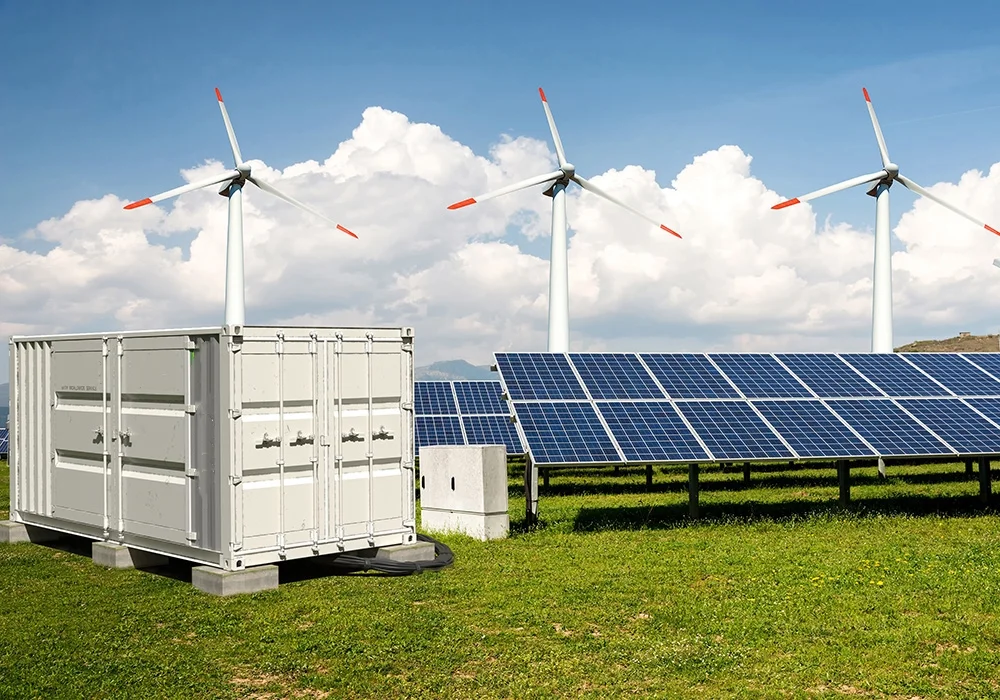
At 0.7 GW, BESS is currently the smallest of the three categories in absolute terms, but it’s arguably the most strategically important right now. With solar deployment increasingly constrained by grid congestion, storage is the release valve that lets Lithuania keep adding renewables without destabilizing the grid — and the government’s own investment plans reflect that: investments in battery storage systems are explicitly aimed at improving grid resilience and reducing the duration and frequency of outages.
Where Lithuania Is Headed
The government’s near-term target is ambitious and specific. Acting Energy Minister Žygimantas Vaičiūnas has said total renewable capacity is expected to reach 7 GW by the end of 2026, with total storage infrastructure surpassing 1.3 GW — which would nearly double today’s BESS fleet within a matter of months.
Longer-term national targets add more color:
- Renewables share: Lithuania has targeted a 45% share of renewables in final energy consumption by 2030, with some more recent statements pointing to an even more ambitious goal of sourcing electricity entirely from local renewables by 2030, and reaching 100% renewable electricity generation by 2050.
- Solar: long-range government projections point to 4.1 GW of installed solar by 2030, extending to 9 GW by 2050.
- Wind: to hit the 2030 renewables goal, wind capacity is meant to roughly double between 2020 and 2030 — a target that, combined with the 2.7 GW already installed onshore, leaves offshore wind (the two 700 MW zones) as the main lever left to pull.
- Storage: beyond the 1.3 GW milestone targeted for end-2026, storage capacity is expected to keep expanding in step with solar and wind, since it’s now the key constraint-reliever for further renewables growth.
The Bigger Picture
Lithuania’s numbers are notable less for their absolute scale — this is a small Baltic country, after all — and more for the speed and shape of the transition. Solar went from a rounding error to multiple gigawatts in under five years, driven unusually by households rather than utilities. Wind is now pivoting from a mature onshore base toward a genuinely difficult offshore build-out, hampered by auction design issues but still moving. And battery storage, while the smallest category today, is growing fastest and is increasingly treated by policymakers as the linchpin that determines how much more solar and wind the grid can actually absorb.
If the government hits its own end-2026 targets — 7 GW of combined renewables and 1.3 GW of storage — Lithuania will have added more clean capacity in a few years than most countries its size add in a decade.