Three machines at a substation outside Alytus carry almost everything that ties Lithuania’s power grid to continental Europe. Litgrid, the country’s transmission system operator, now wants a fourth one on standby.
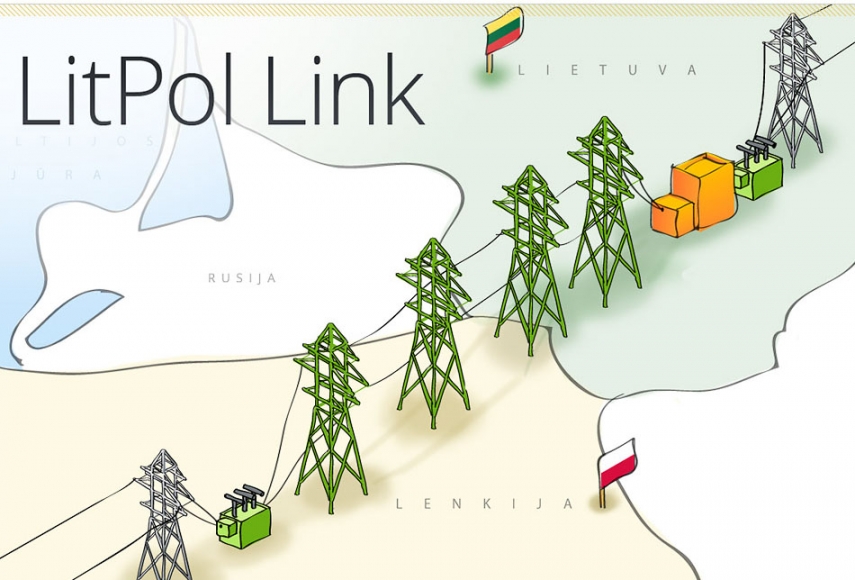
Litgrid has put out to tender the design work for connecting and protecting a reserve autotransformer on the LitPol Link, the interconnector running from Alytus in southern Lithuania to Ełk in north-eastern Poland. The plan is to install a fourth 600 MVA autotransformer at the Alytus 400/330 kV substation. To make space for it, Litgrid will rebuild the 330 kV switchyard of the former LitPol Link converter, which has been standing idle. The design contract also covers physical security measures and supporting infrastructure, so that the site can keep running and be defended against external threats.
The switchyard is spare because the job it was built for has disappeared. When LitPol Link opened in 2015, the Baltic grids were still synchronised with Russia’s, and the only way to link them to Poland was through a 500 MW back-to-back HVDC converter at Alytus. That changed in February 2025, when Lithuania, Latvia and Estonia disconnected from the Russian-controlled system and joined the Continental European synchronous area. Since then the link has run as a direct AC connection. The converter’s role has shrunk accordingly, with its capacity kept only for system needs rather than commercial trading.
Alytus was prepared for synchronisation years ahead. In 2021 Litgrid finished a €22.5m expansion, part-funded by the EU’s Connecting Europe Facility, which installed three 600 MVA autotransformers, at the time the most powerful in the Baltic states. They match the voltage of Lithuania’s 330 kV network to Poland’s 400 kV grid. If one of them failed, or was deliberately put out of action, Lithuania’s only synchronous link to the West would lose part of its capacity, and replacing a unit of that size can take many months. A fourth unit, already connected and protected, is meant to close that gap.
The government is explicit about why. “Russia’s war against Ukraine has shown that energy infrastructure becomes one of the first targets in a crisis,” said Lukas Savickas, Lithuania’s Minister of Energy. “That is why our security today depends not only on securing independent sources of supply, but also on our ability to protect our infrastructure and to restore supply quickly during all kinds of emergencies. Connecting a reserve autotransformer and strengthening physical protection in Alytus is a concrete step towards making sure our connections with the West stay resilient.”
Andrius Šemeškevičius, CEO of Litgrid, said the substation’s importance had grown sharply since the grid switch. “Since the Baltic states synchronised with the continental European grid, the Alytus 400/330 kV substation has become one of the most important nodes in the power system, providing a direct synchronous connection with Poland and all of continental Europe,” he said. “That is why we are steadily strengthening the reliability of this infrastructure and its resilience to various threats. This procurement is one of many measures in Litgrid’s fast-moving Resilience Programme.”
What happens next is a standard sequence, although nobody has attached a timetable or budget to it yet. The design stage will produce the technical solutions for connecting the transformer and for physically protecting the site. Once the design is ready, Litgrid will tender the construction contracts, and only after that will installation start.
On its own, a spare transformer is a modest purchase by the standards of grid investment. It does show where Baltic grid planning has moved since the Russian grid was left behind. Building new connections is no longer enough, and operators now expect to have to protect and quickly restore the ones they have. The Baltic Sea has already had its share of damaged power and data cables. For a country whose link to the European grid runs through a single substation near the Polish border, having a spare transformer ready counts as security planning.