
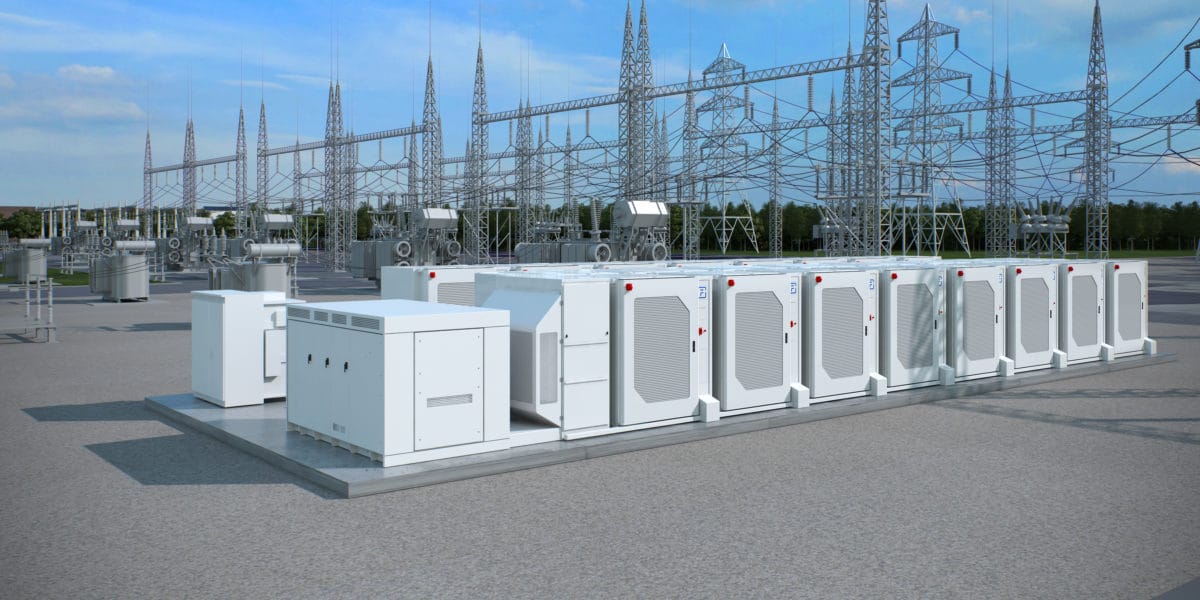
Greece is producing more renewable electricity than ever, but the country is increasingly struggling to extract its full economic value. Solar generation is pushing wholesale prices towards zero during parts of the day, renewable electricity is being curtailed because the system cannot always absorb it, and electricity can become considerably more expensive only a few hours later. The missing link is flexibility — and particularly battery storage.
That is the central issue raised by Emmanouil Karapidakis, Director General of the Hellenic Association of Energy Storage Systems, in an interview with Liberal. His argument is straightforward: Greece has no shortage of interest in storage, with applications for projects exceeding 10 GW, but the country has been too slow to turn that pipeline into operating assets. Around 900 MW has been awarded through tenders, while several gigawatts of projects are seeking to operate on a merchant basis or alongside renewable generation.
Karapidakis also highlighted the increasingly important regional dimension. Greece and Bulgaria are interconnected electricity markets, and Bulgaria has moved considerably faster in deploying battery storage. His concern is that the price volatility being created by Greece’s rapidly expanding renewable fleet can be monetised by storage assets elsewhere in the region rather than by Greek companies operating batteries in Greece.
The point is not that Bulgarian batteries simply buy Greek solar electricity at midday and sell the same electricity back to Greece in the evening. The actual physical flows between the two countries are considerably more complicated. The economic question is more important: where are the assets capable of buying electricity when it is cheap and selling it when it is valuable, and who captures the resulting value?
What battery arbitrage actually means
Battery arbitrage is often described in deceptively simple terms. A battery charges when electricity is cheap and discharges when electricity is expensive. In practice, it is a trading strategy based on capturing an intraday price spread.
Suppose a battery buys electricity at €5/MWh in the middle of the day and later sells it at €150/MWh. The gross spread is €145/MWh. The battery operator must then account for round-trip efficiency losses, network and trading costs, degradation and other operating expenses. The investment case depends on whether the remaining spread is sufficient to generate an attractive return.
The crucial point is that batteries do not create this price difference. They monetise it.
And Greece is creating increasingly large price differences through the rapid deployment of solar generation.
The Green Tank found that Greece recorded 788 hours of near-zero or negative day-ahead market prices during the first half of 2026, compared with 168 during the same period in 2025. Renewable-energy curtailment reached approximately 1.6 TWh in the first six months of the year. Solar’s capture rate — the average price received by solar generation relative to the average wholesale price — fell to only 44% in the first half of 2026, compared with 71.9% in 2024.
This is the classic effect of renewable “cannibalisation”. The more solar generation enters the system at the same time, the more difficult it becomes for all of that electricity to retain its value during the middle of the day.
Storage is one way to change that equation. Instead of selling every unit of solar electricity when thousands of megawatts of photovoltaic capacity are producing simultaneously, a battery can absorb some of it and sell it later when solar production falls and demand remains high.
The first Greek batteries have already demonstrated that the economics can work.
By the end of June 2026, approximately 210 MW of battery capacity was operating in Greece. During April-June, those batteries absorbed 30.7 GWh of electricity and subsequently discharged 27.1 GWh. Their median charging price was only €5.29/MWh, while their median discharge price was €147.8/MWh. On 26 of the 91 days analysed, batteries charged during periods of negative electricity prices. The Green Tank found that the batteries captured more than 70% of the available daily wholesale price spread.
That is important because it demonstrates that the arbitrage opportunity Karapidakis describes is not theoretical. The market is already producing substantial intraday spreads.
The problem is scale.
The 210 MW operating by the end of June prevented an estimated 26.7 GWh of renewable curtailment, equivalent to 2.19% of the renewable electricity curtailed during April-June. By July, the contribution was increasing: batteries absorbed 22.8 GWh of electricity that would otherwise have been curtailed during the month, preventing 13.6% of July’s renewable curtailment. Even so, the cumulative effect remained small relative to the size of the problem.
Why Bulgaria complicates the story
Bulgaria is particularly relevant because it has moved faster on battery deployment. The European Commission’s 2026 country report put operational Bulgarian battery capacity at 1,181 MW and said contracts had been signed for nearly 14 GWh of additional grid-scale storage, alongside 1,120 MW of co-located battery capacity.
At first sight, this might suggest a simple conclusion: Bulgaria has more batteries, therefore it should have cheaper electricity.
But that is not what the market data show.
Nikos Tsafos, Greece’s Deputy Minister of Energy, recently compared hourly electricity prices in Greece, Bulgaria and Romania for 2026. His figures put the average wholesale price at €106/MWh in Greece, €118/MWh in Bulgaria and €126/MWh in Romania. Despite Bulgaria having substantially more battery capacity, its average day-ahead price remained higher than Greece’s.
Tsafos’s explanation is important. Batteries can reduce price pressure when they charge during periods of genuine surplus renewable generation. But if batteries charge when the system does not have excess electricity, they become an additional source of demand. Their charging can therefore push prices upwards rather than downwards.
According to Tsafos, this is particularly relevant during midday hours. He estimates that Bulgaria’s average price during those hours was around €22/MWh higher than Greece’s. The implication is that the presence of batteries does not automatically make a market cheaper. What matters is what the battery is charging from and what the system looks like at the moment it charges.
This is an important qualification to Karapidakis’s observation about Bulgaria. It would be misleading to describe the regional market simply as Bulgarian batteries buying surplus Greek solar at almost zero prices and then selling it back to Greece in the evening.
Cross-border flow data do not support such a simple cycle. The Green Tank found that Greece was a net exporter to Bulgaria during 3,601 hours, or 84% of all hours, during the first half of 2026. Average Greek exports were around 386 MW between 12:00 and 15:00 and approximately 398 MW between 21:00 and midnight. Greece was therefore not simply exporting cheap electricity to Bulgaria at midday and importing the same electricity back after sunset.
But that does not invalidate Karapidakis’s underlying point.
In a coupled regional electricity market, the relevant issue is not whether the same electrons travel across the border twice. Electricity is traded according to market prices, and storage operators can respond to those prices. The economic opportunity created by volatility can therefore be captured by assets on either side of an interconnected market, subject to transmission constraints and market coupling.
The question is consequently not simply how many batteries Greece or Bulgaria has. It is whether Greece is building enough storage to capture the value generated by its own renewable expansion.
The price of flexibility is not visible in the DAM alone
This is where the debate becomes more interesting.
Following Tsafos’s post, Antonis Kontoleon, chairman of the board of the Hellenic Association of Energy Intensive Industrial Consumers (EVIKEN), challenged the idea that headline day-ahead prices provide an adequate comparison of the two electricity systems.
Kontoleon argued that Greek industrial consumers face substantially higher balancing costs than their Bulgarian counterparts. He cited approximately €25/MWh in Greece against around €3/MWh in Bulgaria, saying that the Greek figure had exceeded €35/MWh during the first two weeks of September. These are figures cited by Kontoleon and should therefore be treated as his assessment rather than as an independently established comparison in the debate.
His broader point is important regardless of the precise figures: the day-ahead market price is not the same thing as the total cost of operating the electricity system.
A zero or negative DAM price sounds like an extremely cheap electricity market. But the system may simultaneously be paying for balancing, redispatch, constraint management, reserve capacity and other interventions required to keep the grid secure.
Kontoleon also pointed to more than 3 TWh of renewable generation that he says is being lost through curtailment because there is insufficient storage. The precise figure depends on the period and methodology used, but the underlying problem is independently visible in system data. Greece recorded approximately 1.6 TWh of renewable curtailment in the first half of 2026 alone, while the first five months had already produced around 1.3 TWh.
The implication is significant. Greece can simultaneously have extremely low electricity prices in the day-ahead market and a costly electricity system.
At midday, solar generation can be so abundant that prices collapse. At the same time, some renewable electricity has to be curtailed because the system cannot absorb it. Later in the day, solar production falls and flexible generation is required to meet demand. Gas-fired plants and other balancing resources then become more important.
Storage is designed to connect those two parts of the system.
It can absorb electricity when the system has too much of it and release that electricity when the system needs it. That can reduce curtailment, reduce the need for some gas generation and provide balancing and other flexibility services. But for batteries to deliver those benefits at scale, there must be enough of them, and they must be integrated into the market in a way that allows them to respond efficiently to system conditions.
The real problem is not the number of batteries
This is why the debate over Greece and Bulgaria should not be reduced to a comparison of installed battery capacity.
More batteries do not automatically produce lower wholesale prices. Nor does a low wholesale price necessarily mean that an electricity system is operating efficiently.
A battery has the greatest system value when it is absorbing electricity that would otherwise be curtailed or sold at extremely low prices and releasing it during periods when the system is short of supply. If it charges when electricity is already scarce, it can instead add demand and increase the price pressure.
For investors, this distinction is fundamental. A battery project is not attractive simply because electricity prices are high or because a country has a large renewable pipeline. The investment case depends on the frequency and depth of price spreads, access to balancing and ancillary-service revenues, grid constraints, curtailment patterns, battery utilisation, degradation and the regulatory framework governing each revenue stream.
This also explains why Karapidakis sees Greece’s more than 10 GW storage pipeline as evidence of an opportunity rather than proof that the problem has been solved. Applications are not operating assets. What matters to the system is how much storage is actually connected and available to charge and discharge.
The evidence from the first Greek batteries suggests that the commercial signal is already there. During April-June, the batteries operating in Greece bought electricity at a median €5.29/MWh and sold it at a median €147.8/MWh. Their transactions captured more than 70% of the available wholesale price spread.
That is a powerful indication of what a larger storage fleet could do. But the same data also show the limitation: 210 MW of batteries could prevent only 2.19% of renewable curtailment during the three-month period.
By July, the situation was improving. Batteries prevented 13.6% of that month’s renewable curtailment, and cumulative storage operation from April through July prevented 3.6% of total curtailment over the period. Yet even this remains a small proportion of the electricity being lost.
Greece is creating the arbitrage opportunity itself
The underlying paradox is therefore becoming clearer.
Greece has invested heavily in solar and wind, creating increasing volumes of very low-cost electricity during periods of high renewable production. That has helped push down wholesale prices, but it has also created cannibalisation, curtailment and increasingly large intraday price spreads.
Storage is the mechanism that can turn that volatility into value.
Karapidakis’s warning about Bulgaria matters because electricity markets do not stop at national borders. Where markets are interconnected, the value created by price volatility can be captured by whichever storage assets are available and commercially positioned to respond to it.
But Tsafos’s intervention is equally important because it shows why the story cannot be reduced to “more batteries equals cheaper electricity”. Bulgaria’s larger battery fleet has not produced a lower average wholesale price than Greece. Under some conditions, batteries can actually increase midday demand and prices.
And Kontoleon’s response points to an even broader issue: the headline DAM price does not capture all of the costs created by an electricity system with insufficient flexibility.
The real strategic question for Greece is therefore not whether it should simply match Bulgaria’s battery capacity. It is whether it can build enough storage and other flexible resources to manage the consequences of its renewable build-out.
The opportunity is already visible. Greece is producing electricity at times when its market value can approach zero, while only a few hours later the system is paying considerably more for electricity. At the same time, increasing amounts of renewable generation are being curtailed.
Battery arbitrage provides a way to connect those two realities. A battery buys when electricity is cheap, sells when it is valuable, and earns additional revenues where it can provide balancing and flexibility services.
The issue for Greece is that the market signal has emerged faster than the storage infrastructure needed to respond to it.
That is ultimately what Karapidakis’s warning about Bulgaria is about. It is not really a story about electrons travelling from Greece to Bulgaria and returning later. It is a story about where the flexibility infrastructure is located, who owns it, and who captures the economic value created by an increasingly volatile renewable electricity market.
Greece has already created the price spreads. It is now a question of whether Greek storage developers can build enough capacity — and fast enough — to capture that value domestically while reducing curtailment, balancing costs and reliance on flexible fossil generation.


