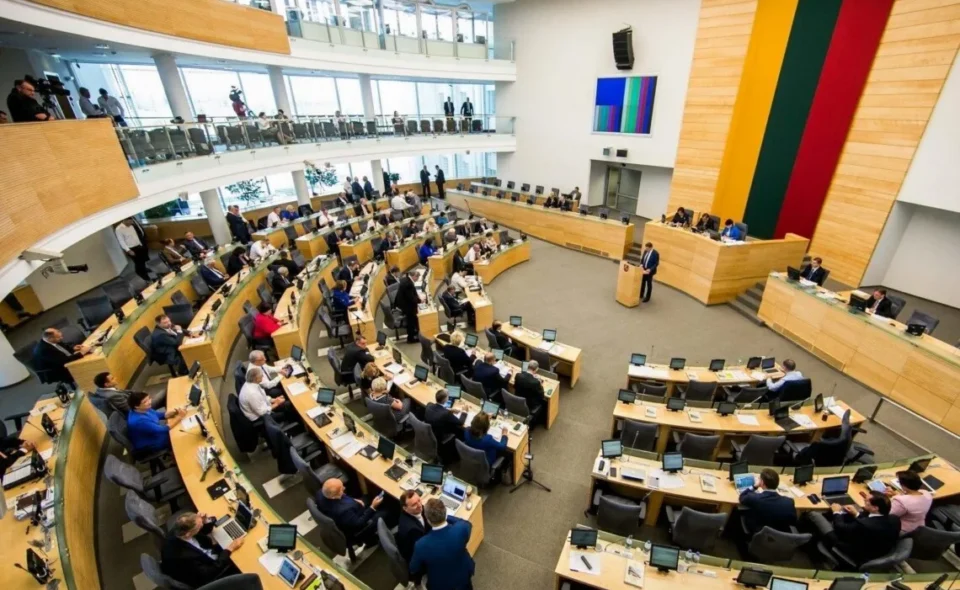
Lithuanian National Energy Regulatory Council (NERC) announces that the second offshore wind tender (for the development rights to a 700 MW offshore wind farm) is considered not to have taken place.
According to the tender regulations, the prospective developer may either submit the development fee or seek support through a two-way contract for difference, with values ranging from €75.45 per MWh ($87.74 per MWh) to €125.74 per MWh ($145.89 per MWh).
The planned farm is to be build in the Baltic Sea roughly ~30 km off Palanga / the western Lithuanian coast. The tender had earlier been launched in Nov 2024 and then suspended on 29 January 2025.
As the deadline for submitting applications for participation in the second Offshore Wind Farm Development Tender expired at midnight on Tuesday, only one participant had registered, which means the tender is deemed invalid.
According to Article 22(10) of the Law on Renewable Energy, a tender is considered not to have taken place if fewer than two participants register to take part in it.
Applications for participation in this tender were accepted from 9 June to 8 September of this year. The tender procedures were temporarily suspended by a Government decision and later resumed on October 6, with applications accepted until October 7 inclusive. The tender committee today decided to propose that NERC deem the tender as having not taken place.
The corresponding resolution will be adopted at the next NERC meeting. NERC emphasises that the decision to announce a repeated tender rests with the Government. The Council is responsible for organising the tender and selecting the winner (including preparing the conditions, organising the committee’s work, and adopting the decision on the winner).
The tender committee consists of two NERC representatives and one representative each delegated by the Ministry of Energy, the Competition Council, the Lithuanian Energy Agency, Vilnius University, and Kaunas University of Technology.
Notwithstanding the setback, Lithuania remains committed to developing its second offshore wind farm in the Baltic Sea, Energy Minister Žygimantas Vaičiūnas confirmed to The Voice of Renewables. The minister said that consultations with the European Commission on the upcoming tender will begin shortly: “Plans to develop the project remain. We will determine how and under what parameters it will be implemented after consultations with the European Commission, which we will begin soon.”
The minister emphasised that both the government and the Seimas will be consulted before finalising the project’s parameters.
According to Vaičiūnas, discussions with the European Commission will also focus on the Contract for Difference (CfD) scheme originally intended to support the project. The state aid arrangement agreed earlier is set to expire this year, prompting a review of its terms and potential adjustments.
Under the CfD model, if the market price of electricity falls below the agreed minimum, the state compensates the developer for the difference. Conversely, if the price exceeds the threshold, the developer returns the surplus to the state.
Vaičiūnas underlined that the new tender conditions must enhance project attractiveness for developers without increasing costs for consumers. He did not rule out the possibility that the next tender could proceed without direct state support, depending on the outcome of talks in Brussels.
“We will consult with the European Commission on possible options. Then the government will decide, and finally the Seimas will make the decision,” the Minister said.
The project marks another step in Lithuania’s long-term strategy to strengthen its offshore wind capacity and advance energy independence through renewable power generation in the Baltic region.
Several offshore wind tenders around the world were cancelled or suspended in 2025 as governments and developers grappled with rising costs, supply-chain pressures, and financing challenges. Denmark scrapped its planned 3 GW tender covering sites such as Hesselø and Kriegers Flak II after receiving no viable bids, acknowledging that its “no-subsidy” model was no longer workable in current market conditions. Norway also abandoned its fixed-bottom offshore wind tender for the Sørvest F area, citing grid connection costs and a strategic shift towards floating wind development. In India, the Solar Energy Corporation of India (SECI) cancelled two tenders—one for 500 MW under a viability gap funding scheme and another for 4 GW of seabed leases—after a poor developer response. Lithuania temporarily suspended its second 700 MW offshore tender early in the year to revise commercial terms and encourage stronger participation before relaunching it in mid-2025.
These cancellations illustrate the shifting economics of offshore wind, with many governments reconsidering tender designs that had been structured for lower-cost eras. Factors such as interest-rate rises, inflation in turbine and installation costs, and supply bottlenecks have led developers to demand clearer revenue frameworks or partial state support. Across Europe and Asia alike, policymakers are now re-evaluating auction mechanisms to balance affordability for consumers with investor confidence, suggesting that more flexible or subsidised tender formats may dominate the next round of offshore wind auctions.
EVENT ALERT: