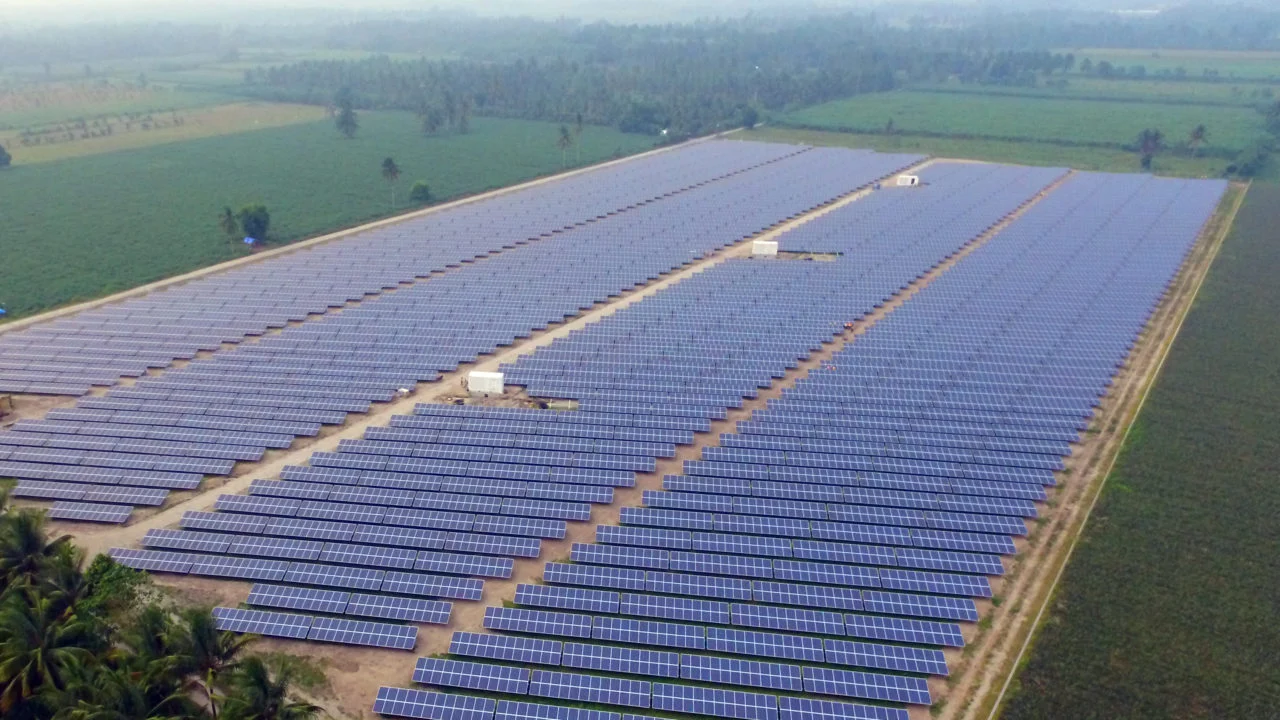



In Sicily, Iberdrola has brought its 243 MW Fenix photovoltaic plant into operation—currently the largest solar installation in Italy. On paper, it is another milestone in Europe’s accelerating build-out of utility-scale renewables. In practice, it is also a test of how far large solar projects can stretch across permitting complexity, grid constraints, and increasingly competitive capital markets without losing pace.
Fenix spans the municipalities of Paternò, Belpasso and Centuripe, a landscape that has become emblematic of Southern Europe’s solar expansion: high irradiation, available land, but also tight integration requirements with transmission infrastructure that is often playing catch-up. The project is expected to generate around 400 GWh annually, enough to supply more than 140,000 households, while avoiding approximately 119,000 tonnes of CO₂ each year compared with fossil-based generation.
The scale is not the headline in itself anymore. In markets like Italy, Spain, and parts of Greece, multi-hundred-megawatt solar parks are increasingly the baseline for utility development pipelines. What matters more is execution—how quickly capacity moves from permitting to commissioning, and whether developers can still underwrite returns in a pricing environment shaped by volatile wholesale markets and rising curtailment risk in constrained nodes.
Fenix was financed with support from the European Investment Bank and backed by SACE’s Archimede guarantee scheme, underscoring a structural shift in European renewables: large solar assets are now as much financial engineering exercises as they are construction projects. Institutional capital and public credit enhancement are becoming central to de-risking projects that would otherwise struggle to reach final investment decision at scale.
Construction mobilised more than 500 workers at peak, reflecting the increasingly industrialised nature of solar deployment. This is no longer a modular, fragmented sector at utility scale; it is a logistics and infrastructure operation, where land assembly, permitting, supply chains and grid connection timelines often matter more than module efficiency gains.
Iberdrola has also embedded environmental mitigation measures into the project design, including the planting of around 60,000 native trees and upgraded drainage systems to manage erosion and surface runoff. These interventions are increasingly standard for large European solar developments, but they also reflect a broader shift in expectation: renewable infrastructure is now judged not only by carbon displacement, but by visible ecological integration at site level.
Italy itself sits at an inflection point. Solar is expanding rapidly, yet grid congestion and permitting delays remain persistent structural bottlenecks. In this context, projects like Fenix are not just capacity additions—they are stress tests of the country’s ability to absorb intermittent generation at scale without undermining system stability or investment appetite.
For Iberdrola, Fenix reinforces a strategy that has become increasingly clear across its European portfolio: concentrate scale in grid-accessible clusters, secure long-term financing early, and prioritise execution certainty over speculative expansion. The adjacent Etruria solar complex in central Italy follows the same logic—bundled assets designed to improve operational efficiency and reduce integration friction.
Together, Fenix and Etruria illustrate a dual-track Italian strategy. In Sicily, Fenix acts as a large-scale anchor asset in a high-resource but grid-constrained region. In Lazio, the Etruria solar complex operates as a multi-asset cluster made up of several mid-sized photovoltaic plants, including sites such as Montalto di Castro, Tarquinia, Montefiascone, Limes 15, Limes 10 and Tuscania, alongside additional acquisitions such as a 42 MW ready-built plant integrated into the portfolio. This structure reflects a deliberate shift towards managing solar not as individual projects, but as coordinated regional systems.
The Etruria model is not defined by any single installation but by aggregation. Its combined capacity of roughly 170–200 MW is less important than the operational logic it introduces: shared infrastructure, consolidated grid access, and portfolio-level optimisation across multiple assets. In parallel, Iberdrola is also extending its presence in southern Italy through hybrid development activity, including photovoltaic projects such as Montelungo in Basilicata, developed alongside wind acquisitions in adjacent zones. While smaller in scale, these developments reinforce a broader corridor-based approach to renewables, where technologies are increasingly co-located to optimise land use and grid connectivity.
Across Italy, Iberdrola’s renewable development pipeline extends to several gigawatts, spanning solar, wind, and hybrid assets at different stages of permitting and construction. The emphasis is not on isolated flagship projects but on building interconnected generation nodes that can operate collectively within regional grid constraints.
What emerges is a structural shift in how solar expansion is being executed. Italy is no longer being approached as a collection of independent renewable projects. It is being treated as a portfolio of interconnected infrastructure systems, where value is created through clustering, grid integration, and scale efficiency rather than standalone megawatt capacity.
In that context, Fenix is not an endpoint. It is a marker of how utility-scale solar in Europe is evolving: from project development into system architecture, and from capacity deployment into managed energy infrastructure.