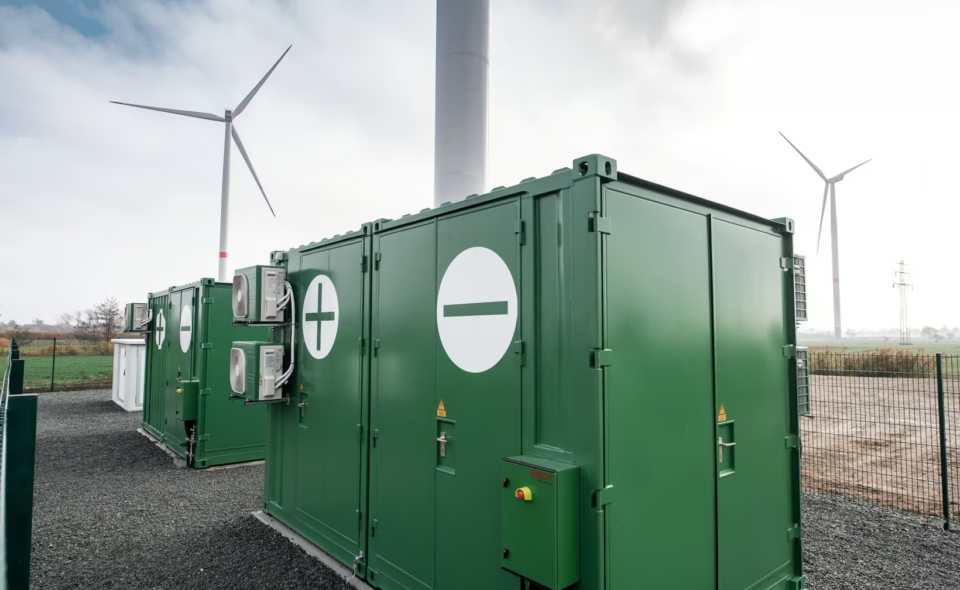
As Europe races to build a more flexible electricity system, battery energy storage is rapidly becoming one of the sector’s most strategic investments. Swiss utility Alpiq has reinforced that trend with plans for a 300 MW / 1.2 GWh battery energy storage system (BESS) in Niedergösgen—one of the largest standalone battery projects ever announced in Switzerland.
Beyond its impressive size, the project signals a broader shift in strategy. Traditionally recognised for its hydropower and conventional generation assets, Alpiq is steadily transforming itself into a provider of flexibility services, combining pumped-storage hydro with utility-scale batteries across multiple European markets.
The company has now secured more than 1 GW of battery projects across Europe, with hundreds of megawatts either operating or already under construction, demonstrating how established utilities are repositioning themselves for electricity systems increasingly dominated by renewable generation.
A Strategic Location at the Heart of the Swiss Grid
The planned battery will be constructed adjacent to Alpiq’s Gösgen run-of-river hydropower plant in the canton of Solothurn, close to both the Gösgen nuclear power station and one of Switzerland’s most important transmission grid nodes.
Location is critical for battery projects, and Niedergösgen offers several advantages. Direct access to the national transmission network enables the battery to deliver fast-response grid services where they are most valuable, while the surrounding concentration of generation assets makes it an ideal hub for balancing power flows.
The system will provide 300 MW of instantaneous power with more than 1.2 GWh of storage capacity—enough energy to supply around half a million households for over four hours.
Although batteries rarely discharge continuously in commercial operation, this combination of high power and long-duration storage allows the facility to participate across multiple electricity markets, from frequency response and balancing services to energy arbitrage and congestion management.
A Milestone for Swiss Battery Storage
Switzerland has traditionally relied on its extensive pumped-storage hydropower fleet to provide flexibility. Facilities such as Grande Dixence and Nant de Drance have long acted as the country’s “natural batteries,” storing electricity by pumping water uphill when demand is low and generating power during peak periods.
However, as solar PV installations accelerate and electricity demand becomes increasingly dynamic, lithium-ion battery storage is emerging as an essential complement to hydro.
Unlike pumped storage, batteries can respond within milliseconds, making them particularly valuable for maintaining grid stability as conventional synchronous generation declines.
The signing of a pre-connection agreement with Swissgrid therefore represents more than a procedural milestone—it secures access to one of the country’s most valuable assets: transmission capacity.
Grid connection rights have become a growing constraint for large-scale battery developments across Europe, making early agreements increasingly important in determining which projects ultimately proceed.
Construction of the Niedergösgen project is expected to begin in 2027, with commissioning planned for 2029.
Building a European Flexibility Portfolio
The Swiss project forms only one part of Alpiq’s rapidly expanding flexibility strategy.
The company has assembled a battery portfolio exceeding 1 GW across several European markets, with approximately one-third already progressing towards operation.
Current figures indicate:
| Project Status | Capacity |
|---|---|
| Operational | 130 MW |
| Under construction | 230 MW |
| Secured development pipeline | More than 1 GW |
Beyond batteries, Alpiq continues investing heavily in pumped-storage hydropower. Alongside its ownership interests in Switzerland’s flagship hydro storage schemes, the company is also pursuing a new pumped-storage project in Spain.
Rather than viewing batteries and hydro as competing technologies, utilities increasingly see them as complementary assets. Batteries excel at providing sub-second response and short-duration balancing, while pumped storage remains the preferred solution for longer-duration energy shifting.
Together, they create a portfolio capable of responding across every timescale required by modern electricity systems.
Europe’s Storage Market Enters a New Phase
Alpiq’s latest investment reflects a wider transformation taking place across Europe’s electricity sector.
Only a few years ago, utility-scale battery projects were primarily deployed to provide ancillary services such as frequency regulation. Today, developers are increasingly targeting multiple revenue streams simultaneously.
Modern battery systems are expected to:
- provide frequency containment and balancing services;
- reduce transmission congestion;
- absorb excess renewable generation during periods of oversupply;
- shift solar energy into evening demand peaks;
- improve electricity market efficiency through arbitrage; and
- strengthen security of supply during system stress events.
As renewable penetration continues to rise, these functions are becoming indispensable.
Across Europe, governments and system operators are recognising that achieving high shares of renewable electricity requires not only more generation capacity but also significantly greater flexibility.
From Generator to Flexibility Provider
Perhaps the most significant aspect of Alpiq’s announcement is what it says about the evolution of Europe’s utilities.
Historically, competitive advantage centred on owning generation assets. Increasingly, it lies in managing flexibility—storing electricity, balancing networks and responding instantly to changing market conditions.
For companies with experience operating complex hydroelectric portfolios, battery storage represents a natural extension of that expertise.
The Niedergösgen project therefore represents more than another large battery installation. It illustrates how established utilities are adapting their business models to support increasingly decentralised, renewable-based electricity systems.
With more than 1 GW of battery projects secured across Europe and ambitions to expand its operational portfolio into the multi-gigawatt range, Alpiq is positioning itself as one of Europe’s emerging leaders in flexibility infrastructure.
As batteries move from demonstration projects to critical grid assets, investments of this scale are likely to become an increasingly common feature of Europe’s evolving energy landscape.