

China’s Sungrow is exploring the sale of a development portfolio of up to 350 MW of battery energy storage system (BESS) projects in Spain, a move that highlights both the country’s rapidly maturing storage market and growing investor appetite for utility-scale flexibility assets across Europe.
Market sources indicate that binding offers are expected during July following a competitive process that has narrowed to a small number of shortlisted bidders. While neither Sungrow nor the prospective buyers have commented publicly on the process, the transaction is attracting attention because it could become one of the largest standalone battery portfolio sales currently being marketed in Spain.
The sale comes as battery storage moves from an emerging technology to one of Europe’s most sought-after infrastructure asset classes. With renewable generation continuing to expand across the continent, investors are increasingly targeting storage projects capable of providing balancing services, relieving grid congestion and capturing value from increasingly volatile electricity markets.
Spain, once viewed primarily as a solar development market, is rapidly establishing itself as one of Europe’s next major destinations for battery investment.
A portfolio spanning several regions
Although the full composition of the portfolio has not been officially disclosed, publicly available permitting records and recent corporate announcements provide a clearer picture of Sungrow’s growing Spanish development pipeline.
At the heart of the portfolio is a cluster of projects in La Vall d’Uixó, Castellón, where Sungrow recently announced what it describes as Spain’s largest battery energy storage hub. The development combines three interconnected projects with a total installed capacity of approximately 171.5 MW and 726.4 MWh. According to the company, the projects will share evacuation infrastructure connected to the 220 kV transmission network, allowing significant economies of scale while supporting the integration of renewable electricity into Spain’s grid.
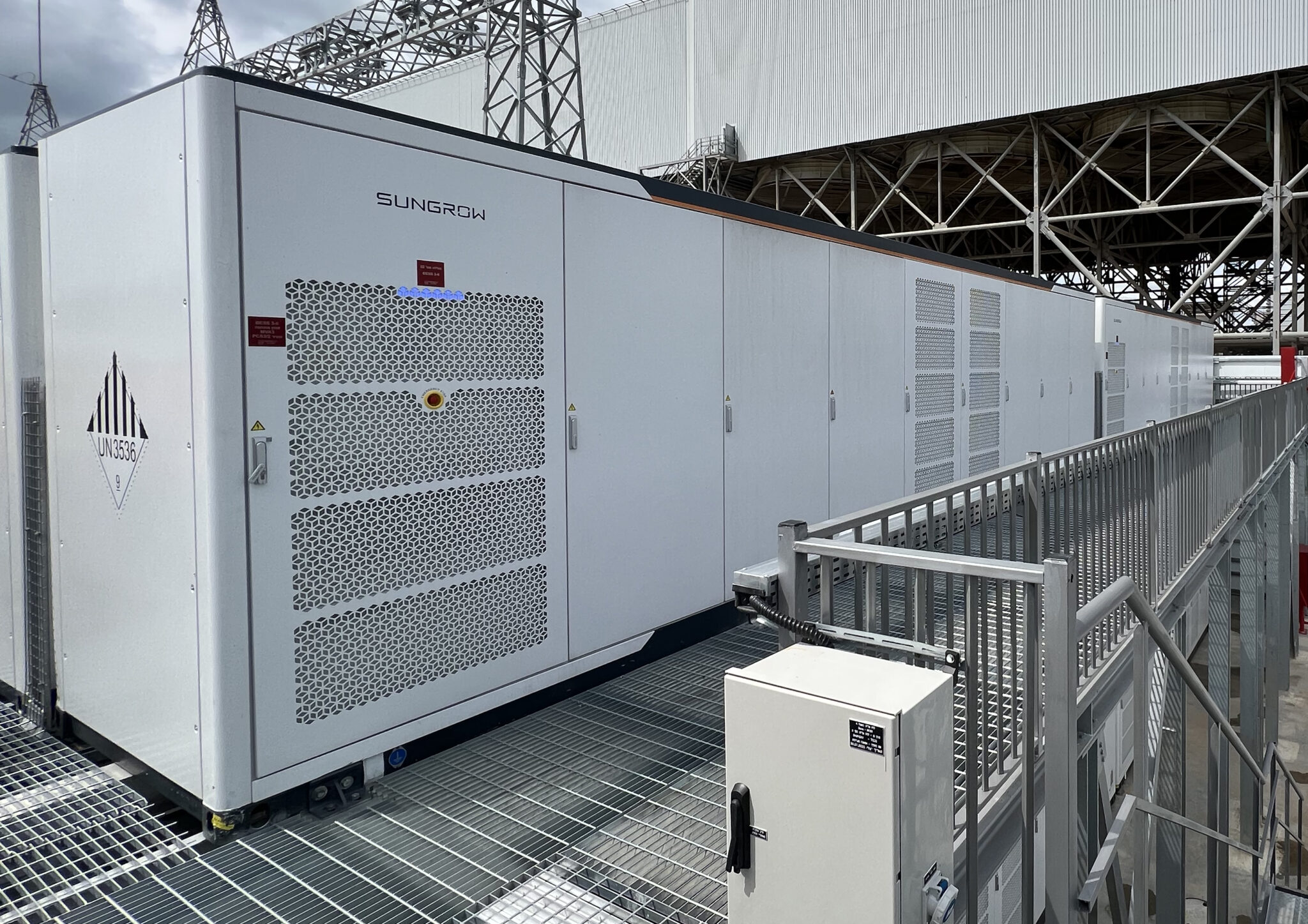
The flagship asset is the 55 MW / 220 MWh BESS Cuevas project, which has entered Spain’s administrative approval process following environmental clearance. Public consultation documents show the installation will comprise 44 Sungrow battery containers using lithium iron phosphate (LFP) technology together with 11 transformer stations supplied by the company itself.
The remaining capacity within the Castellón hub comes from the Vadux Solar and Julben Solar projects, acquired by Sungrow from Spanish developer ID Energy Group in 2025. The acquisition strengthened the company’s presence in eastern Spain and provided a substantial foundation for its standalone storage ambitions.
Beyond Castellón, Sungrow has also advanced projects in Navarra. Planning applications have been submitted for the 40 MW BESS Eunate project in Olite and the 50 MW / 200 MWh BESS Cordovilla project in Galar, extending the company’s pipeline in northern Spain.
Together, these publicly identified developments account for more than 260 MW of capacity, suggesting that additional projects – potentially in Galicia or elsewhere in northern Spain – form part of the reported portfolio of up to 350 MW.
Capital recycling becomes the preferred strategy
Rather than signalling a retreat from the Spanish market, the proposed sale reflects an increasingly common strategy among international renewable energy developers.
Across Europe, developers are originating projects, securing land rights and grid connections, advancing environmental approvals and permitting, before selling de-risked assets to long-term investors capable of financing construction and operation. The approach has become increasingly attractive as higher financing costs have placed greater emphasis on efficient capital allocation and balance-sheet discipline.
By selling projects shortly before construction, developers can recycle capital into new opportunities while infrastructure funds, pension investors and utilities acquire assets that carry substantially lower development risk.
The debate among investors has shifted markedly over the past few years. Rather than questioning whether utility-scale batteries can generate sustainable returns, attention is increasingly focused on identifying projects capable of capturing multiple revenue streams through energy arbitrage, ancillary services, capacity markets and grid flexibility.
For buyers, project quality has become a key differentiator. Grid connection, permitting status, battery duration, network location and revenue optimisation strategies are now often more important than portfolio size alone.
Infrastructure investors circle the sector
Market sources suggest the final stages of the sale process involve a combination of strategic utilities and infrastructure-backed investment platforms.
Among the companies reportedly linked to the process is newly established European storage platform Actuate Energy, backed by US investor NGP Energy Capital Management. Earlier market speculation also connected Engie and Zelestra with the transaction, although neither company has publicly confirmed its involvement.
PwC is understood to be advising Sungrow on the sale process. At the time of publication, no legal advisers acting for either the seller or prospective bidders have been publicly identified.
The level of interest reflects a wider shift across Europe’s energy investment landscape. Infrastructure funds that previously concentrated on operational wind and solar portfolios are increasingly allocating capital to battery storage as revenue opportunities diversify through ancillary services, wholesale electricity trading and emerging flexibility markets.
Spain reaches a storage turning point
Spain has historically lagged behind countries such as the United Kingdom and Italy in deploying utility-scale battery storage despite possessing one of Europe’s largest renewable energy fleets.
That is beginning to change.
The Spanish government’s National Energy and Climate Plan (PNIEC) identifies large-scale storage as essential for integrating rapidly growing volumes of solar and wind generation, reducing renewable curtailment and strengthening electricity system flexibility.
As renewable penetration continues to increase and periods of very low or even negative wholesale electricity prices become more frequent, batteries are increasingly viewed as critical infrastructure capable of shifting renewable generation to periods of higher demand while providing valuable balancing services to the grid.
Projects are now advancing through environmental permitting at an increasing pace, financing activity is accelerating and developers are preparing for a significant wave of construction during the second half of the decade.
A bellwether transaction for Europe’s battery market
Should the transaction proceed, it is is likely to become an important benchmark for Spain’s rapidly evolving battery storage sector.
Beyond the headline capacity, investors will be watching closely to see how the portfolio is valued, how permitting risk is assessed and what assumptions buyers make regarding future revenue streams. The outcome could help establish valuation benchmarks for a growing number of battery portfolios expected to enter the European market over the next two years.
For Sungrow, a successful sale would validate a strategy that combines technology supply, project development and capital recycling into new opportunities.
For the wider industry, it would underline how Europe’s battery market has entered a new phase. Competition is no longer centred solely on developing projects, but increasingly on acquiring the most attractive pipelines before construction begins.
As renewable electricity continues to reshape Europe’s power systems, late-stage battery portfolios such as Sungrow’s are becoming strategic assets – not simply because of their installed capacity, but because they offer investors early access to one of the fastest-growing segments of the continent’s energy transition.