


Europe’s renewable hydrogen industry has invested enormous effort in reducing the cost of renewable electricity and scaling up electrolyser manufacturing. Yet as commercial projects begin moving from planning towards large-scale operation, another question is becoming increasingly important: how can electrolysers run flexibly on intermittent solar and wind power without shortening their own lifespan?
It is a challenge that goes directly to the heart of green hydrogen economics. Every additional year of electrolyser stack life reduces replacement costs, improves project returns and lowers the levelised cost of hydrogen (LCOH). As developers increasingly seek to align hydrogen production with fluctuating renewable generation and wholesale electricity prices, managing equipment degradation is emerging as one of the sector’s most important engineering priorities.
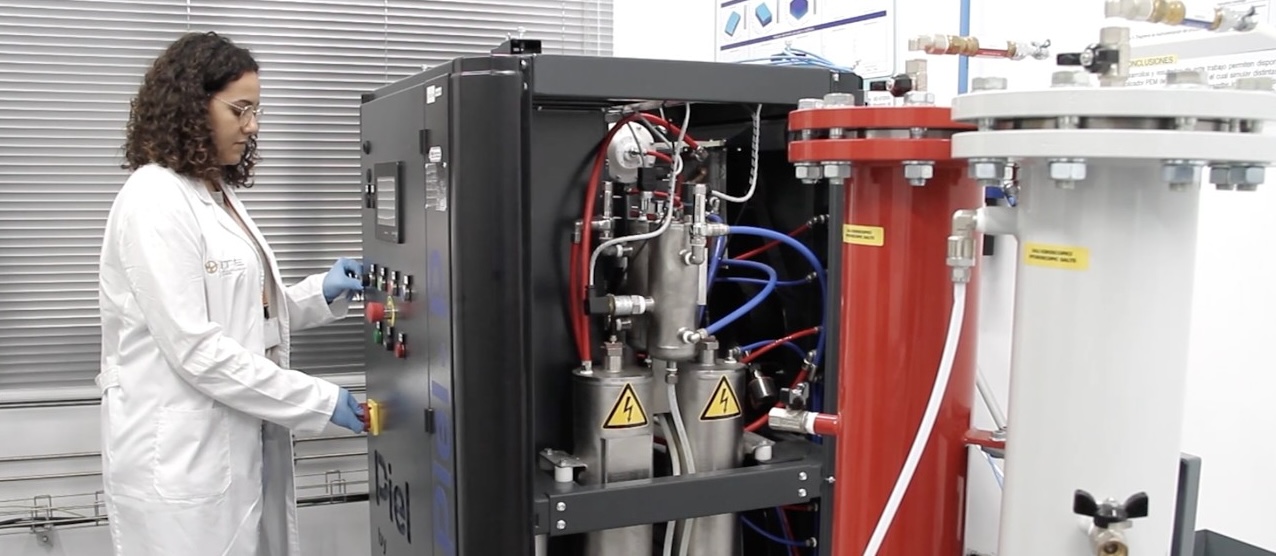
That is precisely the challenge being addressed by Spain’s Instituto Tecnológico de la Energía (ITE) through its Hedera research project. Rather than focusing solely on improving electrolysis efficiency, the initiative combines advanced proton exchange membrane (PEM) electrode development with predictive degradation modelling, optimisation software and a digital twin designed to help operators maximise equipment lifetime while taking advantage of low-cost renewable electricity.
Flexibility Comes at a Cost
PEM electrolysers are widely regarded as the preferred technology for applications requiring rapid response to variable renewable electricity. Unlike alkaline electrolysers, they can increase or decrease hydrogen production within seconds, making them particularly well suited to operate alongside solar and wind power.
However, operating under dynamic conditions presents technical challenges.
Frequent start-stop cycles, rapid load changes and prolonged operation under fluctuating power profiles are recognised as factors that can accelerate degradation mechanisms within PEM stacks. Over time, this can reduce efficiency, shorten equipment lifetime and increase maintenance and replacement costs.
For project developers, this creates a delicate balancing act. Running electrolysers when renewable electricity is abundant—or when wholesale electricity prices are particularly low—can significantly reduce operating costs. Yet the financial benefits of flexible operation may be offset if increased cycling accelerates stack degradation.
As a result, developers are increasingly seeking to optimise not only when electrolysers operate, but how they operate.
A Different Approach to Reducing Hydrogen Costs
The Hedera project takes a comprehensive approach to this challenge.
Researchers developed and validated new PEM electrolysis electrodes using improved catalyst ink formulations and spray-deposition manufacturing techniques designed to produce more uniform and reproducible materials suitable for future industrial-scale production.
The team also investigated the principal degradation mechanisms affecting PEM electrodes under different operating conditions, with particular attention to systems powered by variable photovoltaic and wind generation. By analysing how changing power loads influence component ageing, the researchers aimed to better understand the relationship between operational flexibility and equipment lifetime.
Speaking to The Voice of Renewable, Alejandro Rubio, principal investigator of the Hedera project at ITE, stated that improving electrolyser durability is becoming central to the commercial success of renewable hydrogen.
“Much of the viability of renewable hydrogen for applications such as heavy-duty transport or certain industrial uses hinges on the electrolyser. At Hedera, we have been working precisely on this ‘other side’ of renewables: how to produce hydrogen flexibly using solar and wind power without compromising the equipment’s service life or driving up operating costs.”
Intelligence May Matter as Much as Hardware
Perhaps the project’s most significant contribution lies in the digital tools developed alongside the new electrode technology.
Using laboratory testing and experimental operating data, ITE created a predictive degradation model capable of estimating electrolyser performance under different operating scenarios while assessing how operating strategies influence both equipment lifetime and hydrogen production costs.
The researchers also developed a multi-criteria optimisation algorithm that considers renewable electricity availability, hydrogen demand, storage capacity and degradation simultaneously. Rather than simply maximising hydrogen output or responding to electricity prices alone, the algorithm helps identify operating strategies that balance technical performance with long-term economic value.
ITE further developed a digital twin of an electrolysis plant, enabling operators to simulate different operating scenarios before deployment. Such virtual modelling allows developers to evaluate energy management strategies, estimate equipment ageing and optimise plant design before making investment decisions.
Collectively, these digital tools represent an increasingly important direction for the hydrogen sector, where software and operational intelligence are becoming as valuable as improvements in hardware.
A Broader Shift Across Europe’s Hydrogen Industry
The Hedera project reflects a wider evolution taking place throughout Europe’s renewable hydrogen market.
Much of the industry’s early focus centred on reducing electrolyser capital costs, increasing manufacturing capacity and improving conversion efficiency. Those objectives remain important, but attention is increasingly shifting towards operational optimisation.
Future electrolysers are unlikely to operate continuously at constant output. Instead, they are expected to respond dynamically to renewable generation, wholesale electricity markets, hydrogen demand and grid conditions. In many regions, hydrogen production will increasingly take advantage of periods of abundant solar generation, strong wind output or low—and occasionally negative—electricity prices.
Operating in this way offers clear economic advantages, but it also places greater emphasis on understanding how flexible operation affects equipment lifetime.
Consequently, manufacturers, research institutes and project developers across Europe are investing heavily in predictive maintenance, advanced control systems, digital twins and degradation modelling. Extending stack life may ultimately prove just as important to reducing the levelised cost of hydrogen as incremental improvements in efficiency.
Why Spain Is an Ideal Test Bed
Spain is particularly well positioned to develop these technologies.
With one of Europe’s strongest solar resources, rapidly expanding wind generation and ambitious plans to become a leading producer of renewable hydrogen, the country offers ideal conditions for studying electrolysers operating under highly variable renewable electricity.
As renewable penetration continues to increase, flexible electrolysis is expected to play a growing role in balancing electricity systems while supplying hydrogen to industry, heavy transport and future export markets.
Research projects such as Hedera therefore address not only a technical challenge but also one of the key economic questions facing Europe’s hydrogen transition.
The Next Phase of Hydrogen Innovation
The first phase of the green hydrogen industry focused on proving that renewable hydrogen could be produced at scale. The second concentrated on reducing the cost of electrolysers and expanding manufacturing capacity.
The next phase may be defined by something less visible but equally important: operating electrolysers more intelligently.
As hydrogen projects become larger, more complex and increasingly integrated with renewable electricity markets, digital optimisation, predictive maintenance and degradation modelling are likely to become standard components of project development rather than optional enhancements.
Spain’s Hedera project offers an early glimpse of that future. It suggests that the next major reductions in hydrogen costs may come not only from better electrolysers, but from understanding how to operate them more effectively throughout their lifetime.