
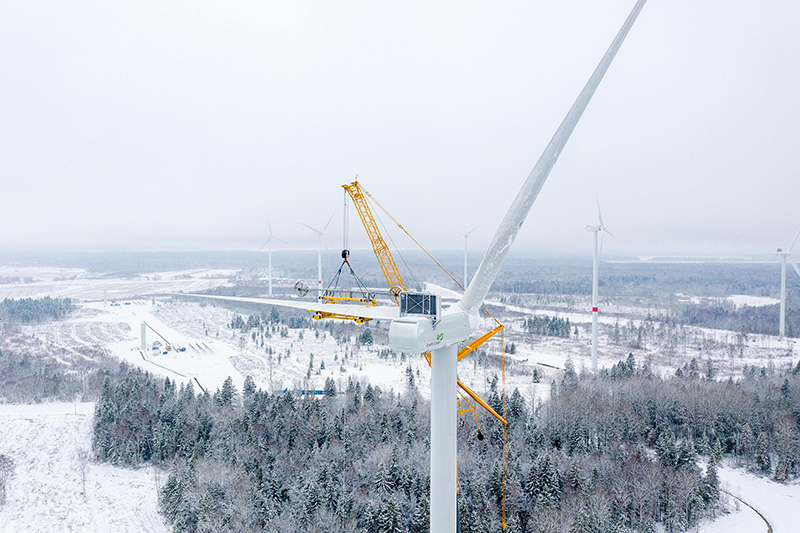
At the beginning of this year the verdict on Estonian wind was blunt: no new wind farm would be finished in the country this year, and probably not next year either. Seven months on, the prime minister has handed a new energy minister an order to fix exactly that.
When Kristen Michal gave Erkki Keldo the energy and environment portfolio this month, the brief contained a phrase every Estonian understands and no translator enjoys. Wind-farm planning and development, it said, should be helped “kännu tagant lahti” as widely as possible. Literally: freed from behind the tree stump. In practice: unstuck.
Keldo moved across from the economy ministry after Andres Sutt resigned, and took the oath in the Riigikogu in mid-September. “Energia ei vaja ideoloogilisi loosungeid, vaid see vajab ikkagi praktilisi lahendusi,” he said when the move was announced: energy needs practical solutions, not ideological slogans. For wind, practical mostly means paperwork.
A stuck winter
The February picture was grim. Four producers, Enefit, Utilitas, Evecon and Enery, had won a 2023 auction to deliver 650 GWh of new wind power, and none would hit the deadline. Evecon said it would finish its park by 2028 and accepted losing its guarantee deposit. Johann-Gustav Lend, head of renewables at Enefit, said obstacles had arisen “either in the planning procedures or… in the form of court disputes”. Rene Tammist, board chair of Utilitas Wind, was harsher: the state “quite clearly has not managed to fulfill its task”, he said, and consumers were paying for it through high electricity prices. The climate ministry refused to ease deadlines or deposits, saying that would break the law and be unfair to bidders who lost.
The National Audit Office had diagnosed the same illness in 2024. Planning and environmental impact assessments eat the most time, the ministry’s fixes saved only a month or two, and nobody agrees on which environmental impacts count as significant. The result: wind supplied just 23.6% of Estonia’s electricity in the first half of 2026, even though renewables overall produced 71.7%, according to River Tomera, head of Elextra, the renewables unit of grid operator Elering.
Signs of a thaw
Developers, though, haven’t walked away. The sixth renewable auction closed at the end of August with nine bids from seven companies for 990 GWh, the largest state auction Estonia has run, at prices from €24.18 to €43.38 per MWh. Winners get a top-up of up to €20/MWh for as long as 12 years, nothing when the exchange price tops €45/MWh, and must be producing by 31 December 2030. Keldo will sign off the results by the end of the year.
The sea is opening up too. In July the defence ministry said a €66.8m radar upgrade, paid for entirely by the EU’s NextGenerationEU fund, had lifted height restrictions off Saaremaa, Hiiumaa and Vormsi and in the Gulf of Riga, allowing turbines taller than 350 metres. Then-defence minister Hanno Pevkur called it the removal of a major obstacle to offshore wind in western Estonia. Offshore still lacks a support scheme after the government dropped a €2.6bn subsidy in 2025, but Keldo inherits a proposed state loan-guarantee scheme covering offshore wind, large-scale storage and nuclear, if the budget can back it.
Critics on the nationalist right point out that all of this began under Sutt, and ask how “no slogans” squares with pushing wind this hard.
The rest of the list
Winter comes first. Michal wants Keldo to work with business to soften high world fuel prices, including by switching from gas to other sources, and to speed up cuts to fossil fuels over the longer term. “Eesootav talv ei tule lihtne,” Keldo said: the coming winter won’t be easy.
Gas stays contentious. Elering plans 900 MW of gas-fired plants by 2035, and Kalev Kallemets, chief executive of nuclear developer Fermi Energia, has warned the tender could end oil-shale power and weaken the case for nuclear. On nuclear itself, Keldo must stand up the regulator created by the Nuclear Energy and Safety Act, passed on 17 June, which will sit inside the Consumer Protection and Technical Regulatory Authority from 1 January 2027. He also has to steer the climate-resilient economy law, sent to parliament in May, past employers who say it needs substantial additions.
Estonians vote next March, so the clock is short. But the contrast with February is striking. Then, the question was why nothing was being built. Now there’s a record queue of bidders, open skies over the western sea and a minister whose explicit job is clearing the way. If Keldo can shift the stump in municipal planning offices, the next headline about Estonian wind may read very differently.


