Carno 3 got the green light to build in 2016. The wind farm that’s actually under construction now looks nothing like the one that was approved.
Santander UK and Rabobank reached financial close on 17 June 2026 on an £80 million senior debt package backing Carno 3, a 45 MW wind farm under construction in mid Wales — not North Wales, as some recent coverage has had it; the site sits in Powys, next to the existing Carno and Carno 2 wind farms.
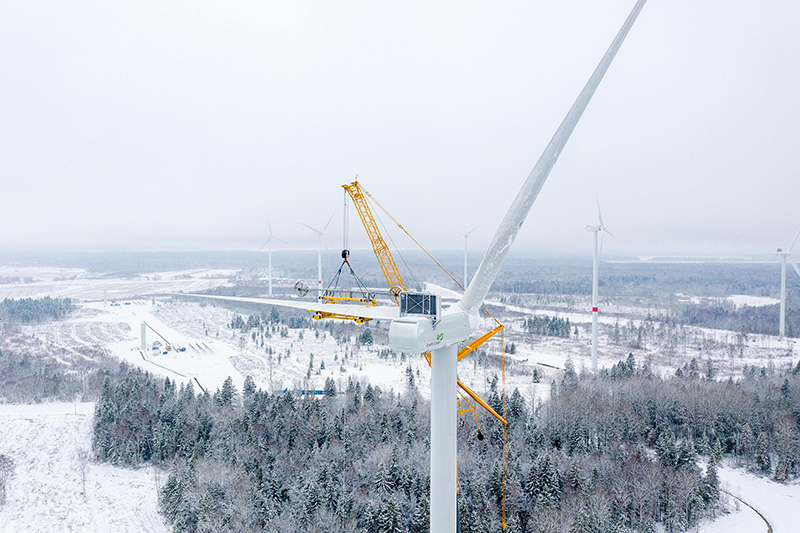
The borrower is Carno 3 LLP, a joint venture between Gresham House, which already manages the adjacent operating sites, and developer Amegni Renewables. Ten Vestas turbines are going up, with Jones Bros Civil Engineering as principal contractor under a separate £46.5 million balance-of-plant contract. Enabling works were already under way before financial close; full construction started in August 2026, with completion targeted for autumn 2027. Once operational, the developers expect the site to generate enough power for around 46,000 homes and cut roughly 65,000 tonnes of CO2 a year.
The more interesting story than the financing itself is how long it took to get here. Powys County Council granted planning consent for Carno 3 in March 2016 — on an application first submitted in July 2010, a six-year approval process on its own. What was consented back then was a 13-turbine scheme rated at up to 41.6 MW. The project now under construction is smaller in turbine count but larger in output: ten machines rated at 45 MW combined.
That gap is a decade of turbine technology compressed into one site — modern units doing more work with fewer foundations, fewer access-track miles, and a lighter footprint than the consented design ever needed. It’s also a decade during which the project sat on a shelf: UK onshore wind spent much of that period effectively locked out of routine financing as government policy toward the technology shifted, planning pipelines slowed, and few new sites in Wales or England reached construction. Jones Bros has described Carno 3 as mid Wales’s first major new wind farm construction start in close to ten years, dating back to the 2017 completion of Garreg Lwyd.
None of the public announcements around financial close disclose how Carno 3’s output will actually be sold — no mention of a CfD, a cPPA, or a straightforwardly merchant structure. That’s a detail project finance lenders don’t take lightly; the revenue mechanism is normally the anchor a construction loan is underwritten against. Whatever the structure, Santander and Rabobank were comfortable enough to jointly commit £80 million against a total project cost that, based on the disclosed construction contracts alone, runs past £100 million — a debt-to-cost ratio that leans more heavily on debt than construction-phase wind financings often carry, though the specific equity split between Gresham House and Amegni hasn’t been made public either.
Part of that comfort likely comes from where the risk actually sits. A meaningful share of the £46.5 million Jones Bros contract isn’t turbine work at all: it covers roughly 20 kilometres of underground cable reinforcing the connection between Welshpool substation and the Abermule connection point, alongside upgrades to 4.4 kilometres of existing access track and construction of 4.7 kilometres of new track. Grid reinforcement of that scale is increasingly the part of UK onshore wind financings that determines both cost and timeline — arguably more than the turbines themselves — and it’s the kind of civil and electrical work that’s easier for lenders to price than the eventual revenue line. More than £50 million of the contracts awarded around Carno 3 have gone to Welsh-based businesses, a detail that speaks to local economic benefit more than to the financing structure, but one the sponsors have been keen to highlight.
Gresham House’s position as both financial sponsor and existing operator of the neighbouring Carno and Carno 2 sites is arguably doing more work in this deal than any single financing term. It gives lenders a functioning, already-operating comparable a few hundred metres away, run by the same manager taking on the construction risk here — a rare degree of asset-level reference point in UK onshore wind. Whether that comfort is well placed is a question financial close doesn’t answer; construction has only just started, and the real test of Carno 3’s economics — and of an £80 million bet on a design that outgrew its own decade-old planning permission — begins now.
Picture of Carno Wind Farm by Mr Oliver-Dixon.