
Iberdrola has moved its alliance with Norges Bank Investment Management from Spanish solar into hybrid wind in Portugal. On 2 November it folded the 274 MW Tâmega wind project into the platform, taking joint capacity past 1,800 MW. The partners now target 2,300 MW by 2027.
On the surface this is another tranche in a well-established capital-recycling deal. The asset itself is what makes it worth a closer look.
What Norges is buying into
Tâmega is two wind farms, Tâmega Norte and Tâmega Sul, in the districts of Vila Real and Braga in northern Portugal. Together they carry 38 Vestas EnVentus V172 turbines rated at 7.2 MW each. Norte accounts for 195 MW from 27 turbines and is expected to produce about 414 GWh a year. Sul should add around 185 GWh.
Total capex is €346 million: €237 million for Norte and €109 million for Sul. That works out at roughly €1.26 million per MW. The European Investment Bank signed a green loan of about €175 million in January, guaranteed by Spain’s export credit agency Cesce. In other words, EIB debt covers around half the build cost.
Earlier contributions to the alliance saw Iberdrola keep a 51% majority. The Tâmega announcement does not spell out the ownership split.
Why the grid connection matters more than the turbines
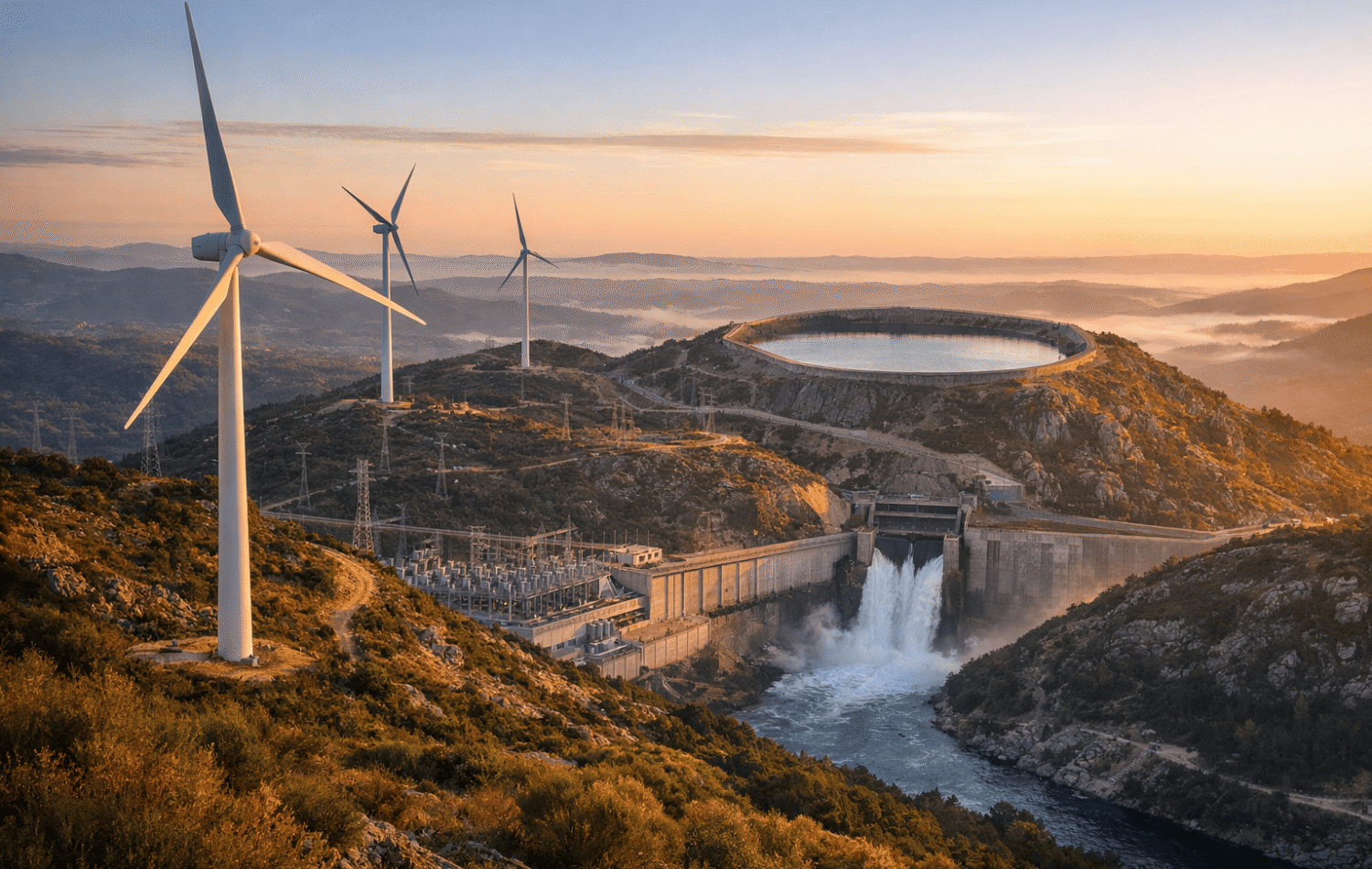
The wind farms do not stand alone. They plug into the same substation as Iberdrola’s Tâmega hydro complex:
- Alto Tâmega hydroelectric plant: 160 MW
- Gouvães pumped storage plant: 880 MW
- Daivões plant: 118 MW
With the wind farms, Iberdrola puts the complex at 1,432 MW and more than €1.85 billion of investment. It cites roughly 40 GWh of pumped storage capacity. The company calls it the first grid-connected wind-hydro hybrid on the Iberian Peninsula.
For anyone who has fought a connection queue, the logic is obvious. Sharing existing grid infrastructure removes the biggest single source of delay and cost in onshore wind. Iberdrola also argues it improves system stability, because the hydro side can absorb and release energy as the grid needs it.
The announcement covers the wind capacity only. The hydro plants are not mentioned as part of the transaction. That leaves the questions a project finance team would ask first:
- How are curtailment and dispatch decisions allocated between the wind owners and the storage operator?
- On what terms does wind output interact with Gouvães?
The public material does not answer either.
Is it all running?
Iberdrola states that Tâmega is already in commercial operation. Its own project page, updated in October, described a different picture:
- Tâmega Norte operational since spring 2026
- Tâmega Sul still under construction, due for commissioning by the end of the year
Either Sul’s remaining 79 MW has come online in the past few weeks, or the closing treats the project as one asset ahead of full completion. Investors tracking yield from the platform will want to know which.
An alliance that keeps resetting its target
The partnership has grown in steps:
- January 2023: Norges agreed to pay €600 million for 49% of 1,265 MW of Spanish wind and solar. It was the fund’s first direct renewables investment in Spain.
- January 2024: the partners added 1,300 MW, brought Portugal into scope, and set a 2,600 MW goal with more than €2 billion of joint investment over three years.
- April 2024: the target settled at 2,500 MW.
- September 2025: the Ceclavín and Tagus XL solar plants in Extremadura added 708 MW.
- February 2026: Caparacena and Ciudad Rodrigo added 646 MW, taking the platform to 1,500 MW.
The headline ambition has therefore drifted from 2,600 MW to 2,300 MW. Meanwhile the original three-year investment window runs out in early 2027. Monday’s release does not address the gap.
Norges’ standing in Iberdrola has also shifted. The fund manages around €2.1 trillion and now holds about 2.3% of the utility. Iberdrola’s 2023 and 2024 releases cited a stake of more than 3%. Neither change undermines the partnership, but both are worth noting.
Portugal’s place in the plan
Iberdrola reported 1,435 MW of installed renewable capacity in Portugal at the end of 2025. It describes itself as the country’s largest renewables investor over the past decade, with more than €2.2 billion deployed.
Much of that portfolio is modest. In 2022 the company ran just 92 MW of wind across three farms. Alongside them sit a string of auction-era solar plants, including the 83 MW Estoi project in the Algarve with battery storage.
The flagship it has not yet delivered is Fernando Pessoa, a 1.2 GW solar project at Santiago do Cacém near Sines:
- Iberdrola won environmental approval in January 2023 and billed it as Europe’s largest PV plant.
- The original target date for operation was 2025.
- In 2024 the environmental licence came under review at the Administrative and Fiscal Court of Beja, following opposition from local residents.
Seen against that backdrop, Tâmega gives Norges something different. It is a Portuguese entry point that is operating, not contested. It is anchored to a storage asset that took a decade and more than €1.5 billion to build.
The model, stripped down
Iberdrola’s formula is now clear:
- Build with cheap multilateral debt.
- Prove the output.
- Sell a minority stake to patient sovereign capital.
- Redeploy the cash.
Tâmega shows the formula stretching to fit more complex, hybrid assets. The partners still need about 500 MW to reach 2,300 MW. Whether Portugal supplies the next tranche will say a great deal about how far Iberdrola’s Portuguese pipeline has really moved.