

Germany has reached an important milestone in the development of its hydrogen economy, with the first delivery of renewable hydrogen through the GET H2 Nukleus network from RWE’s electrolysis plant in Lingen to Evonik’s Marl Chemical Park.
While the announcement marks the successful commissioning of another large-scale electrolyser, its wider significance lies in something much bigger. The project demonstrates that renewable hydrogen can now be produced, transported through dedicated pipeline infrastructure and consumed by industry within an integrated commercial value chain—an essential step towards Germany’s planned national hydrogen network.
The achievement provides one of the clearest indications yet that Europe’s hydrogen transition is beginning to move beyond pilot projects and into operational infrastructure.

A Complete Hydrogen Value Chain
The GET H2 initiative was launched in 2019 as an industry alliance bringing together companies, infrastructure operators, industrial users and research organisations to develop Germany’s hydrogen economy. Today, the consortium includes more than 50 partners covering every stage of the hydrogen value chain.
GET H2 Nukleus serves as the flagship implementation project and forms part of Germany’s Important Project of Common European Interest (IPCEI) Hy2Infra programme.
Unlike many hydrogen projects focused solely on electrolysis capacity, GET H2 Nukleus integrates renewable electricity generation, hydrogen production, transmission infrastructure, industrial demand and future storage facilities into a single operational system.
The successful delivery of hydrogen from Lingen to Marl demonstrates that these individual elements can operate together under real commercial conditions.
Renewable Hydrogen Produced in Lingen
The hydrogen is produced at RWE Generation’s new electrolysis facility in Lingen, Lower Saxony, using renewable electricity, primarily supplied by the company’s offshore wind portfolio.
The project has been designed to produce Renewable Fuels of Non-Biological Origin (RFNBO)-compliant hydrogen under European Union regulations, enabling industrial customers to use certified renewable hydrogen in support of their decarbonisation objectives.
The Lingen project will ultimately comprise 300 MW of electrolysis capacity.
Two 100 MW proton exchange membrane (PEM) electrolysers are currently being commissioned and are expected to deliver a combined 200 MW of operational capacity by the end of 2026. A further 100 MW alkaline electrolyser is scheduled to enter service in 2027.
Technology Suppliers Behind the Project
The electrolysis plant brings together several of Europe’s leading hydrogen technology companies.
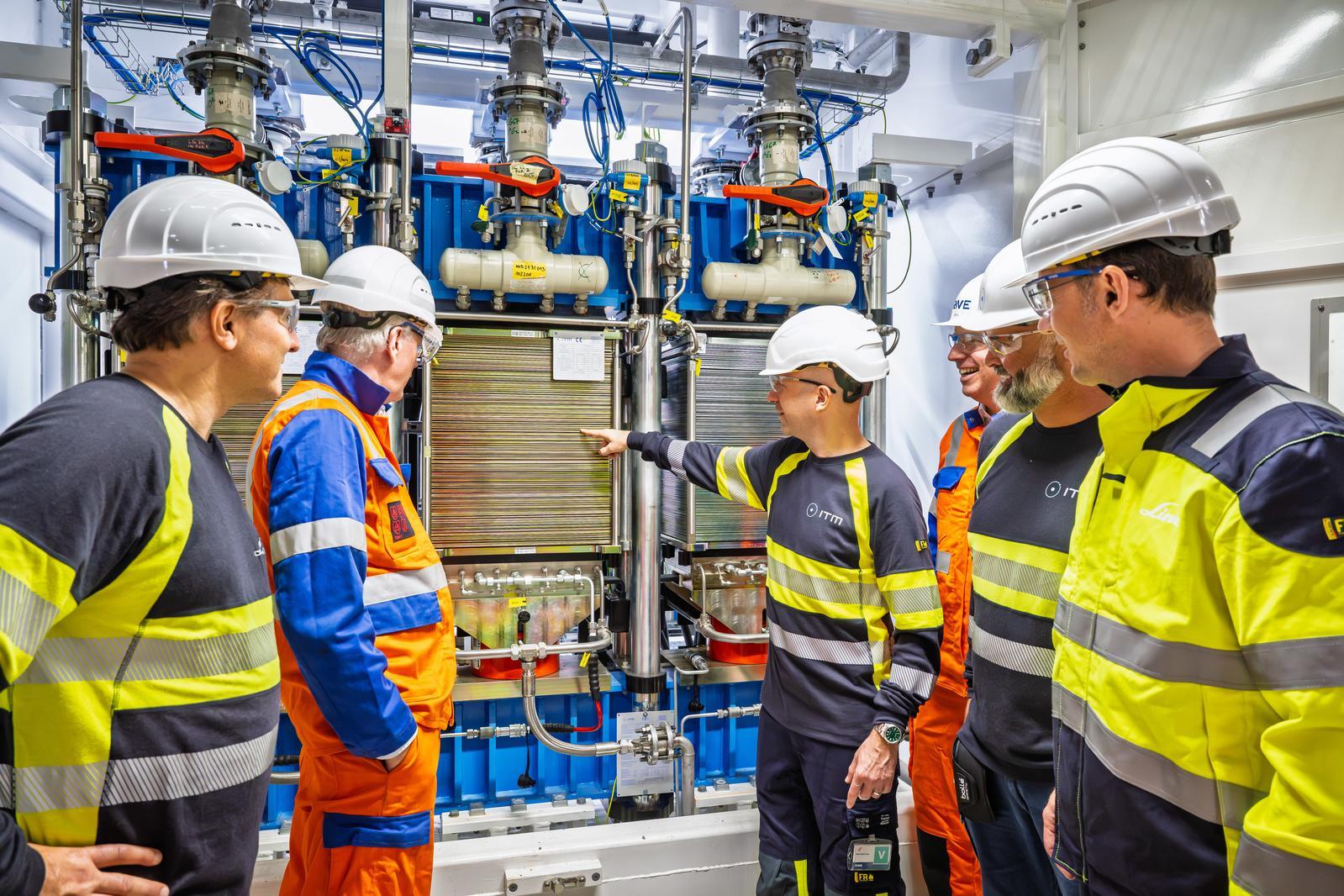
The two 100 MW PEM electrolysers have been supplied by ITM Power, with Linde Engineering acting as engineering partner and system integrator. Together, the units represent one of the largest PEM electrolysis installations currently being deployed in Europe.
The third production train will use alkaline electrolysis technology supplied by Sunfire, with Bilfinger responsible for engineering, procurement and construction activities.
The combination of PEM and alkaline technologies will provide valuable operational experience as Germany scales up industrial hydrogen production.
Repurposing Existing Gas Infrastructure
One of the project’s most significant achievements is the successful conversion of existing natural gas infrastructure for hydrogen transport.
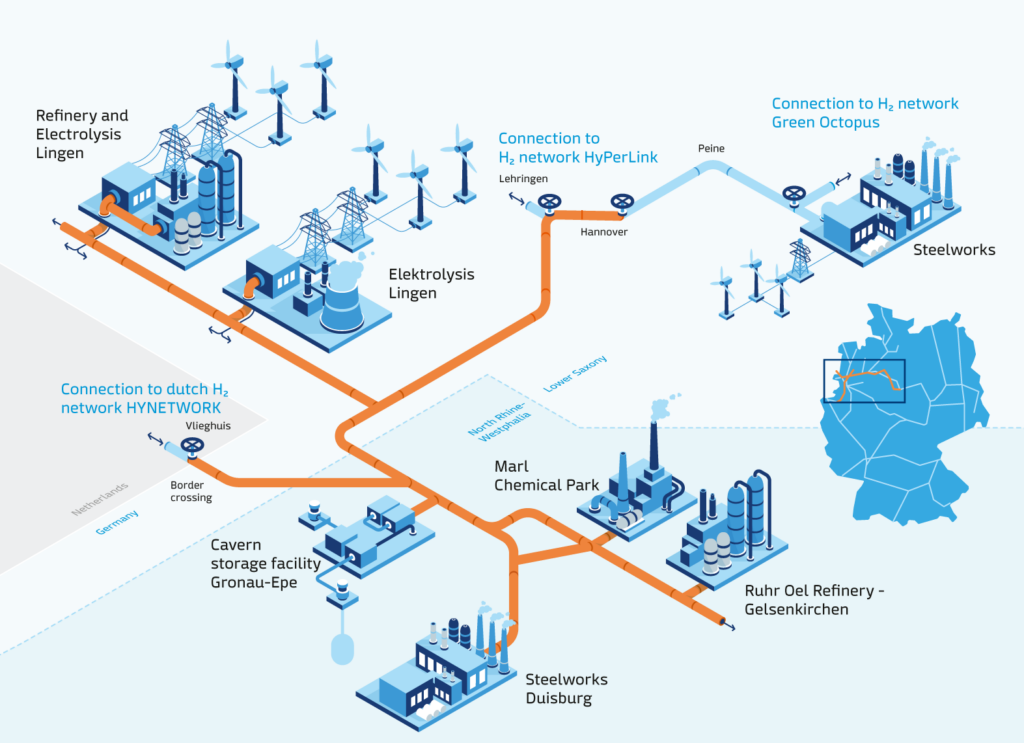
Renewable hydrogen produced in Lingen is transported approximately 120 kilometres through pipelines operated by Open Grid Europe (OGE), Nowega and SYNEQT, Evonik’s pipeline subsidiary.
Rather than constructing an entirely new network, the partners have repurposed sections of existing gas pipelines, reducing costs and accelerating deployment.
As additional pipeline sections enter operation, the network will expand to approximately 130 kilometres and ultimately become part of Germany’s planned hydrogen core network.
More Than a Private Pipeline
The infrastructure is intended to become one of Germany’s first publicly accessible hydrogen transmission systems.
This is an important distinction. Rather than serving a single industrial customer through a dedicated private connection, the network is being developed to support future commercial hydrogen trading.
The project is therefore testing many of the operational principles that will underpin Germany’s future hydrogen market, including third-party network access, capacity booking, balancing services and commercial transmission operations.
These market mechanisms will become increasingly important as hydrogen production and consumption expand across multiple industrial sectors.
Thomas Hüwener, Chief Executive Officer of OGE, said the project demonstrates not only that hydrogen infrastructure can be built successfully, but also that future network operations and market mechanisms can now be tested under real operating conditions.
Supplying Industry at Marl Chemical Park
The hydrogen is delivered directly to Evonik’s Marl Chemical Park, one of Germany’s largest integrated chemical production sites.
Instead of being blended into the gas grid or stored, the renewable hydrogen is immediately used as an industrial feedstock, replacing hydrogen produced from fossil fuels.
For Evonik, access to dedicated hydrogen infrastructure is expected to support the long-term decarbonisation of chemical manufacturing while strengthening the competitiveness of the Marl site.
Thomas Basten, Chairman of SYNEQT, said reliable hydrogen infrastructure would make the chemical park increasingly attractive for both existing operations and future industrial investment.
Hydrogen Storage to Follow
The transport network is only one element of the wider GET H2 development programme.
RWE Gas Storage West is developing what is expected to become Europe’s first commercial hydrogen salt cavern storage facility. Construction of the connecting pipeline has already been completed, with initial filling planned for late 2026 and commercial operation anticipated during 2027.
Large-scale underground storage will play a critical role in balancing renewable hydrogen production as electrolysers become increasingly dependent on variable offshore wind and solar generation.
A Foundation for Germany’s Hydrogen Backbone
The current network represents only the first phase of a much larger hydrogen infrastructure programme.
Future expansion will include additional pipeline conversions between Legden and Dorsten, new hydrogen pipelines linking Dorsten with Marl, further industrial connections and integration with hydrogen storage facilities.
The network is also expected to establish future cross-border connections with the Netherlands, supporting the development of a north-west European hydrogen market.
As these projects come online, GET H2 Nukleus will become one of the foundational building blocks of Germany’s national hydrogen backbone.
Moving Beyond Demonstration Projects
Commenting on the milestone, Nikolaus Valerius, Chief Executive Officer of RWE Generation, said the successful delivery of certified renewable hydrogen showed that production, transport and industrial consumption could now operate together as an integrated system, with the focus turning towards the commercial operation of the electrolysers.
That integrated approach is what distinguishes GET H2 Nukleus from many hydrogen projects currently under development across Europe.
Rather than demonstrating a single technology, the project validates an entire renewable hydrogen ecosystem – from offshore wind-powered electrolysis and dedicated transmission infrastructure to industrial offtake and future underground storage.
For Germany, the project represents an important step towards transforming its hydrogen strategy into operational infrastructure. For the wider European hydrogen sector, it provides one of the strongest demonstrations to date that large-scale renewable hydrogen can be produced, transported and consumed through infrastructure designed to support a competitive future hydrogen market.
EVENT ALERT: