Author: Derek Michalski, Editor.
How a €4.2 billion subsea interconnector aims to turn the Eastern Mediterranean into a major renewable energy corridor
History has a habit of finding new ways to connect the same places. More than two millennia ago, the founding of Alexandria by Alexander the Great marked the beginning of one of the Mediterranean’s most enduring partnerships. Established as a bridge between Greek and Egyptian civilisations, the city grew into one of the ancient world’s greatest centres of commerce, learning and innovation, where ideas, cultures and goods flowed between Africa, Europe and Asia. In the twenty-first century, that relationship is being renewed through a different kind of infrastructure. The GREGY Electrical Interconnection proposes to carry clean electricity rather than merchants and manuscripts, creating a modern energy bridge between Egypt and Greece and redefining connectivity across the Mediterranean through renewable energy.
The future of energy will not be defined only by how much renewable electricity the world can produce, but by how effectively that electricity can be transported across borders. As Europe accelerates its transition towards cleaner energy systems, major interconnection projects are becoming essential infrastructure for energy security, industrial competitiveness and decarbonisation.
One of the most ambitious projects emerging from this new energy landscape is the GREGY Electrical Interconnection, a planned subsea electricity link between Egypt and Greece that aims to create a direct green energy corridor between North Africa and Europe.
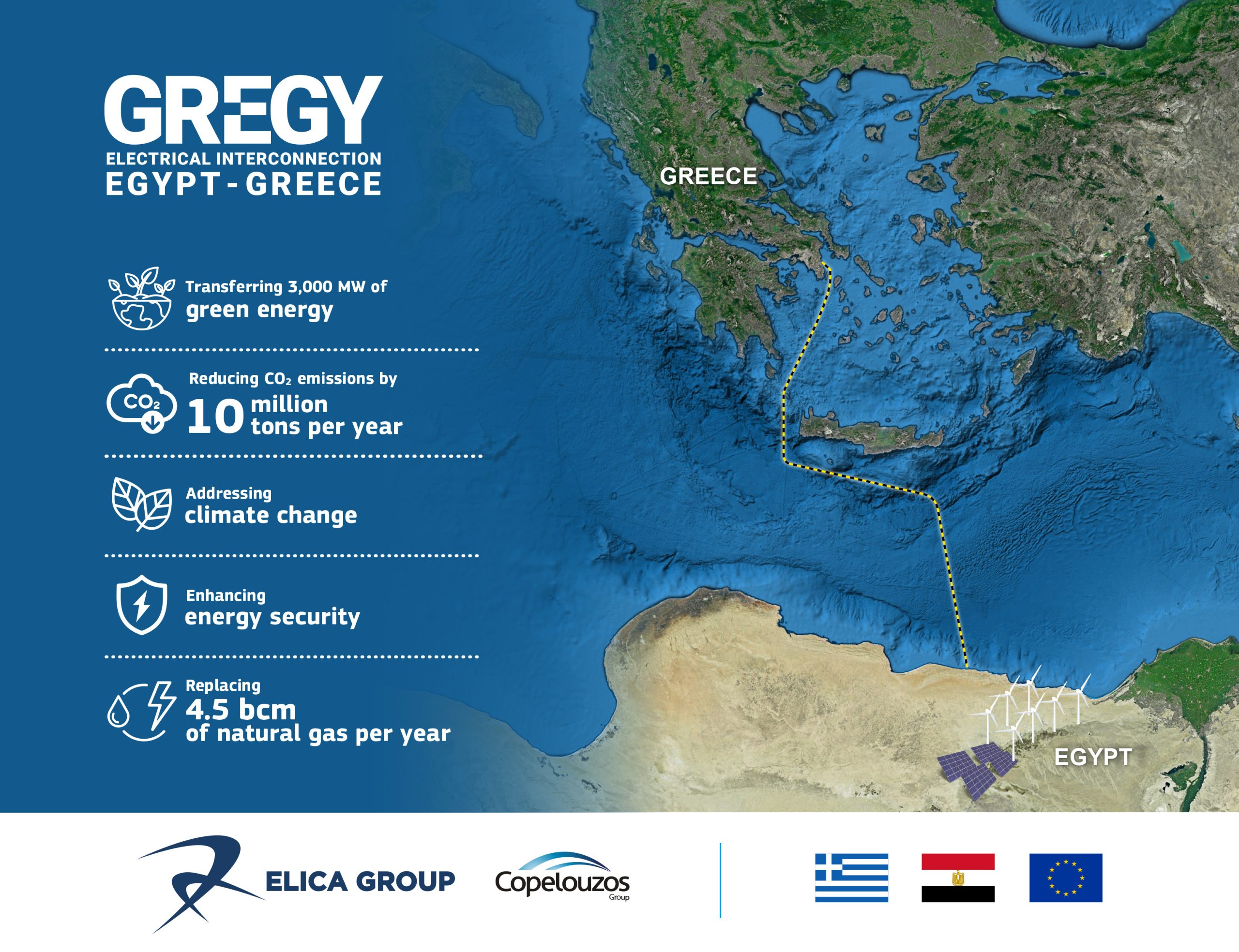
Developed by ELICA Interconnector S.M. S.A., a company of Copelouzos Group, GREGY is designed to transport renewable electricity generated from solar and wind resources in Egypt to Greece and potentially other European markets. The project is planned to have a transmission capacity of 3,000 MW through a high-voltage direct current (HVDC) submarine cable system connecting Egypt directly with mainland Greece.
For Ioannis Karydas, Chief Executive Officer of the Renewable Energy and Energy Storage Business Unit of Copelouzos Group and CEO of ELICA Interconnector, the project represents a fundamental shift in the role of the Mediterranean in Europe’s energy future.
“We are working intensively on a project that will change the energy landscape not only for our country, but for the whole of Southeast Europe, essentially putting the Mediterranean at the forefront of the European green transition,” Karydas said when presenting the strategic importance of GREGY.
The project reflects a growing recognition that renewable energy development and energy connectivity must advance together. Countries with exceptional renewable resources need efficient pathways to export clean electricity, while markets with growing demand need access to reliable low-carbon energy.
Egypt’s renewable resources become part of Europe’s energy strategy
Egypt has emerged as one of the most promising renewable energy locations in the Mediterranean region. Its high levels of solar irradiation, large areas suitable for renewable development and strong wind potential provide a significant foundation for large-scale clean energy generation.
GREGY seeks to connect this renewable potential with European electricity demand, creating a new relationship between energy production in North Africa and consumption in Europe.
The project is expected to carry 100% renewable electricity generated from Egyptian renewable energy facilities. According to the project developer, the interconnector could replace up to 4.5 billion cubic metres of natural gas consumption annually and contribute to reducing carbon dioxide emissions by approximately 10 million tonnes per year.
The strategic significance of this approach extends beyond electricity supply. It represents a broader transformation of the Mediterranean from a region historically associated with fossil fuel routes into a future network of renewable energy connections.
Karydas has described GREGY as “a bridge of sustainable development, energy independence and peace”, highlighting the project’s role in supporting European energy security, reducing emissions and strengthening cooperation between neighbouring regions.
A new energy gateway for Greece and Europe
For Greece, GREGY represents an opportunity to strengthen its position as a regional energy hub.
Located between Europe, North Africa and the Eastern Mediterranean, Greece is strategically positioned to become a gateway for renewable electricity flows. The project supports the country’s wider ambition to play a central role in the development of new European energy corridors.
The European Union has recognised the importance of the project by including GREGY within its Projects of Common Interest / Projects of Mutual Interest framework and the Global Gateway initiative, which supports strategic infrastructure connecting Europe with partner regions.
At a time when Europe is seeking greater energy diversification, interconnectors such as GREGY offer an alternative model based on electricity networks rather than traditional fossil fuel supply chains.
“The GREGY project is the cornerstone for the creation of North-South corridors for the transfer of green energy,” Karydas has said, emphasising the project’s potential role in reshaping regional electricity flows.
Engineering one of the Mediterranean’s largest electricity connections
The technical challenge of building GREGY is considerable. The planned submarine cable will extend for approximately 950 kilometres across the Eastern Mediterranean and will use HVDC technology, which is particularly suited to transmitting large volumes of electricity over long distances.
The project requires extensive engineering preparation, including marine surveys, environmental assessments, cable route studies, converter station design and integration with national transmission systems.
The development process has included technical and financial studies supported through European advisory mechanisms. The European Bank for Reconstruction and Development (EBRD) and the European Union have supported initial studies required to advance the project, including cable routing analysis and cost-benefit assessments.
Grzegorz Zieliński, EBRD Director and Head of Energy Europe, said the project aligns with priorities including market integration, green energy transition and energy security.
The road to construction and operation
GREGY is progressing through the preparation stages required for a major international electricity infrastructure project.
The current development timetable envisages completion of technical studies, environmental assessments and regulatory procedures before the final investment decision.
In January 2025, Karydas said the project was advancing towards a final investment decision and that the objective was for the power link to begin operation in 2030.
Construction will involve several major components, including manufacturing of the HVDC cable system, installation of the subsea connection, construction of converter stations and integration with electricity networks in Egypt and Greece.
The total expected investment is approximately €4.2 billion, reflecting the scale and complexity of creating a new electricity bridge between continents.
Beyond electricity: economic and industrial opportunities
The significance of GREGY extends beyond the transmission of electricity. The project could stimulate renewable energy investment in Egypt, create opportunities for engineering and infrastructure companies, and support new industries dependent on abundant clean power.
One potential application is green hydrogen production, where renewable electricity can be used to produce hydrogen for industrial applications and future energy markets.
For Europe, access to additional renewable electricity sources could support industrial decarbonisation and help reduce exposure to fossil fuel price volatility. For Egypt, renewable electricity exports could become an important part of a future clean energy economy.
The executive vision behind the project
The leadership behind GREGY sees the project as part of a wider transformation in how countries cooperate on energy.
Rather than viewing energy only as a commodity, the project positions electricity infrastructure as a foundation for long-term economic and diplomatic cooperation.
“GREGY is a bridge of sustainable development, energy independence and peace,” Karydas stated following the agreement supporting the project’s initial studies. He added that the interconnection would contribute to Europe’s energy security, decarbonisation efforts and stronger cooperation between countries.
This vision reflects a broader shift taking place across the global energy sector. Renewable energy is increasingly becoming an international infrastructure challenge, requiring cooperation between producers, consumers, governments, financial institutions and technology providers.
A defining project for the Mediterranean energy transition
If successfully delivered, GREGY could become one of the defining infrastructure projects of the Mediterranean’s energy transition.
The physical connection will be a submarine electricity cable, but the strategic ambition is much larger: to create a lasting renewable energy partnership between Egypt, Greece and Europe.
As Europe moves towards a cleaner and more interconnected energy system, projects such as GREGY demonstrate how geography, technology and cooperation can combine to create new energy routes.
The Mediterranean has connected civilisations for thousands of years. GREGY aims to make it a bridge for a new era — one powered by renewable electricity and built around shared energy security.