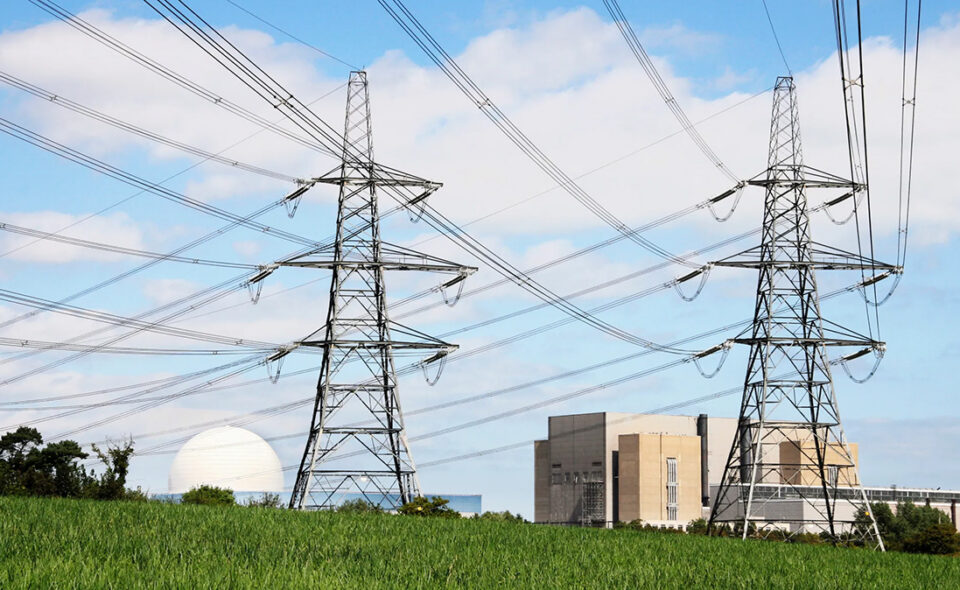
Grid stability used to be a byproduct nobody had to design for. Spin enough steel — the rotating mass inside coal, gas, nuclear, and hydro turbines — and the grid gets inertia for free. That mass resists sudden frequency swings when a generator trips or a line faults. Synchronous machines also naturally push back against local voltage dips. Inverter-based resources — solar, wind, batteries — don’t have that mass. A conventional “grid-following” inverter measures the grid’s voltage and frequency and injects current in lockstep. That works fine while synchronous generation still sets the beat. But push grid-following penetration high enough as that generation retires, and there’s no longer a strong enough reference signal for all those followers to follow. The system becomes prone to oscillations, voltage collapse, and cascading trips.
Grid-forming (GFM) inverters solve this differently. Instead of sensing a synchronous machine, they act like one. They set their own internal voltage phasor and actively regulate frequency and voltage. That gives them synthetic inertia, fast fault response, and system strength — even as the sole generation left online in a local area. Think of the difference between an instrument playing in time with the band and one that can act as the metronome.
Nowhere is that shift more consequential than in Europe. The continent is retiring synchronous coal and gas plants. It’s adding solar and wind faster than almost anywhere in the world. And in the Baltic states, it just abruptly cut a whole synchronous zone off from its inherited source of inertia. That combination has made Europe’s transmission system operators (TSOs) the world’s most active regulators of grid-forming technology — years ahead of the US market-design conversation.
Why this is “the quiet shift”
Nobody outside power systems engineering talks about GFM inverters. But they’re arguably the load-bearing technology for the renewable transition’s endgame. Dynamic line rating and reconductoring solve a capacity problem: how much power the existing wires can move. Grid-forming inverters solve a different problem: whether a grid built increasingly of solar, wind, and batteries can stay upright at all without synchronous machines to lean on. Without GFM at scale, operators hit a de facto ceiling on renewable penetration, regardless of available capacity or storage. The system goes dynamically unstable before it goes energy-constrained.
The European Commission has effectively priced how much rides on getting this right. Its Grid Action Plan estimates European grids need around €584 billion of investment by 2030. Electricity consumption is expected to rise roughly 60% by the same date. And 40% of the distribution network is already over 40 years old. GFM technology isn’t a line item in that €584 billion figure. But it’s a precondition for spending the rest of it productively — there’s little point building more transmission and connecting more renewables if the system can’t ride through a fault.
How grid-forming control actually works
There’s no single GFM algorithm. Several competing control philosophies are in use, and they trade off complexity, hardware stress, and performance differently:
- Droop control — the simplest, most widely deployed approach. Output frequency and voltage adjust in proportion to deviations in real and reactive power, mimicking a governor-controlled synchronous generator’s droop characteristic. Cheap and well understood. But slower and less precise under large disturbances.
- Virtual Synchronous Machine (VSM) control — runs a real-time software model of a synchronous generator’s swing equation, complete with virtual rotor inertia and damping. More faithful under transient conditions. Costs more in tuning complexity.
- Power-synchronization control — synchronizes via active power control rather than a phase-locked loop. Performs better on very weak grids, where phase-tracking becomes unstable.
- Virtual oscillator control — a newer, decentralized approach. Each inverter behaves like a coupled nonlinear oscillator that naturally synchronizes with its neighbors, without needing an explicit machine model. Still mostly at the research and early-pilot stage.
Europe has built the most extensive machinery anywhere for pinning these approaches down in enforceable terms. Since June 2024, ENTSO-E’s Technical Group on Grid Forming Capability has been developing quantified guidance under a revised Network Code on Requirements for Generators, known as NC RfG 2.0. It published a Phase II Technical Report in November 2025 — “a consolidated version endorsed by all participating stakeholders,” per ENTSO-E — covering non-synchronous generation and storage across the EU. New storage and generation connections above 1 MW will need to demonstrate grid-forming capability. That applies to new connections and substantial modifications, not retrofits of the existing fleet. Once the European Commission formally adopts NC RfG 2.0, ENTSO-E will issue an Implementation Guidance Document. After that, individual member states set their own technical thresholds and timelines. So the rule will look somewhat different in Germany than in Greece, even though both derive from the same European code. IEEE has been doing analogous work on the other side of the Atlantic, through Std 2800-2022 and its 2800.2 amendment, reducing interconnection barriers for grid-forming resources. Europe and North America are converging on the same technical vocabulary, even through different institutional paths. Either way, operators won’t trust GFM at scale without simulation-grade confidence it behaves correctly during real disturbances — not just in a lab.
Where it’s already running: Europe’s implementation map
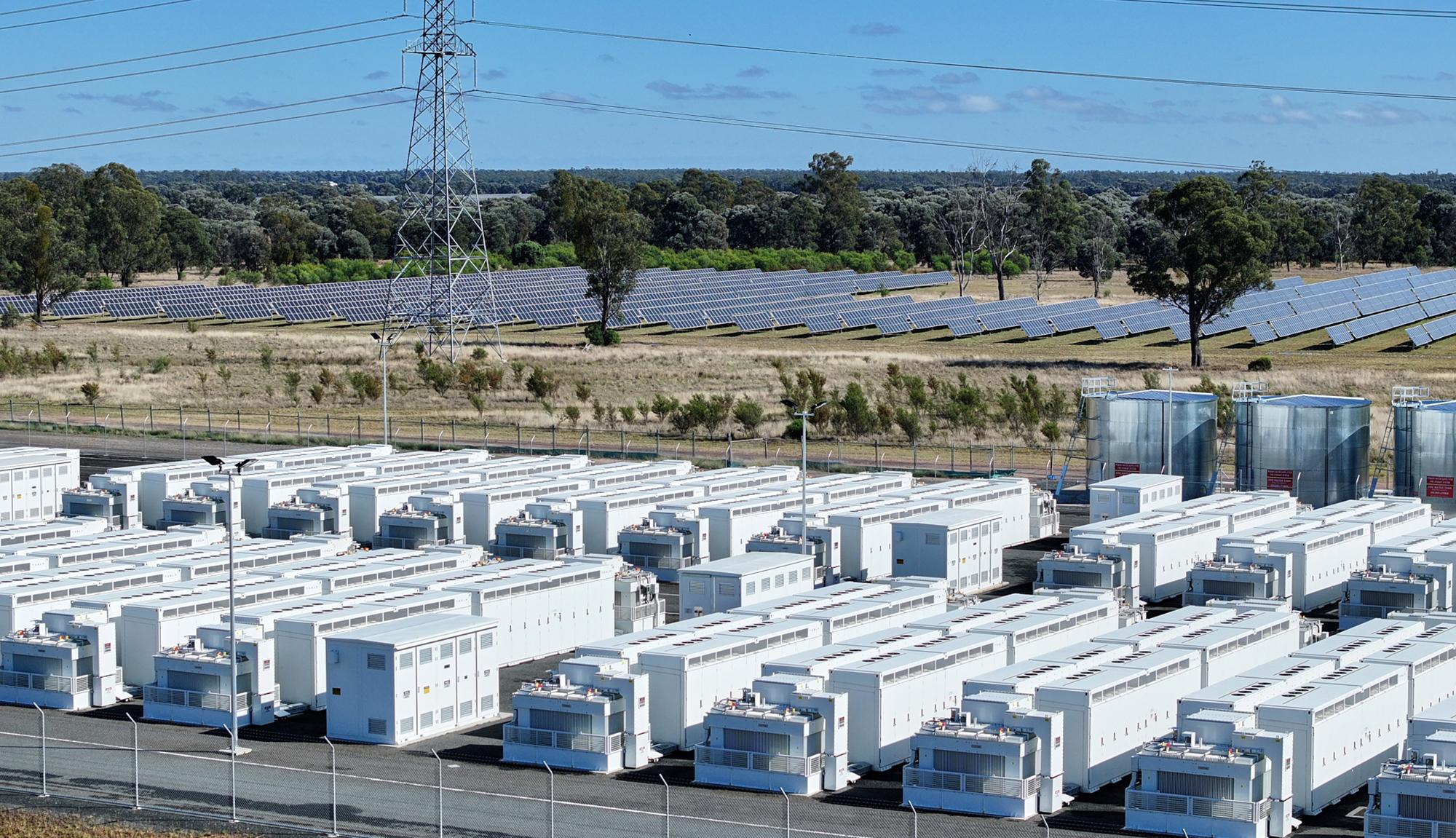
Deployment has moved from single-digit-megawatt pilots to gigawatt scale, almost entirely via battery energy storage (BESS), which is mechanically far better suited to fast GFM control than solar or wind. Australia remains the global proving ground. Its 150 MW/194 MWh Hornsdale Power Reserve, which switched from grid-following to grid-forming operation in 2024, and the Riverina Battery exposed stability problems earliest and generated the world’s first large-scale operating data. But the procurement machinery that has turned GFM into a purchased grid service is now most advanced in Europe.
United Kingdom. NESO — the National Energy System Operator, successor to National Grid ESO — runs the world’s most mature dedicated procurement mechanism for stability: the Stability Pathfinder. Phase 2 alone produced ten contracts worth £323 million: five synchronous condensers, five grid-forming batteries. NESO projects roughly £500 million in consumer savings over ten years from that round. One Phase 2 contract delivered Great Britain’s first operational grid-forming battery, in Scotland. “These sites will support network stability during disturbances and lower the cost of maintaining inertia on the system,” said Matt Magill, Director of Engineering and Customer Solutions at NESO. Also in Scotland, the 300 MW Blackhillock battery is one of the programme’s largest contracts. It shows the scale GFM procurement has already reached, in a market originally built to replace the inertia lost as coal and older gas plants retire.
Germany. This is probably the world’s most methodically engineered rollout. It’s run by the country’s four TSOs — Amprion, TenneT Germany, 50Hertz, and TransnetBW — under a 2023–24 “System Stability Roadmap” built on three pillars. The first pillar is direct TSO investment. Siemens Energy’s SVC PLUS grid-forming STATCOM at Rheinau, commissioned for Amprion on 29 January 2026, is billed by Siemens Energy as “one of the most powerful STATCOM installations worldwide.” It sits within the company’s broader “grid-forming for HVDC, STATCOM and E-STATCOM” product line. The second pillar is a dedicated market. Germany’s TSOs began procuring Momentanreserve — instantaneous reserve, effectively synthetic inertia — through long-term auctions, starting with a delivery window from 22 January 2026 to 21 January 2028. Contracts run two to ten years. The market splits into Premium and Basic products, each in positive and negative directions, with 90% and 30% availability requirements respectively. Initial pricing ran from roughly €76/MWs annually for Basic products up to nearly €889/MWs for the top Premium tier. “This is checked retroactively,” said Carmen Kompatscher, Strategy & Sales Operation Manager for Germany at Fluence. “If you fall below 90%, you lose the full year’s remuneration.” The scale involved is large. TenneT alone has published a 2030 target of 140 GW positive and roughly 260 GW negative instantaneous reserve. 50Hertz, Amprion, and TransnetBW have each published comparable, smaller targets. (The units are gigawatt-seconds of stored kinetic-equivalent energy, not steady output.) The third pillar is a mandatory grid-forming requirement, phasing in over five years. Alongside it runs SUREVIVE, a field trial from July 2024 to June 2028, led by distribution operator Westnetz and funded by Germany’s Federal Ministry for Economic Affairs and Energy. Partners include Schoenergie (construction and operation), Fraunhofer ISE and the University of Stuttgart’s Institute for Combustion Engines (research and validation), and SMA (equipment), with Stadtwerke Trier, Amprion, and TransnetBW as associated partners. SUREVIVE tests multi-megawatt battery GFM inverters at grid level 4 — the high-voltage-to-medium-voltage substation boundary — under both isolated test conditions and live parallel operation. The goal is best-practice guidance, plus business models for distribution-connected customers joining the instantaneous-reserve market from 2026. Under SUREVIVE, Schoenergie and battery maker HiTHIUM brought Germany’s first utility-scale grid-forming BESS project online in October 2025. That gave Fraunhofer ISE its first live testbed for validating GFM models against real distribution-grid behavior, rather than simulation alone.
Ireland and Northern Ireland. EirGrid and SONI, the two all-island transmission operators, published an All-Island Grid-Forming Strategy in February 2026. It covers both wind and solar power park modules and HVDC interconnectors. This matters because Ireland already runs among the highest instantaneous renewable-penetration levels anywhere in Europe. It also sits inside a wider €3.5 billion grid investment package running from 2026 to 2030 — so GFM requirements are being written into the grid code as the network is substantially rebuilt, rather than retrofitted onto an already-finished grid.
The Baltics. This is Europe’s sharpest real-world test. Lithuania, Latvia, and Estonia disconnected from the Russian-controlled BRELL grid and synchronized with Continental Europe in February 2025. They lost their inherited source of grid inertia overnight, and had to build stability infrastructure essentially from scratch. A €1.6 billion synchronization programme covered nine synchronous condensers and six large-scale battery systems across the three countries. Lithuania’s TSO, Litgrid, moved earliest. It partnered with Fluence and Siemens on a “storage as virtual transmission line” pilot near Vilnius, layering grid-forming capability, virtual inertia, black-start capability, power-oscillation damping, and voltage control onto a single asset. “VTL is one of the most exciting applications for battery energy storage,” said Manuel Perez Dubuc, CEO of Fluence. “We’re proud to work with a forward-thinking TSO like Litgrid and our partner Siemens to demonstrate the benefits of storage as a transmission asset.” Rokas Masiulis, CEO of Litgrid, put it in terms of necessity rather than experimentation: “As the Lithuanian TSO, we are in a unique position… we have to be bolder and seek innovative solutions: that’s why we are looking at battery energy storage at the transmission level.” Litgrid had separately deployed a four-site, 200 MW/200 MWh battery portfolio with Fluence ahead of the BRELL cutover. GFM-capable battery build-out has kept accelerating since, including projects supplied by CATL and Trina. The Baltics are probably the clearest European illustration of what it looks like to build a synchronous zone’s system strength almost entirely out of power electronics — with no large neighboring synchronous grid left to lean on.
Italy. Italy took a distinctive regulatory route. Rather than running a UK-style dedicated tender, TSO Terna wrote grid-forming-relevant requirements directly into its grid code: Annex A79 for battery storage, Annex A68 for photovoltaic plants. New BESS projects bidding into Italy’s capacity market and its MACSE ancillary-services auctions increasingly need grid-forming capability just to qualify for market access. Spanish manufacturer Power Electronics built a commercial strategy around exactly this. It markets its PCSM battery inverter as Annex A79-compliant, capable of voltage and reactive-power regulation, power-oscillation damping, frequency support, and black-start functionality. A “Multi PCSM” architecture lets developers connect up to four independent battery blocks. “Italy needs technologies that can support the system in capacity markets and fast-response ancillary services,” said Samuele Saccone, Business Development Manager at Power Electronics. Terna has said the country needs roughly 71 GWh of new grid-scale storage by 2030. That means the Annex A79/A68 requirements will end up shaping the technical spec of most of Italy’s coming battery fleet, almost by default.
The Nordics. Sweden, Norway, Finland, and Denmark approached this problem collectively, rather than country by country. Through an initiative called ConDoN — Converter-Dominated Nordic Grid — the four Nordic TSOs (Svenska kraftnät, Statnett, Fingrid, and Energinet) published a joint position paper on grid-forming converters in November 2025. It calls them essential infrastructure for a power system steadily converting from synchronous machines to power electronics. The approach is sequenced: grid-forming capability is already required for HVDC links, STATCOM installations, and battery storage, with equivalent requirements for wind and solar expected to follow as European network codes mature. That’s a more structured position than a simple “operate grid-forming when possible” instruction. It signals the Nordic region intends to move in step with Germany and the UK, not behind them.
Spain, Greece, Poland. All three markets have the underlying ingredients for rapid adoption. Renewable penetration is growing fast in each, and Poland in particular has one of Europe’s fastest-growing battery markets — more than 5 GW already contracted, a pipeline above 12 GW, illustrated by projects like Greenvolt’s 200 MW operational site and a further 600 MW under construction. But grid-forming-specific mandates or large confirmed deployments remain less mature here than in the markets above. Greece has active commentary on GFM’s “emerging role” in its energy transition, without a confirmed large-scale rollout yet. Spain is home to Power Electronics, which supplies grid-forming systems into Australia, the UK, and Italy — but a comparable domestic Spanish deployment programme isn’t yet clearly established. Poland’s TSO, PSE, has not published a grid-forming mandate on the scale of Germany’s or the UK’s, even though its battery boom provides exactly the fertile ground such a mandate would need.
The common thread across the continent: grid-forming adoption moves fastest where grids already feel weak-grid symptoms directly — the UK, Germany, Ireland — or where a grid has been abruptly cut off from its historical source of inertia, as in the Baltics. Elsewhere in Europe, the underlying market conditions are outpacing the grid-forming-specific policy. That’s exactly the gap the EU-level NC RfG 2.0 process is designed to close.
Who is actually building this
Siemens Energy supplies grid-forming capability across HVDC links, STATCOMs, and its E-STATCOM product line. It’s the technology behind both Amprion’s Rheinau installation and the Fluence-partnered Baltic pilot. Fluence, together with Siemens, is among the most visible integrators of grid-forming batteries — at transmission scale with Litgrid, and at distribution/utility scale in Germany’s Momentanreserve market. SMA, better known for solar inverters, plays two roles: it’s an equipment partner in the SUREVIVE distribution-grid trial, and, through technical staff like Daniel Duckwitz, an active voice in the wider industry conversation about where GFM’s practical limits sit. Power Electronics, based in Spain, built its commercial strategy around compliance with Italy’s Terna Annex A79/A68 requirements, while also supplying the UK and Australian markets. Hitachi Energy and GE Vernova both offer competing STATCOM lines — Hitachi Energy’s STATCOM portfolio and GE Vernova’s FACTSFLEX STATCOM. That puts all three vendors in direct competition for the wave of TSO-procured stability infrastructure now rolling out across Germany, the UK, and the Nordics.
The challenges holding it back
Cost and hardware stress. Grid-forming operation typically carries a capex premium of around 3–8% over standard grid-following inverters. It also demands tougher thermal and overcurrent design margins, because a GFM inverter has to actively source fault current rather than just riding through it. Semiconductors sized for grid-following duty aren’t always sized for grid-forming duty.
Fault current limits. This is the thorniest technical problem. Synchronous generators can source many multiples of rated current briefly during a fault. That’s what lets protection relays detect and clear faults quickly. Power electronics can’t safely do that — inverters are typically limited to roughly 1.1–2x rated current before self-protection kicks in. That mismatch complicates fault detection and protection coordination on grids designed around synchronous-generator behavior. It remains a major open area of control research.
Verification and modelling burden. Utilities won’t credit grid-forming capability without simulation-grade proof it behaves correctly. Germany’s Momentanreserve design illustrates the point in miniature: availability is “checked retroactively,” in Fluence’s Carmen Kompatscher’s words, with a full year’s remuneration at stake if a battery falls short. More broadly, compliance frameworks increasingly demand whole-facility models — the load, the power-conversion stack, cooling, protection, and control. These need real, vendor-specific control-loop representations, validated against hardware and compatible with standard grid-study tools. That’s a heavy lift for developers. It’s also a genuine bottleneck on how fast capacity gets certified and connected.
Standards and interoperability are still catching up. Even with ENTSO-E’s Phase II Technical Report on the table, there’s no single, fully quantified European grid code defining “grid-forming” numerically — inertia constant, overcurrent margin, droop characteristics — consistently across every member state. That’s exactly why the current approach layers a shared technical framework on top of country-specific implementation. Germany’s Momentanreserve pricing tiers, the UK’s Pathfinder contracts, and Italy’s Annex-based market-access rules are three different national mechanisms built on the same underlying concept. Firmware and control behavior also differ meaningfully between vendors. That complicates system studies where hundreds of grid-forming units from different manufacturers need to behave predictably together — a problem SUREVIVE’s live distribution-grid testing is explicitly designed to surface early.
Will everything need to be grid-forming? That’s still unsettled. Daniel Duckwitz of SMA Solar Technology argues that grid-forming capability is likely to become close to standard for high-voltage-connected battery storage. It’s far less straightforward for solar PV, which typically lacks enough stored DC-link energy for meaningful inertia. Wind turbines face their own mechanical and control complications. And low- and medium-voltage-connected systems face a different problem: grid-forming operation can conflict with existing islanding-detection safety logic. Current thinking treats grid-forming less as a wholesale replacement for grid-following control, and more as a minimum required share — enough grid-forming units, well distributed, to anchor system strength, with grid-following resources still doing useful work riding on that backbone. Getting that ratio right, region by region, is an active area of research and market design. It’s exactly the question the Nordic TSOs’ sequenced approach — HVDC and STATCOMs and batteries now, wind and solar to follow — is trying to answer empirically.
The impact on Europe’s future grid
What Europe is building is a layered system, not a single mandate. There’s an EU-level framework — NC RfG 2.0 and ENTSO-E’s Phase II report — setting a common floor above 1 MW for new connections. National TSOs are translating that floor into their own mechanisms: Germany’s priced Momentanreserve market, the UK’s competitively tendered Stability Pathfinder, Italy’s grid-code-embedded Annexes. And live field trials — SUREVIVE in German distribution grids, the Litgrid/Fluence/Siemens pilot in Lithuania — are generating the real-world validation data regulators say they need before trusting grid-forming performance at true fleet scale.
If this layered approach succeeds, the €584 billion Europe plans to spend on grid infrastructure by 2030 buys something more than a bigger grid. It buys a genuinely more stable, more renewable-capable one. Grid-forming capability is what lets the Baltics run as an island-adjacent synchronous zone at high renewable shares, without instability events forcing operators to curtail wind and solar just to keep the lights on. It’s what lets Ireland keep pushing instantaneous renewable penetration higher, without waiting for new synchronous plant to be built. And in Germany, the published 2030 instantaneous-reserve targets — well over 100 GW combined across the country’s four TSOs — show grid-forming battery capacity being treated as core infrastructure, sized on the same order as conventional generation capacity itself, not as a niche ancillary service.
Two inflection points are worth watching next. The first: whether large-scale wind and solar plants, not just batteries, start shipping with commercial-grade grid-forming control. Almost all deployment to date, in Europe as in Australia and Texas, has been battery-led. The second: whether the European Commission’s formal adoption of NC RfG 2.0 turns today’s patchwork of national mechanisms into one genuinely harmonized European requirement. Either way, the direction of travel looks settled. Qualitative “operate grid-forming when possible” instructions are giving way, market by market, to quantified technical requirements and dedicated paid stability products. And the operators building Europe’s future grid are increasingly specifying grid-forming capability upfront in procurement, rather than retrofitting it once the stability problem has already arrived.