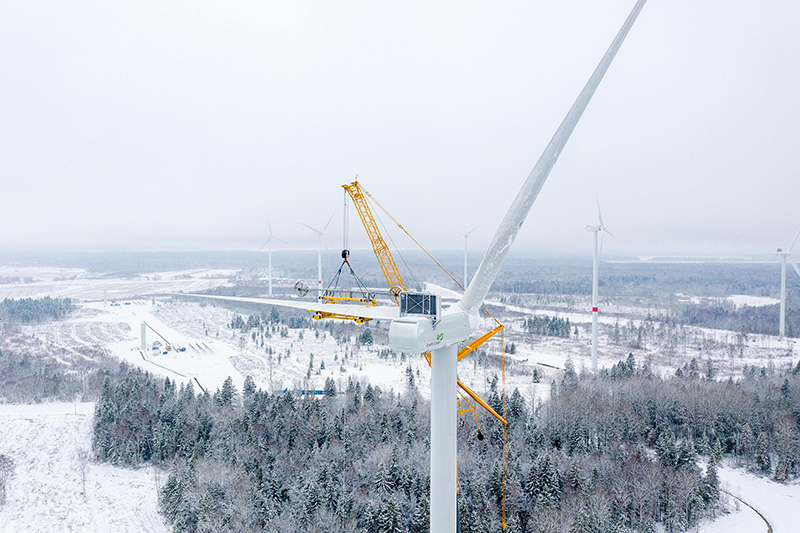
Wind power plants in Moldova will now be installed according to a methodology approved by the Ministry of Energy, which outlines where such facilities can be built, how close they may be to settlements and infrastructure, and the conditions for dismantling turbines and restoring agricultural land.
Under the new rules, wind farms will be prohibited in scientific, natural, landscape and resource reserves, as well as in national parks, dendrological and zoological gardens, natural monuments, wetlands, forests, rivers, and bird migration routes. These restrictions are based on the Law on Protected Natural Areas.
The regulation also sets out minimum distance requirements between wind turbines and various types of infrastructure. For instance, turbines must be located at least 50 metres from national roads, 100 metres from railways, and a distance equivalent to five times the turbine’s tower height from residential properties. In the case of an 80-metre turbine, this would mean a minimum of 400 metres from the nearest dwelling. Full calculation formulas are available on legis.md.
Recent amendments to the Land Code have already made it easier to install wind power plants and battery storage systems without changing the official use of agricultural land. At present, Moldova’s installed wind capacity stands at 254 MW, out of a total of 784 MW. Later this autumn, the Ministry of Energy is expected to launch a second tender under the “fixed price” support scheme, offering 170 MW of new wind capacity on the condition that at least 22 MW / 44 MWh of storage batteries are also installed.
The new order also details how decommissioning and recycling will be handled once turbines reach the end of their operational life. Operators will be required to prepare a dismantling plan that ensures the proper management of materials and waste, with reusable and recyclable components separated from those requiring special disposal. All elements will then be sent to recycling centres, temporary storage sites or other designated facilities, in line with environmental standards.
The Ministry says these measures are designed to balance Moldova’s growing renewable energy capacity with environmental protection and community safety.