
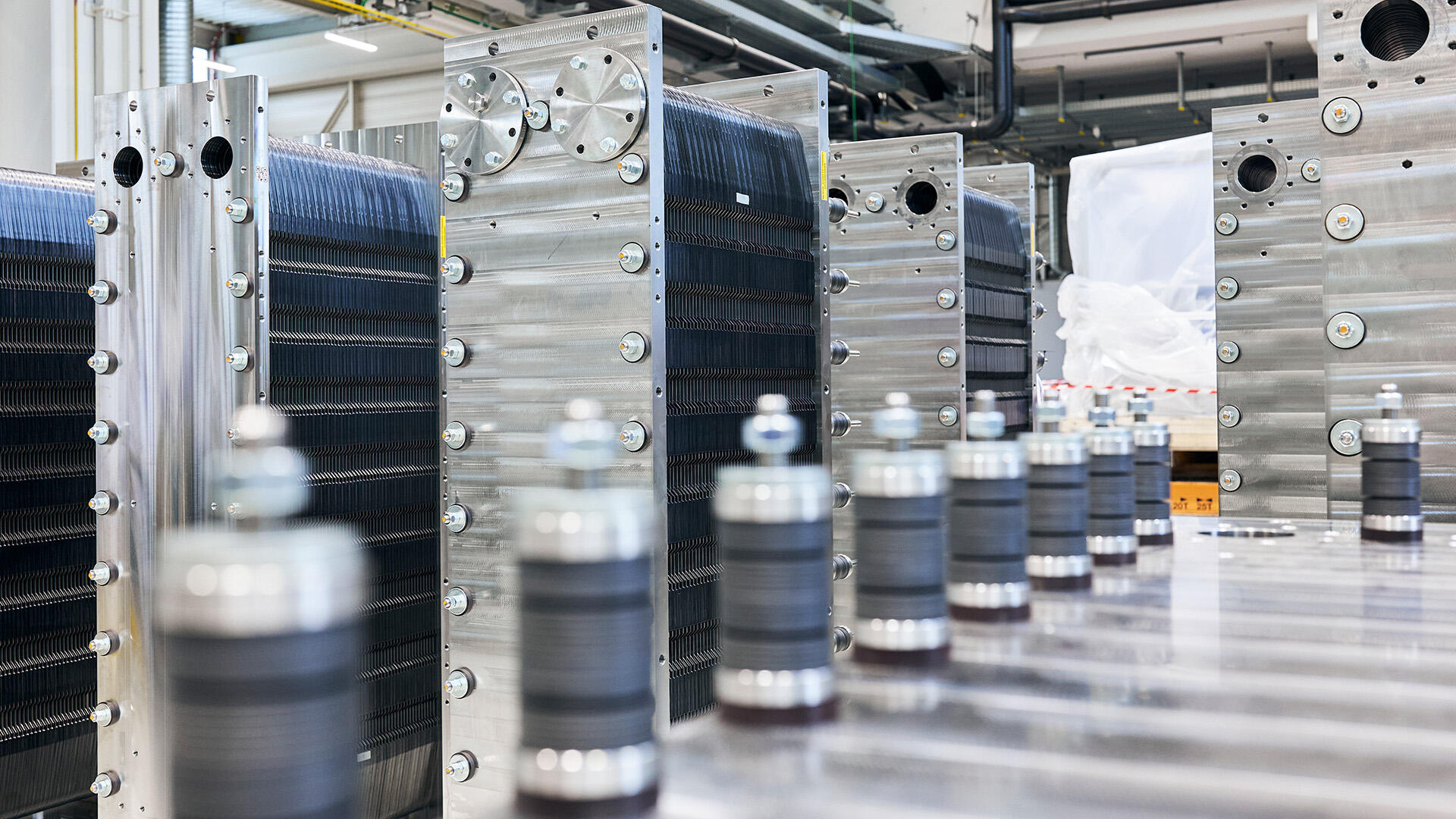


As hydrogen moves from pilot projects to industrial-scale deployment, a new generation of engineering challenges is emerging beneath the headlines. Hydrogen Pulse by The Voice of Renewables provided a technical analysis series examining the critical technical, commercial and system-level constraints that will determine whether hydrogen can scale from policy ambition to industrial reality.
This edition explores one of the sector’s most consequential unanswered questions: how electrolysers perform under the highly variable operating conditions of modern renewable electricity systems.
Electrolyser Durability Is Emerging as the Defining Challenge for Green Hydrogen
The hydrogen industry has spent much of the past decade focused on a single metric: efficiency.
Manufacturers compete on kilowatt-hours per kilogram of hydrogen. Policymakers model levelised production costs. Investors compare technology pathways based on projected energy consumption. Entire business cases have been built around the assumption that declining renewable electricity costs and improving electrolyser efficiency will steadily reduce the cost of green hydrogen.
Yet as the industry moves from demonstration projects towards gigawatt-scale deployment, a different question is beginning to dominate both engineering and financing discussions.
Not how efficiently electrolysers produce hydrogen.
How long they can continue doing so under the operating conditions they will actually encounter.
The industry is discovering that the next phase of competition may not be an efficiency race at all. It may be a durability race.
For a sector increasingly seeking infrastructure-scale financing, the ability to predict stack performance over fifteen, twenty or even twenty-five years may ultimately prove more valuable than marginal improvements in conversion efficiency.
The Industry’s Missing Dataset
A striking reality sits at the centre of the hydrogen sector today.
Nobody has operated large fleets of gigawatt-scale electrolysers under highly dynamic renewable operating conditions for fifteen years.
Not electrolyser manufacturers.
Not utilities.
Not developers.
Not industrial gas companies.
The entire industry is attempting to finance assets based on operating lifetimes that have not yet been demonstrated at scale under the conditions for which they are increasingly being designed.
Manufacturers commonly cite stack lifetimes ranging from 60,000 to 90,000 operating hours depending on technology type and operating assumptions. These figures are embedded within project finance models, levelised cost calculations and investor presentations.
However, many of these assumptions originate from controlled operating environments that differ significantly from the conditions anticipated in future hydrogen systems.
The industry’s challenge is therefore no longer simply one of technology deployment. It is increasingly one of uncertainty management.
From Industrial Equipment to Power System Asset
Historically, electrolysers were industrial process equipment.
Whether deployed in refineries, chlor-alkali facilities or chemical manufacturing plants, they typically operated under relatively stable load profiles. Reliability, efficiency and maintenance scheduling were the primary engineering concerns.
Green hydrogen changes that equation fundamentally.
Modern electrolysers are increasingly expected to behave less like industrial process units and more like active power system assets.
They are being positioned as controllable loads capable of:
- absorbing surplus renewable generation
- responding to electricity price signals
- participating in balancing markets
- mitigating renewable curtailment
- supporting power system flexibility
This creates an entirely different operating paradigm.
A hydrogen plant connected to offshore wind or utility-scale solar generation may experience hundreds or thousands of load transitions each year. Output may fluctuate significantly throughout the day, while seasonal variability introduces prolonged periods of reduced utilisation.
The consequence is that electrolysers are increasingly being asked to perform functions for which long-term operational evidence remains surprisingly limited.
The Real Question: Are Electrolysers Being Optimised for Electricity Markets or Asset Life?
One of the most important debates emerging within the hydrogen sector concerns operating philosophy.
At first glance, the issue appears straightforward. Electrolysers consume large quantities of electricity, and therefore it seems logical to operate them when electricity is cheapest. Yet the rapid expansion of renewable generation and increasingly volatile power markets are exposing a deeper structural tension between electricity market optimisation and long-term asset performance.
Grid operators value flexibility. Electricity traders value flexibility. Renewable developers value flexibility. Electrolyser manufacturers, however, often place greater emphasis on stable operating conditions that preserve stack integrity and predictable degradation pathways.
This divergence is becoming more pronounced as projects move from pilot scale to industrial deployment.
At the centre of the debate lies a more fundamental question: what is an electrolyser actually designed to be?
Historically, electrolysers functioned as industrial process equipment. Whether deployed in refineries, chlor-alkali plants or chemical production facilities, they were generally expected to operate continuously under relatively stable conditions, with optimisation focused on efficiency and reliability rather than dynamic response.
The emerging hydrogen economy is redefining that role.
Across Europe, North America, Australia and the Middle East, electrolysers are increasingly being designed as flexible electricity system assets. They are expected to absorb surplus renewable generation, respond to wholesale electricity price signals, participate in balancing markets, mitigate curtailment and provide system flexibility in grids dominated by intermittent wind and solar power.
This represents a fundamental shift in function. Electrolysers are no longer being conceived solely as production units. They are becoming active participants in electricity market dynamics.
The consequences of this transition are still not fully understood.
Large-scale developments such as Shell’s Holland Hydrogen I in the Netherlands, REFHYNE II in Germany, Air Liquide’s Normand’Hy project in France, NEOM in Saudi Arabia and multiple emerging European hydrogen valleys are all being developed with increasing expectations that electrolysers will operate dynamically in response to power system conditions.
The underlying assumption is that flexibility creates economic value. In many cases, that assumption holds. Periods of negative electricity pricing, renewable oversupply and transmission congestion can provide attractive opportunities to reduce hydrogen production costs. As renewable penetration increases, the value of flexibility is expected to rise further.
However, flexibility is not without cost.
Each start-up, shutdown, ramp event and load transition introduces additional mechanical, thermal and electrochemical stress on system components. While the magnitude of these effects varies across technologies and operating conditions, the directional relationship is consistent: more aggressive response to electricity market signals increases exposure to cycling-related degradation.
This introduces a more complex optimisation problem than has historically been considered in hydrogen project design.
A project optimised purely for low electricity prices may not be optimised for lowest lifetime hydrogen cost.
An electrolyser that captures every negative pricing event and responds to every short-term market signal may achieve attractive early operating economics while simultaneously accelerating stack ageing and increasing long-term replacement costs.
As a result, degradation is emerging as a fourth economic variable in hydrogen project design. Unlike electricity prices, which are visible and continuously optimised, degradation costs accumulate gradually within the asset and often only become visible years later through reduced performance, shortened stack lifetimes or increased maintenance expenditure.
This is shifting the industry towards a more nuanced understanding of optimisation.
For most of the past decade, hydrogen project design focused on three primary variables: electricity price, electrolyser efficiency and utilisation rate. Today, a fourth variable is entering the equation: degradation cost. Its inclusion fundamentally changes how operating strategies are evaluated.
Within this emerging framework, three broad operating philosophies are taking shape across the industry.
The first is baseload operation. Under this model, electrolysers operate at relatively high and stable utilisation levels, with minimal cycling. The objective is to maximise asset life, minimise degradation and produce predictable hydrogen output profiles. This approach is often favoured by industrial users with continuous hydrogen demand and by equipment manufacturers who seek operating conditions that align closely with controlled lifetime testing assumptions.
The second is merchant-style operation. Here, electrolysers respond dynamically to wholesale electricity prices, renewable generation patterns and balancing market signals. The objective is to minimise electricity procurement costs and capture additional value from market volatility. As power systems become more variable, this approach becomes increasingly attractive, although it carries greater uncertainty regarding long-term degradation and stack replacement requirements.
The third is a hybrid operating model, which is increasingly being explored as a practical compromise. In this configuration, electrolysers maintain a stable minimum load while retaining sufficient flexibility to respond to periods of exceptionally low electricity prices or high system value. This approach attempts to balance electricity market optimisation with asset preservation, and is gaining traction as a potential default strategy for large-scale projects.
Despite growing interest in these operating paradigms, there remains limited long-term empirical evidence demonstrating which strategy delivers the lowest lifetime hydrogen cost under real renewable operating conditions.
This is largely because the industry’s largest renewable-powered electrolyser projects are only now entering commercial operation. As a result, the operational datasets required to resolve these questions at scale do not yet exist.
The implications of this uncertainty extend beyond engineering design.
For lenders, infrastructure investors and project sponsors, operating philosophy directly affects asset valuation. A project optimised for highly dynamic operation may achieve lower short-term electricity costs but face greater uncertainty regarding stack degradation trajectories, replacement timing and long-term performance guarantees. Conversely, a more conservative operating strategy may sacrifice short-term market opportunities in exchange for greater predictability and reduced technical risk.
Both approaches carry trade-offs. Neither has yet emerged as a definitive industry standard.
This uncertainty is becoming one of the defining features of the sector’s next phase of development.
The hydrogen industry has spent years asking how electrolysers can be integrated into renewable electricity systems.
It is now confronting a more fundamental question.
Should electrolysers be optimised primarily for participation in electricity markets?
Or should they be optimised for their own long-term physical and economic integrity?
The answer will shape not only how electrolysers are operated, but how hydrogen projects are financed, valued and deployed over the coming decades.
Understanding Electrolyser Degradation Mechanisms
Degradation is often discussed in broad terms, but the underlying mechanisms differ significantly between technologies.
PEM Electrolysers: The Cost of Flexibility
Proton Exchange Membrane (PEM) technology has become the preferred option for many renewable-integrated projects because of its rapid response capabilities.
PEM systems can ramp quickly, operate across wide load ranges and respond effectively to variable renewable generation.
However, flexibility introduces its own engineering challenges.
Potential degradation mechanisms include:
- iridium catalyst dissolution
- platinum migration
- membrane thinning
- gas crossover increases
- pinhole formation
- electrode structural changes
Research increasingly suggests that degradation rates are influenced not only by operating hours but also by operating profile.
A stack operating continuously at stable load may age very differently from one accumulating the same operating hours through thousands of load transitions.
Alkaline Electrolysers: Proven Technology, New Operating Conditions
Alkaline electrolysis remains the most established hydrogen production technology and benefits from decades of industrial operating experience.
Yet most of that experience was accumulated under relatively stable operating conditions.
Potential degradation mechanisms include:
- electrode ageing
- diaphragm deterioration
- gas purity fluctuations
- electrolyte contamination
- pressure management challenges
- efficiency losses at partial load
The key issue is not whether alkaline systems can cycle.
The question is how frequently they can cycle before long-term economics begin to deteriorate.
Solid Oxide Electrolysers: Efficiency Versus Survivability
Solid Oxide Electrolyser Cell (SOEC) technology offers perhaps the most compelling efficiency pathway available today.
By operating at elevated temperatures, SOEC systems can achieve lower electricity consumption than low-temperature alternatives, particularly when integrated with industrial heat sources.
However, the very conditions that enable higher efficiency create durability concerns.
Potential degradation mechanisms include:
- thermal stress cracking
- seal degradation
- electrode delamination
- material fatigue under thermal cycling
- ceramic component failure
For highly dynamic renewable applications, the trade-off between efficiency and durability remains one of the sector’s most important unanswered questions.
The Utilisation Paradox at the Heart of Green Hydrogen
Hydrogen economics have traditionally rewarded high utilisation.
Capital-intensive electrolysers generate the lowest hydrogen production costs when operating close to full capacity for extended periods.
Yet electricity markets increasingly reward flexibility.
Negative pricing events, renewable oversupply and congestion management opportunities create incentives for intermittent operation.
Developers therefore face two competing objectives: to maximise utilisation to improve asset economics and to maximise flexibility to reduce electricity costs.
The industry has not yet established where the optimal balance lies.
Indeed, one of the biggest unanswered questions in hydrogen project design may be whether the lowest-cost hydrogen is produced by maximising operating hours or by optimising operating behaviour.
Why Degradation May Become More Important Than Electricity Cost
For much of the past decade, electricity cost has dominated hyFor much of the past decade, electricity cost has dominated discussions around hydrogen economics.
The logic appeared straightforward. Electricity typically accounts for between 60 and 80 per cent of green hydrogen production costs, making access to low-cost renewable power the primary determinant of competitiveness. Consequently, developers, policymakers and investors focused overwhelmingly on securing cheap electricity, improving electrolyser efficiency and increasing utilisation rates.
That logic remains broadly valid.
However, as the industry moves from pilot projects to multi-hundred-megawatt and gigawatt-scale developments, a second economic variable is beginning to attract increasing attention: degradation.
The reason is simple.
Electricity is a visible cost.
Degradation is a deferred cost.
And deferred costs are often more difficult to quantify.
A project may achieve an attractive hydrogen production cost during its first years of operation while simultaneously accumulating long-term economic liabilities through accelerated stack ageing. These costs may not become apparent until years later, when performance begins to decline, replacement schedules shorten or maintenance requirements exceed original assumptions.
For investors evaluating twenty-year infrastructure assets, this distinction is becoming increasingly important.
Consider a hypothetical 500 MW electrolyser facility operating under highly dynamic renewable conditions. If stack replacement is required several years earlier than anticipated, the consequences extend far beyond maintenance expenditure. Earlier replacement affects cashflow projections, debt service coverage ratios, reserve account requirements and ultimately the levelised cost of hydrogen.
What initially appears to be a technical issue can rapidly become a financing issue.
This challenge is increasingly relevant because many of the world’s largest hydrogen projects are entering territory for which there is limited historical precedent.
Developments such as Holland Hydrogen I in the Netherlands, NEOM in Saudi Arabia, the Green Energy Oman initiative, Air Liquide’s Normand’Hy project in France and multiple large-scale European hydrogen valley projects are being designed around operating assumptions that have not yet been fully validated through decades of commercial experience.
Their economics depend not only on electricity prices but also on assumptions regarding stack durability, replacement intervals and long-term performance degradation.
The uncertainty becomes particularly acute when considering electricity market optimisation strategies.
Many developers are seeking to take advantage of increasingly volatile power markets characterised by negative pricing periods, renewable curtailment and fluctuating wholesale electricity prices.
In theory, operating electrolysers only during periods of low-cost electricity should reduce hydrogen production costs.
In practice, however, more aggressive cycling may accelerate degradation.
This creates a new optimisation problem for project operators.
The lowest electricity cost may not correspond to the lowest lifetime hydrogen cost.
An electrolyser operating continuously at moderate electricity prices may ultimately prove more economical than one aggressively chasing market opportunities if the latter experiences significantly higher degradation rates.
This question is becoming one of the industry’s most important unresolved economic debates.
Indeed, several developers and financiers now describe hydrogen economics as a balancing exercise between two competing objectives:
- minimising electricity expenditure
- preserving stack value
Historically, the industry focused almost exclusively on the first objective.
Increasingly, attention is shifting towards the second.
The implications for project finance are substantial.
Banks and infrastructure investors are beginning to scrutinise degradation assumptions with the same intensity previously reserved for electricity price forecasts. Warranty structures, replacement schedules, operating envelopes and long-term performance guarantees are becoming central components of technical due diligence.
This shift reflects a broader evolution in how hydrogen assets are perceived.
In the early years of the sector, electrolysers were often viewed primarily as technology deployments.
Today they are increasingly being evaluated as infrastructure assets expected to generate predictable returns over decades.
Infrastructure investors do not finance efficiency claims.
They finance cashflows.
And cashflows ultimately depend on asset longevity.
This is one reason why the industry’s leading manufacturers are increasingly investing not only in efficiency improvements but also in durability testing, lifetime modelling, performance guarantees and digital monitoring capabilities. The ability to demonstrate predictable degradation trajectories may soon become as commercially valuable as incremental improvements in conversion efficiency.
The emerging reality is that hydrogen projects are no longer optimised solely around the cost of electricity.
They are increasingly optimised around the interaction between electricity cost, operating strategy and asset degradation.
That represents a fundamental shift in industry thinking.
For much of the past decade, hydrogen developers asked a single question: how cheaply can we buy electricity? The next decade may be defined by a more sophisticated one: how can the total lifetime cost of hydrogen production be minimised without destroying the asset that produces it?
That question sits at the centre of the industry’s next phase of development.
And the answer may determine which projects remain competitive long after the first generation of subsidies has disappeared.
Digital Twins, AI and the Future of Electrolyser Performance
Many industry participants increasingly believe that the next major gains in hydrogen economics will come not from stack chemistry alone, but from understanding how electrolysers age in real operating environments.
This is driving growing investment in digital twins, predictive maintenance platforms, advanced diagnostics and machine-learning-based optimisation tools across the electrolyser industry.
The underlying challenge is straightforward. Most degradation mechanisms occur gradually and are influenced by dozens of interacting variables, including load cycling frequency, operating temperature, pressure fluctuations, start-stop sequences, water quality, current density distribution across individual cells and exposure to highly variable renewable power profiles.
Historically, operators had limited visibility into how these factors interacted over thousands of operating hours. Today’s projects are increasingly deploying high-frequency sensor networks and stack-level monitoring systems capable of generating vast operational datasets.
The goal is no longer simply to maximise hydrogen production.
It is to maximise lifetime asset value.
A growing number of manufacturers are developing digital twin models capable of simulating stack behaviour under different operating regimes. Rather than relying solely on scheduled maintenance intervals, operators can increasingly use real-time performance data to identify early signs of degradation, predict component failure and optimise maintenance schedules before performance losses become economically significant.
This approach is already well established in industries such as aviation, offshore wind and gas turbines, where digital monitoring has become a core component of asset management. The hydrogen sector is now attempting to apply similar methodologies to electrolysis systems.
The commercial implications could be substantial.
Consider two electrolyser plants producing identical volumes of hydrogen. If one operator can extend stack life by two or three years through optimised dispatch strategies, predictive maintenance and degradation-aware control systems, the resulting reduction in replacement costs could outweigh modest differences in conversion efficiency.
This is beginning to shift the industry’s focus from simple performance metrics towards lifecycle optimisation.
An equally important development concerns electricity market participation. Future electrolysers are expected to operate in increasingly volatile power markets characterised by negative pricing events, renewable curtailment and balancing market opportunities. Digital control systems may ultimately determine when it is economically rational to ramp, idle or operate at partial load based not only on electricity prices but also on the estimated degradation cost associated with each operating decision.
In other words, the optimisation problem is becoming multidimensional.
The cheapest electricity may not produce the cheapest hydrogen if obtaining that electricity accelerates stack ageing.
A growing recognition of this challenge can already be seen across several of the world’s largest hydrogen projects. Developments such as REFHYNE II in Germany, GET H2 Nukleus, Shell’s Holland Hydrogen I in the Netherlands, Air Liquide’s Normand’Hy project in France and the NEOM Green Hydrogen Project in Saudi Arabia are all expected to generate unprecedented volumes of operational data as they move from demonstration-scale installations towards industrial deployment.
While project sponsors rarely disclose detailed degradation performance publicly, these facilities are widely viewed within the industry as critical learning platforms that will help establish future benchmarks for stack performance, maintenance requirements and operating strategies under commercial conditions.
The issue becomes increasingly significant as projects expand from tens of megawatts to hundreds of megawatts and ultimately gigawatt scale. At these sizes, relatively small deviations in degradation assumptions can have major implications for stack replacement schedules, maintenance expenditure, debt sizing and overall project economics.
Several electrolyser manufacturers have already begun repositioning themselves accordingly. Companies including ITM Power, Nel, Siemens Energy, Thyssenkrupp Nucera and Sunfire have increasingly highlighted fleet monitoring, operational analytics, digital services and performance optimisation as growing components of their long-term value proposition. The implication is clear: future competitive advantage may depend as much on understanding how electrolysers operate over decades as on how efficiently they perform on day one.
The broader hydrogen market has also provided indirect evidence of the importance of operational optimisation. During the market reset of 2024–2026, numerous hydrogen projects across Europe and North America were delayed, resized or restructured as developers revisited assumptions around utilisation rates, electricity market exposure and long-term operating costs. While these decisions were primarily driven by power prices, financing conditions and demand uncertainty, they also exposed a deeper issue: the industry still lacks extensive real-world evidence demonstrating how large fleets of renewable-powered electrolysers perform over long periods under highly dynamic operating conditions.
This uncertainty is becoming increasingly relevant for project financiers. Banks, infrastructure funds and export credit agencies are paying far greater attention to stack degradation assumptions, replacement schedules, warranty structures and performance guarantees than they did only a few years ago. As hydrogen projects transition from venture-backed initiatives to infrastructure-scale investments, operational predictability is becoming a financing requirement rather than merely an engineering objective.
Yet perhaps the most important observation is what remains unknown.
The absence of major project failures directly attributed to electrolyser degradation should not be interpreted as evidence that the challenge has been solved. Rather, it reflects the fact that many of the world’s largest renewable-powered electrolyser fleets are only now entering commercial operation.
The industry’s most valuable durability dataset does not yet exist.
It is being created in real time by the first generation of industrial-scale hydrogen projects.
For that reason, the future market leader may not be the company that builds the most efficient electrolyser stack.
It may be the company that develops the most sophisticated understanding of how that stack behaves, degrades and can be optimised over twenty years of operation.
For a sector increasingly seeking infrastructure-style financing, degradation management may ultimately become one of the most valuable intellectual properties in the hydrogen economy. The next major breakthrough in green hydrogen may therefore come not from electrochemistry, but from the ability to predict the future condition of an electrolyser before degradation becomes visible.
Why Electrolyser Lifetime Has Become a Bankability Issue
The durability challenge now extends far beyond engineering.
It is increasingly influencing project finance.
Electrolyser stacks are becoming the equivalent of turbines in a wind farm or combustion systems in a power station: critical assets whose replacement profile directly affects project economics.
Consequently, lenders and infrastructure investors are asking increasingly detailed questions regarding:
- degradation modelling
- warranty structures
- replacement schedules
- operating envelopes
- performance guarantees
- stack replacement contingencies
Many investors now view degradation uncertainty as one of the largest residual technology risks remaining in the green hydrogen sector.
The issue is not whether electrolysers work.
The issue is whether the assumptions underpinning twenty-year financial models remain valid after twenty years of operation in a highly dynamic renewable electricity system.
The Shift from an Efficiency Race to a Durability Race
For most of the past decade, the hydrogen industry has treated efficiency as the primary measure of technological progress.
That focus was understandable during the industry’s formative years.
Yet the next phase of market development may reveal a different hierarchy of value.
In a world characterised by volatile electricity markets, intermittent renewable generation and infrastructure-scale financing, the most important metric may no longer be kilowatt-hours per kilogram of hydrogen.
It may be the number of operating hours an electrolyser can deliver before its economics begin to deteriorate.
The future leaders of the hydrogen industry may therefore be remembered not as the companies that built the most efficient machines, but as those that built the most durable ones.
Conclusion: Hydrogen Will Be Financed on Durability
The hydrogen sector has largely answered the question of whether electrolysers can produce green hydrogen at scale.
The more difficult question now emerging is whether they can maintain performance, efficiency and economic viability under the operating conditions that the energy transition increasingly demands.
Electrolysers are no longer simply hydrogen production equipment. They are becoming active participants in electricity systems shaped by intermittency, volatility and flexibility requirements.
That transformation changes the engineering challenge fundamentally.
The future of electrolysis may therefore be determined less by how efficiently stacks operate on day one and more by how predictably they perform on day four thousand.
Because ultimately, the hydrogen economy will not be financed on efficiency claims.
It will be financed on durability.
Author: Derek Michalski, Editor
EVENT ALERT: