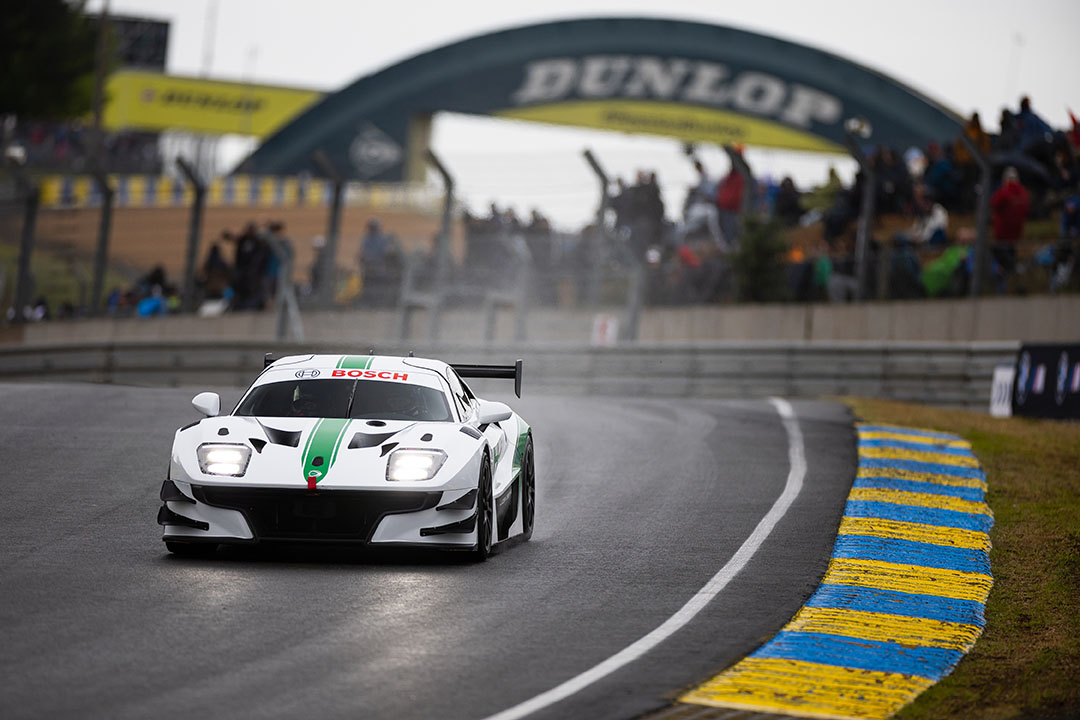


Bosch Engineering and Maserati are set to demonstrate the potential of hydrogen combustion technology at this year’s 24 Hours of Le Mans, unveiling a hydrogen-powered racing engine capable of delivering what the companies describe as hypercar-level performance.
The powertrain has been integrated into the Ligier JS2 RH2 prototype, combining Bosch Engineering’s hydrogen combustion expertise with Maserati’s Nettuno engine architecture. The vehicle will be exhibited in the H2 Village throughout race week before completing a demonstration lap of the Circuit de la Sarthe on race morning.
The latest iteration of the project is based on Maserati’s Nettuno V6, a 3.0-litre twin-turbocharged petrol engine featuring dry sump lubrication. Bosch engineers retained several key components from the original design, including the cylinder head and turbocharger, while redesigning elements such as the pistons, fuel injection system, ignition system and engine control unit to enable operation on hydrogen.
The result is a hydrogen combustion engine producing approximately 480kW and 880Nm of torque in motorsport specification, performance figures that Bosch believes demonstrate hydrogen’s viability as a high-performance, low-emissions fuel for future motorsport applications.
According to Bosch, the hydrogen-powered version replaces the original combined direct and port fuel injection arrangement with a dedicated hydrogen direct injection system using the company’s HIDI LCV injectors.
Ingo Mauel, Head of Bosch Motorsport, said the project highlights the importance of collaboration in accelerating the development of sustainable performance technologies.
“To make a vision like the hydrogen race car a reality, you need a strong team,” Mauel said. “Our strategic partnership with Ligier Automotive is the foundation on which we are developing and testing the vehicle. At the same time, our collaboration with Maserati provided a first-class basis for the engine. This pooling of expertise is our key to bringing sustainable performance to the road faster.”
Maserati said the Nettuno engine’s advanced design made it particularly suitable for adaptation to hydrogen fuel.
“Nettuno is a state-of-the-art engine that continues to demonstrate robustness, efficiency, and versatility,” said Davide Danesin, Head of Maserati Engineering. “For this reason, it has proven to be particularly well-suited for conversion to hydrogen, thanks to its inherent strength, which allows it to withstand very high cylinder pressures.”
The demonstration represents the latest milestone in a partnership between Bosch Engineering and Ligier Automotive that began in 2021 with the goal of developing a hydrogen-powered race car. The resulting Ligier JS2 RH2 prototype was first unveiled at Le Mans in 2023 ahead of the centenary edition of the race.
Since then, Bosch says the vehicle and powertrain have accumulated almost 8,000 kilometres of track testing across a range of operating conditions without experiencing technical issues. Ongoing development has reportedly increased both power and torque output while further reducing emissions.
Jacques Nicolet, President of Ligier Automotive, said the programme demonstrates the opportunities created when expertise from different areas of the automotive industry is combined.
“The Ligier JS2 RH2 project perfectly illustrates what can be achieved when three complementary areas of expertise come together,” Nicolet said. “Our collaboration with Bosch Engineering and Maserati allows us to explore the full potential of hydrogen in motorsport, combining performance with sustainability.”
Nicolet also highlighted the historical connection between the two marques, noting that the original Ligier JS2, powered by a Maserati V6 engine, won the Tour Auto in 1974.
“Today, this legacy inspires us to look ahead,” he said. “Together, we are not only developing a race car demonstrator, but also opening the door to future applications, such as a decarbonised track-day car integrating Maserati engine technology and Bosch hydrogen systems.”
The Ligier JS2 RH2 will form part of a wider hydrogen showcase at this year’s H2 Village, which will feature a range of hydrogen-powered vehicles, refuelling demonstrations and technical exhibits designed to highlight the growing role of hydrogen in motorsport and mobility.
Among the organisations participating are MissionH24, Alpine, Toyota Racing, ArianeGroup, Blue Spirit Aero, EODev, Hylico, TotalEnergies, the University of Le Mans and several educational and technology-focused initiatives promoting hydrogen innovation.
As hydrogen continues to gain momentum as a potential solution for decarbonising motorsport and heavy transport, the Le Mans demonstration will provide a high-profile platform for manufacturers and technology developers to showcase the progress being made towards commercial deployment.