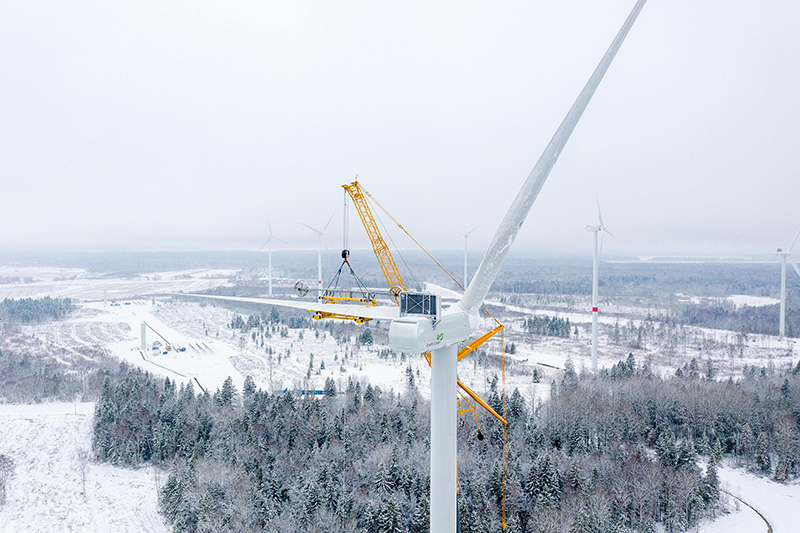
Berliner Stadtwerke, Berlin’s municipal utility, announced on 2 September 2026 that it has acquired the Diehlo-West wind project from developer JUWI. The project, located in Diehlo, a district of Eisenhüttenstadt in Brandenburg’s Oder-Spree county about 90 km southeast of Berlin, comprises two Vestas V150 turbines with a combined capacity of 12 MW. The site is already permitted and construction has begun; grid connection is expected in the third quarter of 2027. Berliner Stadtwerke says the project will supply green electricity to more than 21,500 households once operational. No purchase price was disclosed, and neither company issued a quote alongside the announcement in the coverage reviewed for this article.
JUWI, a renewable energy developer based in Wörrstadt, Rhineland-Palatinate, developed the project through to permitting before selling it — a common model in the German wind sector, where developers often monetize a project once it clears planning risk rather than building and operating it themselves.
The acquisition adds to a wind portfolio Berliner Stadtwerke has built mostly, though not exclusively, by developing projects itself since the company’s founding in 2014. Its Windenergieanlage Großbeeren (3.45 MW, one turbine) went into operation in 2018 for about €4.7 million, and a further three-turbine expansion at Großbeeren (17.1 MW) was completed by early 2022 for roughly €17 million. The company’s Windpark Albertshof, near Bernau, comprises nine Vestas turbines totaling 31.05 MW and began operating in 2021, an investment of €38.7 million that more than doubled the company’s wind capacity at the time, from 20.4 MW to 51.5 MW. Following the 2022 Großbeeren expansion, the company reported operating 16 wind turbines plus a stake in one additional wind park, for combined capacity above 68 MW supplying roughly 56,000 households — figures that predate the Diehlo-West deal and do not yet reflect it. The company has said it invested more than €172 million in renewable energy generation between 2014 and 2018 alone.
Acquiring a pre-developed project rather than building one in-house is not new for Berliner Stadtwerke — an earlier two-turbine wind project near Sputendorf, southwest of Berlin, was likewise bought rather than developed by the company around 2016 — but most of its subsequent wind capacity growth has come from in-house development. The Diehlo-West deal suggests the company continues to use both routes to expand generation: developing sites itself when it takes on planning risk directly, and buying permitted, construction-ready projects like Diehlo-West when a developer such as JUWI has already cleared that stage.
Berliner Stadtwerke operates under a constraint dating to its 2014 founding, when the city government limited the utility to supplying only as many customers as its own generation capacity allows — a structure meant to protect established private energy suppliers, but one that makes each new generation project, whether built or bought, a direct constraint on how many Berlin households and businesses the municipal utility can serve with its own green power.