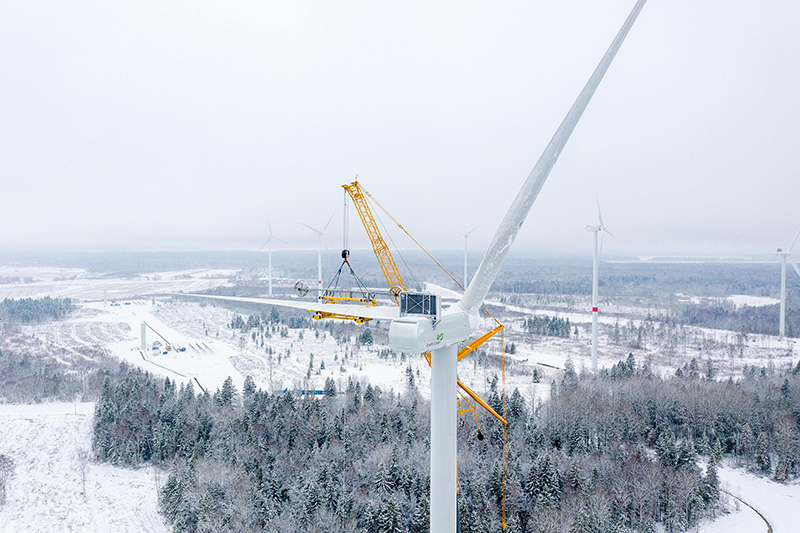
Eurowind Energy has completed its acquisition of EnBW’s Swedish renewable energy business, folding roughly 120 MW of operating onshore wind, a sizeable pipeline of projects still in development, and an established operations-and-maintenance unit into the Danish developer’s portfolio. The deal was announced on 13 July 2026 and, according to the companies, closed after clearing Sweden’s foreign direct investment screening regime — a routine-sounding line that turns out to be the most interesting part of the story.
On paper, this should not have been a foreign-investment case at all. The seller, EnBW Sverige AB, is the Swedish arm of EnBW Energie Baden-Württemberg, the German utility. The buyer is Eurowind Energy A/S, headquartered in Denmark. Both are EU companies, and Sweden’s FDI Act — the Act (2023:560) on the Screening of Foreign Direct Investments, administered by the Swedish Inspectorate of Strategic Products (ISP) — is explicit that the notification obligation applies to foreign investors, defined as non-EU nationals, non-EU-registered entities, or any entity “directly or indirectly owned or controlled” by one of those. An intra-EU wind-farm sale is, by the letter of the law, exactly the kind of transaction the regime was not built to catch.
Except that Eurowind Energy is no longer quite the company that description implies.
What actually changed hands
Start with the deal itself, which is straightforward. EnBW’s Swedish platform comprised seven operating wind farms totalling around 120 MW, a development pipeline the companies have not sized publicly, and a small in-house O&M operation that had been keeping those turbines running. Neither side has disclosed a price; both have said only that terms are confidential.
The sale fits a pattern. EnBW has been retreating from Nordic renewables through 2026, having sold Danish service activities to Eurowind earlier in the year, ahead of the Swedish transaction. In its own public statements, the utility has framed the divestments not as a retreat from renewables but as a reallocation: EnBW says it will “withdraw from the development and operation of wind and solar projects in the Nordic markets to focus its resources more strongly on its core markets and the transformation of the energy infrastructure in Germany,” redirecting the proceeds toward what it calls the largest investment programme in its history — grid, gas and hydrogen infrastructure at home, plus continued renewable build-out inside Germany’s borders. It’s a bet that a 100-year-old, majority state-owned German utility is better off deepening its position in one market than running a scattered portfolio of Nordic wind assets it will always manage at arm’s length.
For Eurowind, the logic runs the other way: this is exactly the kind of asset a Nordic-focused consolidator wants. The Swedish O&M team is expected to keep running the newly acquired turbines while working alongside Connected Wind Services Danmark, the O&M specialist — Denmark’s largest independent wind-service provider, with more than 1,000 turbines under contract — that Eurowind bought outright in March 2026. Layering EnBW’s Swedish generation and service staff onto that base extends Eurowind’s reach into a second Nordic market at once, rather than building a Swedish service capability from scratch.
The stake that changes the legal picture
Here is where the deal stops being a routine consolidation story. In late April 2026, Blackstone Infrastructure — the New York-headquartered arm of the US private equity giant — agreed to invest up to €2 billion in Eurowind Energy for a 24.7% stake, in a deal announced as a straightforward growth-capital investment. Danish media and energy group Norlys and Eurowind CEO Jens Rasmussen were reported to remain the company’s majority owners after the transaction closed; Blackstone’s own framing was that the capital would let Eurowind “install three to four times more solar and wind energy as well as batteries” than its prior pace, backed by what the firm called “long-term perspective with perpetual capital.”
Sweden’s FDI Act doesn’t stop at the identity of the direct buyer. It is built to trace ownership upward: a Swedish or EU acquirer must still notify if it is, in the Act’s language, directly or indirectly owned or controlled by a non-EU person or entity — the nationality of the immediate buyer is treated as irrelevant if foreign control sits somewhere upstream. A US private equity firm now owns close to a quarter of the company that just bought a chunk of Sweden’s onshore wind fleet, and that is very plausibly why Eurowind found itself filing with the ISP for a deal that would have sailed through unremarked two years ago.
It’s worth being precise about what is and isn’t established here. Neither company’s public materials on the EnBW transaction mention Blackstone at all, let alone confirm that its stake is what triggered the notification requirement. And “control” is doing real legal work in the statute: a 24.7% minority stake, with Danish ownership retaining majority control and (per Blackstone’s own announcement) Rasmussen and Norlys staying in charge, sits well below the ownership levels that most jurisdictions treat as unambiguous control. Sweden’s regime does also require notification from purely Swedish and EU investors for sufficiently large or sensitive deals regardless of foreign ownership, so a filing here would not, by itself, prove Blackstone was the reason. What can be said is narrower but still notable: the specific claim that this deal needed foreign-investment clearance is difficult to square with a purely Danish-owned Eurowind, and lines up cleanly with the one thing that changed about Eurowind’s ownership in the months before the Swedish deal was announced — a New York private equity firm buying in.
If that reading holds, this deal is an early, low-drama test case for a pattern that Sweden’s own numbers suggest regulators are already used to handling: in 2025, roughly 99% of the ISP’s roughly 2,000 FDI filings cleared in the initial 25-business-day window, with only two investments blocked outright. A screening regime built to catch strategic threats is, in practice, processing a rising volume of essentially benign infrastructure deals — and as US and other non-EU infrastructure capital keeps flowing into mid-sized European renewables platforms through minority stakes rather than outright acquisitions, more of those platforms’ subsequent EU-to-EU deals may cross a filing threshold their executives don’t expect to hit.
What it means for Eurowind’s pace
For Eurowind itself, the Swedish deal is arguably the first acquisition to test Blackstone’s promised acceleration in practice. The Connected Wind Services Denmark purchase predates the Blackstone investment by several weeks; the EnBW deal is the first major generation-asset acquisition to close since Blackstone’s capital became available. At roughly 1.6 GW of onshore wind, solar, battery and biogas capacity across 16 European markets before this deal, Eurowind has room to grow into the “three to four times” pace Blackstone’s investment was pitched as enabling — and EnBW’s continued Nordic retreat suggests the German utility, at least, is not going to be a competing bidder for whatever comes up next in Sweden or Denmark.
Whether Stockholm’s screening desk becomes a recurring stop on that expansion path is the more interesting question the deal leaves open.