“It’s not coherent.” That’s Bruno Ladsous’s flat assessment of French energy policy – worth sitting with before getting to the part where France is, by most measures, doing repowering better than anyone else in Europe. Ladsous heads the national anti-wind federation Vent de Colère, and his complaint is that the government’s own PPE3 energy programme names repowering a national priority specifically to avoid opening new land to turbines – yet the same ministry keeps approving new greenfield farms anyway, even as France’s 2035 onshore targets are already being hit ten years early. Pick one, he argues.
He has a point about that contradiction, and much less of one about France’s underlying repowering framework, genuinely the most procedurally advanced in Europe. The gap between those two facts is the real story here.
What France actually built
France’s third Programmation Pluriannuelle de l’Énergie, published February 2026, sets a 31–35 GW onshore wind target for 2030 and names repowering – renewing turbines at existing, already-connected sites – as the preferred route, specifically to limit new land use. Any government can make that statement. What France did next is the more interesting part: it turned “repowering” into defined legal categories with numbers attached.
A ministerial circulaire dated 20 March 2026 lays out five repowering configurations – taller replacements, same-height replacements with longer blades, on-site relocation, and so on – each with a precise threshold for what counts as a “substantial” modification requiring full re-authorisation versus a lighter-touch process. A height increase under 35% doesn’t trigger a new environmental review; developers proceed with a simple prefectoral notification, and prefects must respond within two months. It’s the second such circulaire (an earlier one, September 2025, was lightly revised in March), and the direction is consistent: reduce ambiguity, give developers a number to plan around, hold the state to a clock.
It’s working by the metric that matters most to developers: whether they show up to bid. The 11th round of France’s PPE2 Éolien onshore tender, closed May 2026, selected 39 winning projects – mostly repowering – totalling 808 MW at an average €77.08/MWh, drawn from 144 bids for nearly 2,378 MW, close to three times the volume on offer. A paper policy doesn’t generate that kind of oversubscription.
France has also legislated the part most countries treat as an afterthought: what happens to the old turbines. Since 2024, decommissioned farms must hit a 95% mass-recovery rate, foundations included – worth noting against WindEurope’s estimate that Europe could be generating 40,000–60,000 tonnes of turbine blade waste annually by 2030 with no consistent recovery standard.
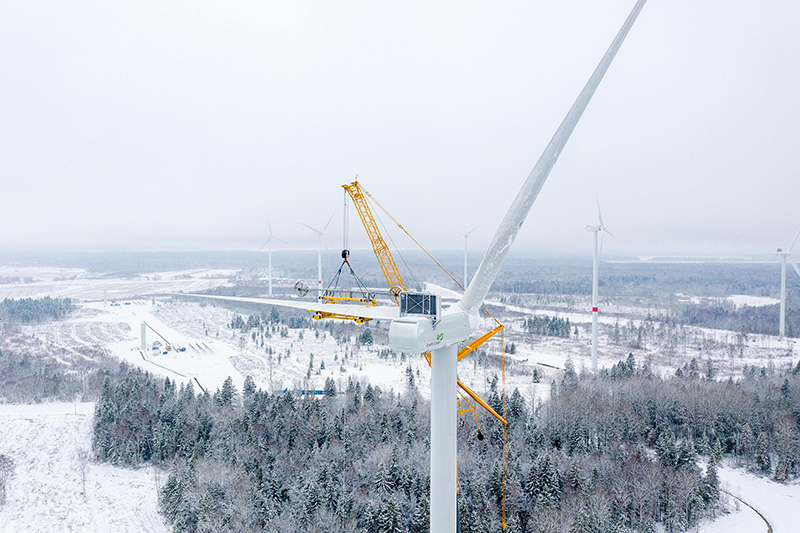
And it isn’t abstract: at Plomodiern, in Brittany, a 2009 wind farm is being rebuilt this year into developer Energiter’s “Phénix” park, reusing the existing grid connection rather than requiring a new one – the unglamorous outcome, keep the connection and permitting history, just swap the machines, that France’s framework is designed to make routine.
The part that doesn’t make the press release
Ladsous’s incoherence argument isn’t the only friction point, and it isn’t the sharpest one.
Repowering is sold on the premise that you’re improving an already-accepted site rather than opening a new one. Vent de Colère’s counter is that the premise stopped holding once turbine heights caught up with turbine ambitions: modern repowered installations can reach 246 metres, dwarfing what they replace. Ladsous’s condition for accepting repowering is a genuine, per-project environmental evaluation proving no new nuisance, tested at public inquiry – and his position is that this isn’t happening rigorously today. Whether or not that persuades you, it’s a specific objection to a specific design choice, not generic nimbyism.
Then there’s the legal system underneath it all. French wind power is, sector-wide, unusually litigious — about 70% of permits end up contested in administrative court, a figure covering wind generally rather than repowering specifically (worth flagging, since no repowering-only figure exists in the record, and Vent de Colère’s objections slightly predate the March circulaire). France’s answer has been to narrow the avenues for challenge: reform removed an entire level of jurisdiction, the Cour de Cassation, from wind disputes, sending them straight to the Cour Administrative d’Appel for a first-and-final ruling. That’s what makes a two-month deadline meaningful rather than theoretical – and what critics read as the state closing off recourse because citizens were using it. France’s speed isn’t a free lunch; part of it was bought by making projects structurally harder to challenge once approved.
That’s the honest version of “France gets repowering right”: a country that solved the developer’s problem — predictability, defined thresholds, a clock the state must keep — without solving, or arguably by narrowing, the resident’s problem of being heard.
What the rest of Europe can take from this
Germany has the volume France doesn’t – repowering is already 35% of its newly installed onshore capacity — but not the clarity. Its running fight over a 1,000-metre turbine-to-residence distance rule is exactly the ambiguity France’s thresholds avoid: a 2022 Energy Policy study found Germany’s “hidden” repowering potential at non-qualifying sites is nearly double the potential at sites that qualify. Germany is still arguing over where the line sits; France drew its line and attached a deadline.
Poland is further back. Its “10H” rule banned turbines within ten times their height of any residence, locking 99.7% of the country out of wind development from 2016 until a partial 2023 relaxation to 700 metres. Full liberalisation to 500 metres remains politically stuck in 2026: modelling puts repowering potential at roughly 11 GW under 500 metres versus just 4 GW under a harder 1,000-metre line still being pushed by a far-right coalition partner. Poland is still litigating the starting line; France legislated its own two years ago.
The UK is almost a mirror image. Its de facto onshore ban only lifted in July 2024, and the country is now discovering, after the fact, that repowering had quietly been doing much of the sector’s work anyway — 58% of onshore projects approved since 2022 were replacements, not new builds. France planned for that outcome; the UK backed into recognising it.
Italy is solving the same problem with a different tool. Its FER X decree, finalised August 2026, roughly quadruples wind capacity eligible for support, from 4 GW to 16.5 GW, via 20-year pay-as-produced contracts for difference awarded by auction. ERG’s win in the first round – 141 MW across two repowering projects, more than doubling its capacity on those sites – shows the model moves money fast. But it’s a financial answer, not a procedural one: Italy is buying down the economics; France removed the friction from permitting.
The lesson
Procedural predictability – a defined threshold, a deadline the state must keep – is something a government can legislate in a single circulaire, far faster than it can build the political consensus Denmark achieved over decades of cooperative wind ownership. That’s why France’s framework is worth copying: it’s fast to write and it visibly works, judging by developer demand at auction.
What it hasn’t done is make repowering less contested. Predictability for developers and acceptability for the people living next to a 246-metre turbine are not the same problem, and France’s experience is reasonably strong evidence that solving the first doesn’t solve the second. Copy the thresholds and the deadlines. Go in expecting to still have Ladsous’s argument, or one very like it, on your hands regardless.