

Author: Derek Michalski, Editor.
China may be pointing the industry towards a different future
The solar industry has spent the last decade pursuing one overriding objective: reducing the cost of electricity generation. That strategy has been extraordinarily successful. Photovoltaic technology has moved from a relatively expensive renewable solution into one of the cheapest sources of new electricity generation in many markets, driven by manufacturing scale, efficiency improvements and dramatic reductions in module costs.
However, the success of solar is creating a new challenge. As renewable penetration increases, the economic value of electricity is becoming increasingly dependent not only on how cheaply it can be generated, but also on when it is available and how effectively it can support the wider power system. A megawatt-hour generated at midday during periods of high solar output does not necessarily have the same value as a megawatt-hour delivered in the evening, when demand remains high and renewable generation begins to decline.
China’s latest hybrid solar project in Xinjiang provides an interesting example of this changing dynamic. The 1 GW Hami solar complex, developed by China Three Gorges Corporation, combines approximately 900 MW of photovoltaic generation with a 100 MW concentrating solar power (CSP) facility equipped with molten-salt thermal storage. The project combines low-cost solar generation with the ability to continue producing electricity after sunset by storing solar energy as heat and releasing it later when required.
The significance of the project is not simply that China has built another large renewable energy facility. China already dominates global solar deployment and manufacturing. The more interesting question is why one of the world’s most cost-focused renewable energy markets is investing in a more complex system designed to increase flexibility and dispatchability.
The answer may reveal an important shift in the economics of solar power.
Solar’s first revolution was about cost
The first major phase of the solar industry was defined by cost reduction. Developers, manufacturers and investors focused on a clear objective: build more photovoltaic capacity while continuously lowering the cost per megawatt-hour generated.
This approach transformed the energy sector. Solar became one of the fastest-growing energy technologies in history, with annual installations reaching levels that would have been considered unrealistic only a decade earlier. The industry’s success was built around a simple formula: larger factories, cheaper modules, improved efficiency and increasingly competitive project economics.
For a long time, the main question facing solar developers was straightforward: how much electricity can this project generate, and how cheaply can it do so?
That question remains important, but it is no longer sufficient.
As solar capacity expands, electricity markets are changing. When large volumes of photovoltaic generation enter the system at the same time, wholesale prices can fall during periods of strong sunshine. In several mature renewable markets, including parts of Europe, Australia and the United States, solar projects increasingly face lower capture prices because their output is concentrated during hours when many other plants are producing electricity at the same time.
This does not mean solar is becoming less valuable. It means the definition of value is changing.
The industry is moving from a generation challenge towards a system integration challenge.
The Hami project: moving from generation to dispatchability
The Hami project represents a different approach to renewable energy development. Rather than focusing exclusively on producing the lowest-cost electricity, it attempts to increase the usefulness of that electricity by extending renewable generation beyond the hours when sunlight is available.
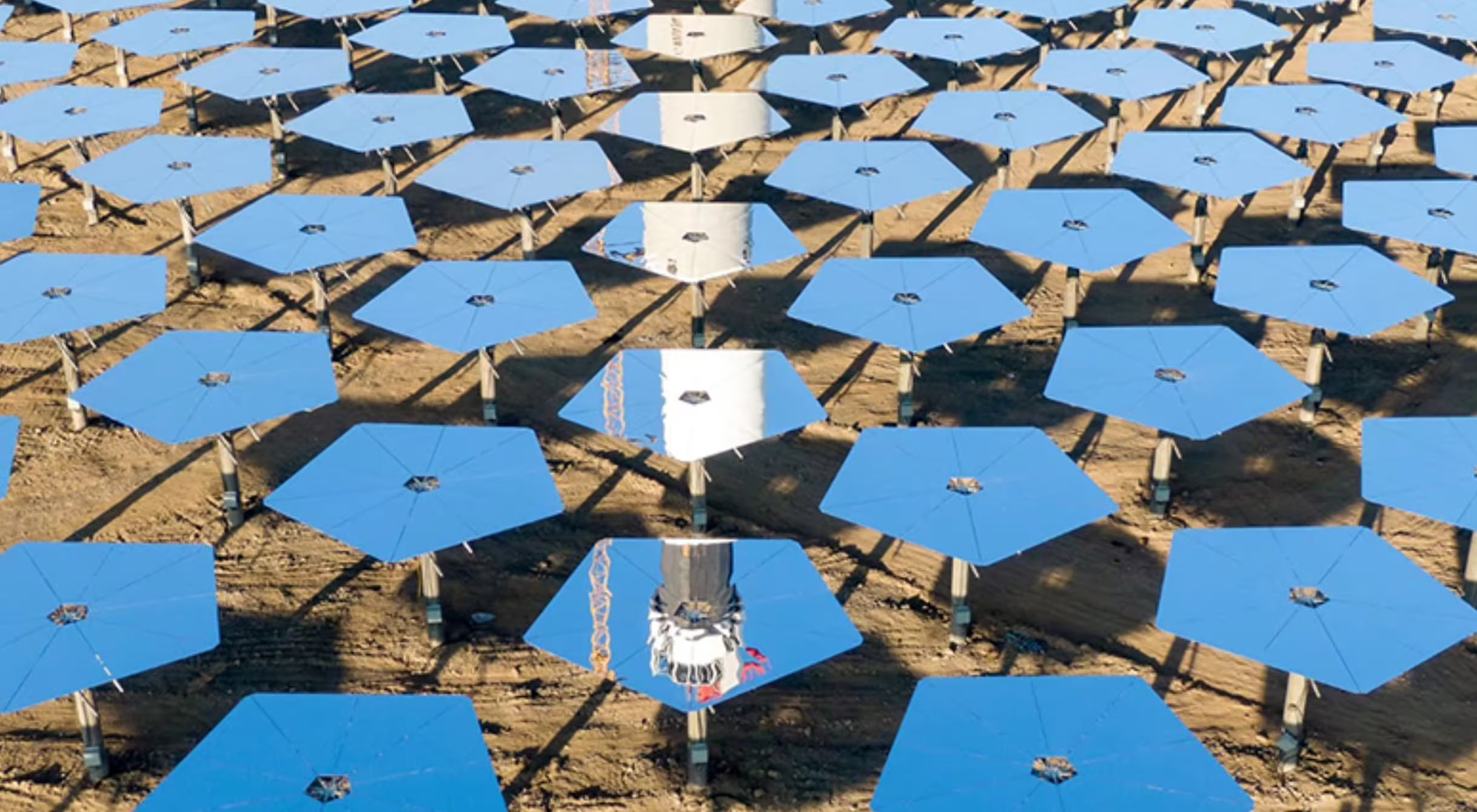
The photovoltaic component provides the low-cost generation that has made solar globally competitive. The CSP component adds a different capability. Using mirrors to concentrate sunlight, CSP systems generate high-temperature heat that can be stored in molten salt. That stored thermal energy can later be converted into electricity through a steam turbine, allowing renewable generation to continue after sunset.
This technology is not new. CSP plants have been operating for decades in markets such as Spain, the United States and the Middle East. However, combining large-scale photovoltaic generation with CSP storage represents a different project philosophy. Instead of asking only how much electricity can be produced, the project asks how electricity production can be better aligned with the needs of the power system.
This distinction is becoming increasingly important.
The future of renewable energy is unlikely to be defined simply by the amount of generation capacity installed. A system with large volumes of cheap solar electricity but limited flexibility may struggle during periods when generation patterns do not match demand. A system with slightly higher generation costs but greater ability to deliver electricity when required may create more economic value.
The challenge is moving from producing electricity cheaply to producing electricity strategically.
Why timing is becoming the new metric for renewable value
Electricity is unlike most commodities because its value changes constantly. The same megawatt-hour can have very different economic importance depending on the time of day, the condition of the grid and the balance between supply and demand.
This is why flexibility is becoming one of the most important themes in the energy transition.
Battery storage has emerged as the leading solution for many flexibility requirements. Lithium-ion batteries are highly effective for fast response, frequency regulation and shifting electricity over several hours. Their rapid deployment has changed the economics of renewable integration and enabled solar and wind projects to participate in new markets.
However, not every flexibility challenge can be solved in the same way. As power systems require longer-duration storage, different technologies may become relevant depending on geography, market design and system requirements.
Thermal storage, pumped hydro and other long-duration technologies are being explored because they can provide energy shifting over longer periods. CSP with molten salt storage is particularly suited to regions with strong direct solar resources, where it can convert abundant sunlight into a more controllable form of renewable generation.
The key point is not that CSP will replace batteries. It almost certainly will not. The significance of projects such as Hami is that they demonstrate a broader change in thinking: renewable assets are increasingly being designed around the value of their output, not simply the volume of their output.
China is testing a broader energy system strategy
China’s investment in hybrid renewable projects should be viewed within the context of its wider energy transition. The country remains the world’s largest solar market and continues to deploy photovoltaic capacity at a scale unmatched globally. At the same time, it faces the same challenges as other markets with rapidly growing renewable generation: managing variability, reducing curtailment and ensuring that electricity supply remains aligned with demand.
Large renewable energy bases in China’s western regions are often located far from major population centres and industrial demand. This creates a need for transmission infrastructure, storage solutions and flexible generation technologies that can improve the overall efficiency of the system.
Hybrid projects are one response to that challenge.
The combination of different technologies allows developers to optimise renewable assets according to local conditions. In some regions, solar combined with batteries may provide the most economic solution. In others, thermal storage, pumped hydro or other technologies may offer advantages.
The future energy system will not be built around one universal technology. It will be built around combinations of technologies that solve specific system problems.
Beyond LCOE: the changing economics of solar assets
For many years, levelised cost of electricity (LCOE) was the dominant measure used to compare energy technologies. It remains an important metric because cost competitiveness is essential. However, LCOE does not fully capture the value of electricity in increasingly complex power systems.
A renewable asset with the lowest generation cost is not necessarily the most valuable asset.
Investors and developers are increasingly looking at additional factors: the project’s ability to capture higher market prices, participate in ancillary services, provide flexibility, reduce grid constraints and create multiple revenue streams.
This represents a significant change in how renewable projects are evaluated.
The best-performing assets of the future may not simply be those with the strongest solar resource or the lowest construction costs. They may be those that combine generation, storage, forecasting, digital optimisation and market participation to maximise the value of every megawatt-hour produced.
The solar industry is moving from an era of cost optimisation towards an era of asset optimisation.
The next solar race
The first solar revolution was about making clean electricity affordable. The next phase will be about making renewable electricity valuable.
China’s Hami project does not prove that CSP will become the dominant technology for future solar development. Photovoltaics will remain the foundation of global solar expansion because of their exceptional cost competitiveness and scalability.
However, the project does challenge one of the industry’s biggest assumptions: that the cheapest electricity is always the most valuable electricity.
As renewable generation becomes more abundant, the competitive advantage will increasingly belong to projects that can provide electricity when the system needs it most. The next generation of solar assets will not only compete on how much power they produce or how cheaply they produce it. They will compete on how effectively they integrate into a changing electricity system.
The future solar winner may not be the company that builds the cheapest megawatt-hour.
It may be the company that understands the true value of timing.