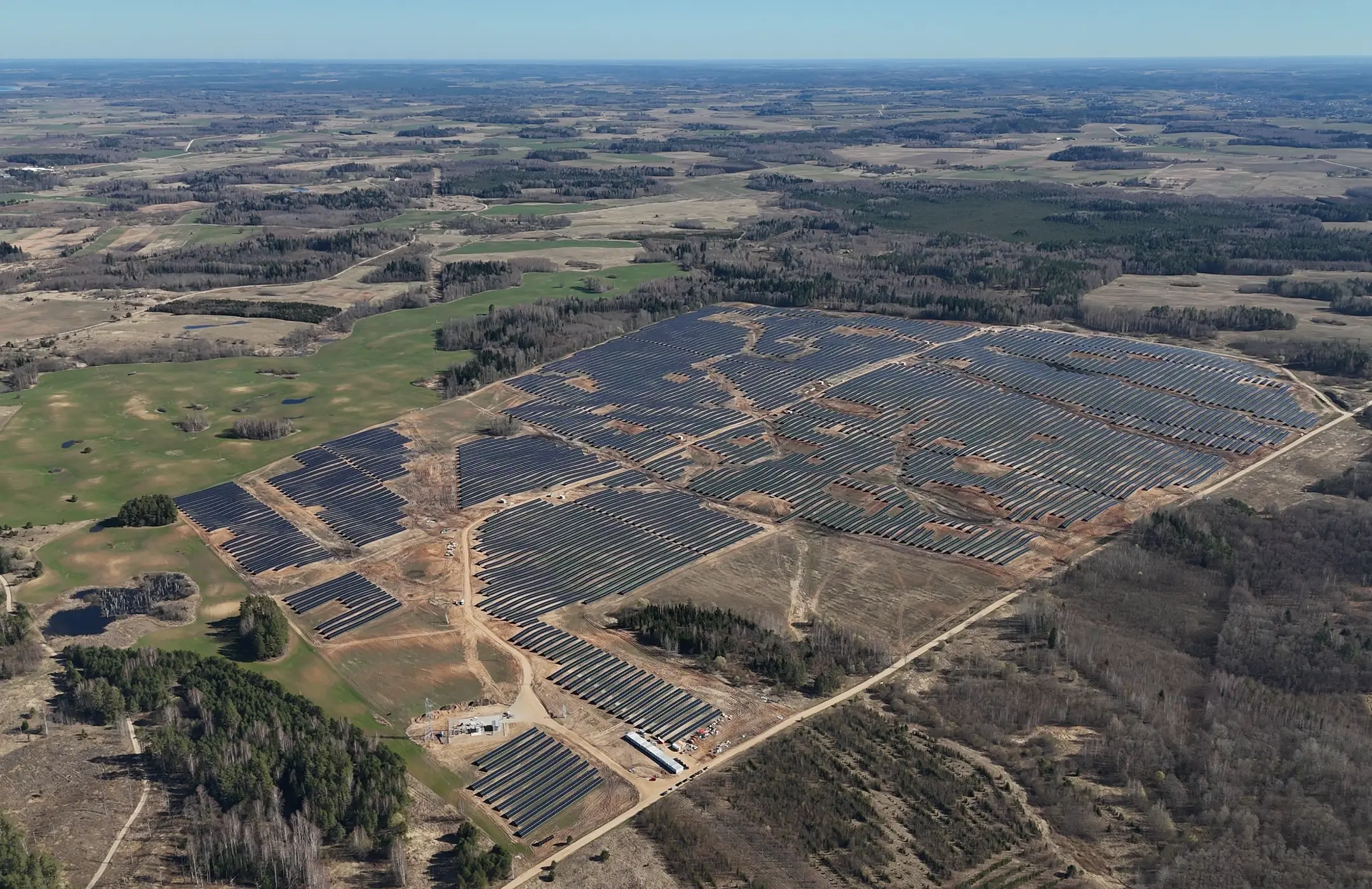


Lithuania has taken another step in strengthening its renewable electricity system after transmission system operator Litgrid connected a new utility-scale solar park in Kaišiadorys District to the national grid. Developed by the Clean Energy Infrastructure Fund (CEIF), managed by Envolve Capital, the project has an authorised export capacity of 40 MW and a total installed capacity of 50 MW, making it one of the country’s larger operational solar assets.
While the commissioning itself is significant, the project also highlights a broader trend shaping Lithuania’s energy transition. The challenge is no longer simply deploying more renewable generation. Increasingly, the focus is shifting towards ensuring that transmission infrastructure, system flexibility and market mechanisms can absorb growing volumes of variable renewable power efficiently and profitably.
The solar park’s transformer substation has now been energised, allowing the facility to begin supplying electricity to the transmission network during its commissioning phase.
“The solar park’s transformer substation has now been connected to the electricity transmission network, allowing the facility to begin generating its first electricity. This demonstrates that despite the rapid expansion of renewable energy, we remain ready to integrate new renewable generation capacity in cooperation with project developers. Every successfully connected project strengthens the transformation of Lithuania’s energy system and increases the country’s domestic electricity generation capacity,” said Ignas Mickevičius, Acting Head of Litgrid’s Renewable Energy Centre.
According to Envolve Capital, the project is among the largest within its Lithuanian portfolio and incorporates single-axis solar tracking technology designed to maximise electricity production throughout the day. The company said the successful grid connection reflects close cooperation with Litgrid and supports both Lithuania’s renewable generation capacity and its long-term energy security objectives.
The Juknoniai Solar Park, of which the Kaišiadorys installation forms part, is currently operating under commissioning and has already begun exporting electricity to the transmission network.
Renewable capacity reaches another milestone
Following the connection of the new solar park, the combined installed capacity of operational solar and wind power plants across Lithuania’s transmission and distribution networks has reached 6,288 MW, while authorised export capacity has increased to 5.4 GW – more than half of the country’s total electricity generation capacity.
Lithuania now has 3,557 MW of installed solar capacity.
The country’s renewable expansion continues at an exceptional pace. During the first half of 2026, renewable energy sources generated 68% of all electricity produced domestically, supplying around 50% of Lithuania’s total electricity demand. At the same time, approximately 752 MW of additional renewable generation and battery storage capacity was connected to the electricity system, underlining the scale of investment now entering operation.
From building renewable capacity to optimising the electricity system
The latest connection reflects an important shift in Lithuania’s electricity market.
Over the past decade, policy has focused on accelerating renewable deployment. Today, as renewable penetration continues to rise, the priorities are becoming increasingly operational. Grid capacity, network reinforcement, battery energy storage systems, hybrid renewable projects, demand-side flexibility and sophisticated electricity trading strategies are emerging as the next competitive differentiators for project developers and investors.
For transmission system operators such as Litgrid, the challenge is evolving from connecting individual projects to managing an increasingly decentralised and weather-dependent electricity system while maintaining security, reliability and affordability.
That transition has gathered pace since the successful synchronisation of the Baltic electricity system with Continental Europe in February 2025, one of the most significant milestones in Lithuania’s modern energy history.
Litgrid prepares the network for the next investment cycle
As renewable investment accelerates, Litgrid is simultaneously expanding its long-term network planning.
The company recently completed Lithuania’s 2026–2035 Ten-Year Network Development Plan, prepared jointly with gas transmission operator Amber Grid and EPSO-G. It is the country’s first integrated infrastructure strategy covering electricity, natural gas and hydrogen, recognising the growing interaction between electrification, renewable gases and industrial decarbonisation.
Litgrid has also published its latest 2028–2035 power system adequacy assessment, analysing future security of supply as renewable generation, electricity demand and industrial electrification continue to increase.
The company remains financially well positioned to support this investment programme. During the first quarter of 2026, Litgrid reported revenue of €158.7 million, EBITDA of €47.8 million and net profit of €37.2 million, providing a solid foundation for continued grid expansion.
Envolve Capital strengthens its position in the Baltic renewable market
The Kaišiadorys project forms part of Envolve Capital’s broader investment strategy across Central and Eastern Europe.
Following its rebranding from Modus Asset Management in 2025, the company has expanded its focus beyond traditional renewable asset management towards large-scale energy infrastructure investment.
Its flagship Clean Energy Infrastructure Fund is actively developing utility-scale solar and wind projects across Lithuania, Latvia and Poland, supported by financing from both commercial banks and international institutional investors.
Over the past eighteen months, Envolve Capital has secured €24.8 million from Swedbank for Lithuanian solar projects, €20 million from Eiffel Investment Group to accelerate construction of a 177 MW renewable portfolio across the Baltic region and Poland, and additional project financing from Alior Bank for new solar developments in Poland. Together, these investments position the fund among the region’s more active renewable infrastructure platforms.
A maturing renewable energy market
The Kaišiadorys connection demonstrates how Lithuania’s renewable energy sector is entering a new stage of development.
The country’s success is no longer measured solely by the number of megawatts installed. Increasingly, long-term value will depend on how effectively renewable generation can be integrated into the electricity system, supported by transmission infrastructure, storage, flexible demand and increasingly sophisticated electricity markets.
For developers, investors and grid operators alike, the next phase of the energy transition will be defined not simply by building more renewable capacity, but by making that capacity work more efficiently within an increasingly complex and interconnected power system. That is precisely what projects such as Kaišiadorys – and the infrastructure enabling them – are helping to achieve.
EVENT ALERT: