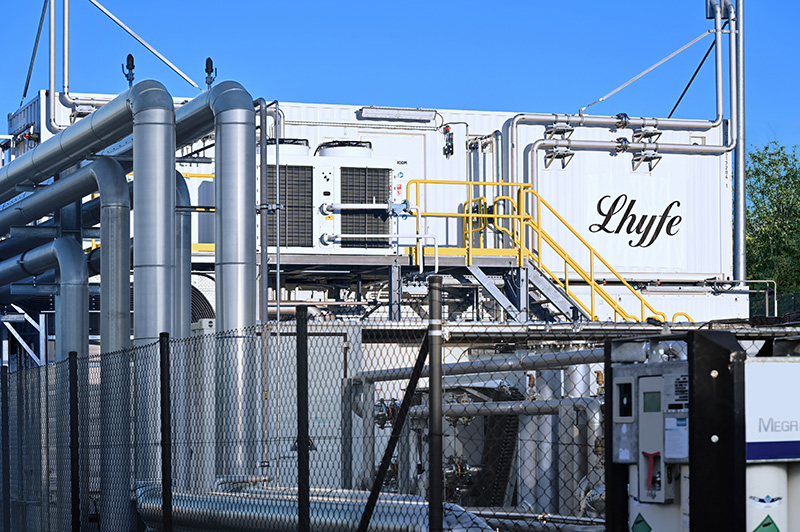
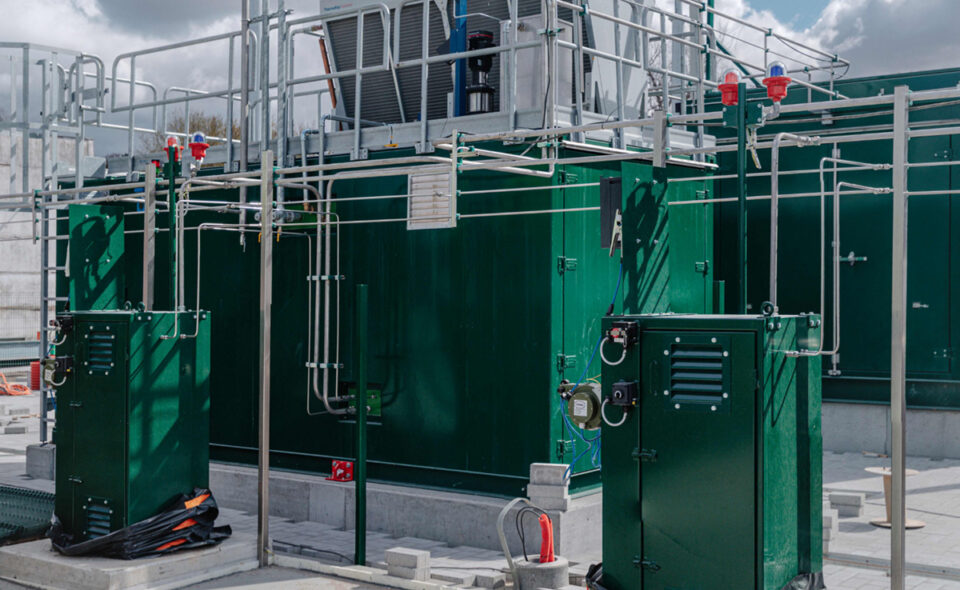
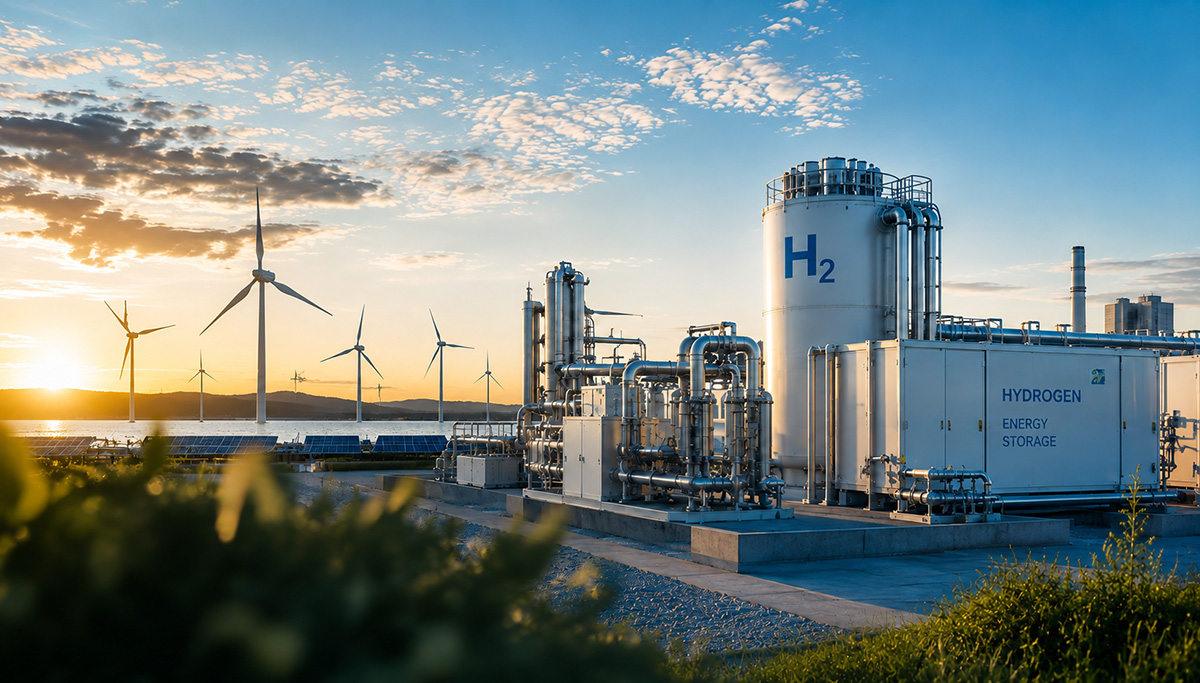
Motor Oil Hellas’s green hydrogen unit at its Agioi Theodoroi refinery in Corinthia is entering commissioning, with construction largely complete as of late August 2026 and testing and gradual equipment start-up underway through early autumn; full production is targeted for 2027. The 50 MW electrolyser plant is described by the company as the first industrial-scale green hydrogen facility in Southeast Europe, with an annual production target of about 7,500 tonnes of hydrogen, intended to cut roughly 9,000 tonnes of CO2 a year by displacing “grey” (fossil-derived) hydrogen currently used in the refinery’s own processes.
The project — branded EPHYRA in Motor Oil’s EU funding paperwork — is backed by a €111.7 million grant from the EU’s Recovery and Resilience Facility, approved by the European Commission, on top of an earlier €18 million secured for the programme. Its 50 MW of capacity was built up in two contract stages: Swedish company Metacon was awarded an initial 30 MW electrolysis contract in March 2025, followed weeks later by an add-on order for a further 20 MW. Metacon CEO Christer Wikner said at the time the completed plant “will be one of the largest [hydrogen production plants] in Europe.” What’s less visible in most coverage of the project is where the hardware actually comes from: the electrolysis units are manufactured by PERIC Hydrogen Technologies, based in Handan, China, with Siemens involved as a technology partner and final assembly carried out at Metacon’s own factory in Patras, Greece. An EU flagship decarbonization project, funded through the bloc’s post-pandemic recovery instrument, is thus built around Chinese-made core equipment — a detail that sits somewhat awkwardly next to the EU’s separate, ongoing push (including provisions in Germany’s own recent offshore wind legislation) to reduce dependence on Chinese suppliers for clean-energy hardware.
Initial hydrogen output from 2027 is earmarked for a narrow set of uses: three 12-metre fuel-cell buses operated by Athens’s OSY public transport authority, vehicles run by motorway operator Olympia Odos, a pilot cold-ironing (shore power) installation at the Port of Piraeus, and the refinery’s own internal consumption. Motor Oil has said it plans to add 50 more fuel-cell buses to Athens’s fleet, backed by roughly €80 million from the EU’s Modernization Fund, and to build a second hydrogen refuelling station at the Ano Liosia bus depot.
The plant is also the anchor of TRIERES, an EU Horizon Europe-funded “Small Hydrogen Valley” project (Clean Hydrogen Partnership grant no. 101112056) linking the refinery’s production to a wider network of industrial, transport and research users. TRIERES groups 26 partners across five countries, including Motor Oil subsidiaries AVINOIL, Dioriga Gas and LPC, and runs from July 2023 to April 2028, with an explicit ambition to extend hydrogen use across the Balkans, southeastern Europe and the eastern Mediterranean, and to link up with existing hydrogen valleys in the Netherlands, Austria, Cyprus and Egypt.
On the specific claim that the plant has “future plans for sustainable aviation fuel”: that framing doesn’t hold up cleanly against what’s actually been announced. The concrete future fuel-diversification project tied to Agioi Theodoroi is IRIS, a separate EU Innovation Fund-backed initiative (grant no. 101133015, running to June 2033) that pairs carbon capture at the refinery’s steam methane reforming unit with a plant producing synthetic e-methanol from renewable hydrogen and captured CO2 — aimed squarely at the maritime fuel market, with a target of avoiding 8.5 million tonnes of CO2 over its first decade. Motor Oil is separately involved in a commercial sustainable aviation fuel supply arrangement with Aegean Airlines and Shell at Athens airport, but that’s a fuel-blending and supply partnership using externally sourced SAF, not a hydrogen-to-aviation-fuel production line at this refinery. The aviation angle appears to be a conflation of these two separate initiatives rather than an announced plan.
Agioi Theodoroi is one piece of a roughly €4 billion investment program Motor Oil has laid out through 2030 to shift from a pure refiner toward a broader energy company, spanning its renewables arm MORE (847 MW installed, about 94% wind, with a 3.7 GW development pipeline and 72 MW/144 MWh of battery storage operating since 2025) alongside carbon capture and circular-economy operations. The company has also flagged a possible 200 MW hydrogen expansion under a separate joint venture with Greek utility DEI (Public Power Corporation), referred to as NORTH-1, at a different site in northern Greece — a considerably larger project than Agioi Theodoroi, but one still at an earlier planning stage.