H2APEX and Lhyfe have expanded an existing hydrogen supply agreement, with Lhyfe committing to deliver up to 100 tonnes of RFNBO-certified renewable hydrogen to H2APEX annually over the next two years. Announced September 16 from Rostock, Grevenmacher and Nantes, the deal builds on a cooperation the two companies already had running and is aimed squarely at one problem: Germany’s hydrogen demand is outpacing the hydrogen Germany can actually produce.
That gap is the real story here. Germany has more electrolyzer projects in the pipeline than almost anywhere in Europe, but pipeline and production are different things — plants take years to permit, build and certify, while mobility fleets and industrial buyers need supply now. Lhyfe’s volumes give H2APEX a way to serve customers in the interim, without waiting on its own capacity to catch up.
H2APEX is very much in that catching-up phase. The Rostock-Laage-based company, led by CEO Peter Rößner, is building a 100-megawatt electrolysis plant at its home site — targeting more than 7,500 tonnes of green hydrogen a year and roughly €45 million in annual revenue once it’s running, with completion slated for 2027 and partial backing through the EU’s IPCEI framework. It’s also expanded aggressively by acquisition, picking up a 1-gigawatt hydrogen project from HH2E in 2025. But none of that changes what’s true today: H2APEX has ambitious plants under construction and customers who need molecules this year, and those two timelines don’t line up on their own.
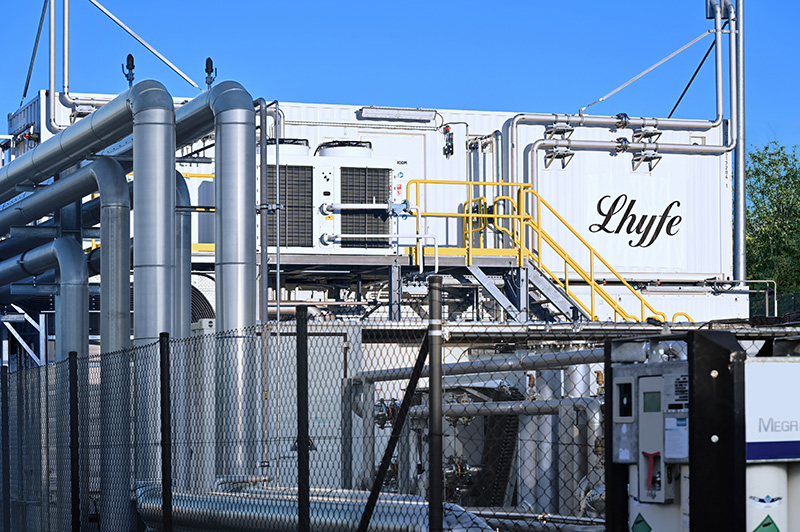
Lhyfe is the supplier on the other end of that gap, and it’s had a big year making that role its calling card. The French renewable hydrogen producer told investors in March that it doubled revenues in 2025 to around €10 million, expanded installed electrolysis capacity by 70%, grew its customer base by roughly 60%, and completed more than 850 hydrogen deliveries across nine European countries — all while claiming the title of Europe’s largest producer of RFNBO hydrogen by water electrolysis. The H2APEX extension isn’t an outlier; it’s the pattern. Lhyfe struck a similar supply and infrastructure partnership with construction group STRABAG earlier this year, and in July sold Messer a 30% equity stake across four of its renewable hydrogen sites alongside a ten-year offtake contract. Selling certified volumes to partners who already have the pipelines, refueling stations and industrial relationships in place, rather than building all of that out itself, looks like a deliberate growth strategy rather than a one-off.
That’s really what makes this deal worth noting beyond its own numbers: it’s a small, clean example of how the green hydrogen market is actually maturing. A few years ago, most announcements in this space were about megawatts under construction — future capacity, promised timelines. What’s showing up now, in this deal and in Lhyfe’s other 2026 partnerships, is commercial plumbing: certified supply changing hands between companies that specialize in different parts of the value chain, so that demand doesn’t have to sit around waiting for any single company’s plant to finish.
“Germany continues to be one of Europe’s most important hydrogen markets,” said Matthieu Guesné, Lhyfe’s founder and CEO, in the companies’ joint statement. “Expanding our cooperation with H2APEX reflects the increasing demand for RFNBO-certified renewable hydrogen and underlines the importance of strong partnerships across the hydrogen value chain.” Rößner framed it from the buyer’s side: “Demand for green hydrogen is growing faster than new production assets can currently be brought into operation across the market… To meet this growing demand, we combine our own production capacities and infrastructure projects with long-term partnerships such as our cooperation with Lhyfe.”
None of this solves Germany’s underlying capacity problem — 100 tonnes a year is a modest volume next to the thousands of tonnes H2APEX’s own Rostock-Laage plant is meant to eventually produce, and next to national demand projections that run into the hundreds of thousands of tonnes by the early 2030s. What it does is keep customers supplied with genuinely renewable, RFNBO-certified hydrogen while the bigger projects on both companies’ books work through construction and certification. If Germany’s hydrogen ramp-up succeeds, deals like this one — unglamorous, incremental, running quietly in the background of the bigger capacity announcements — are as likely to be why as any single flagship plant.